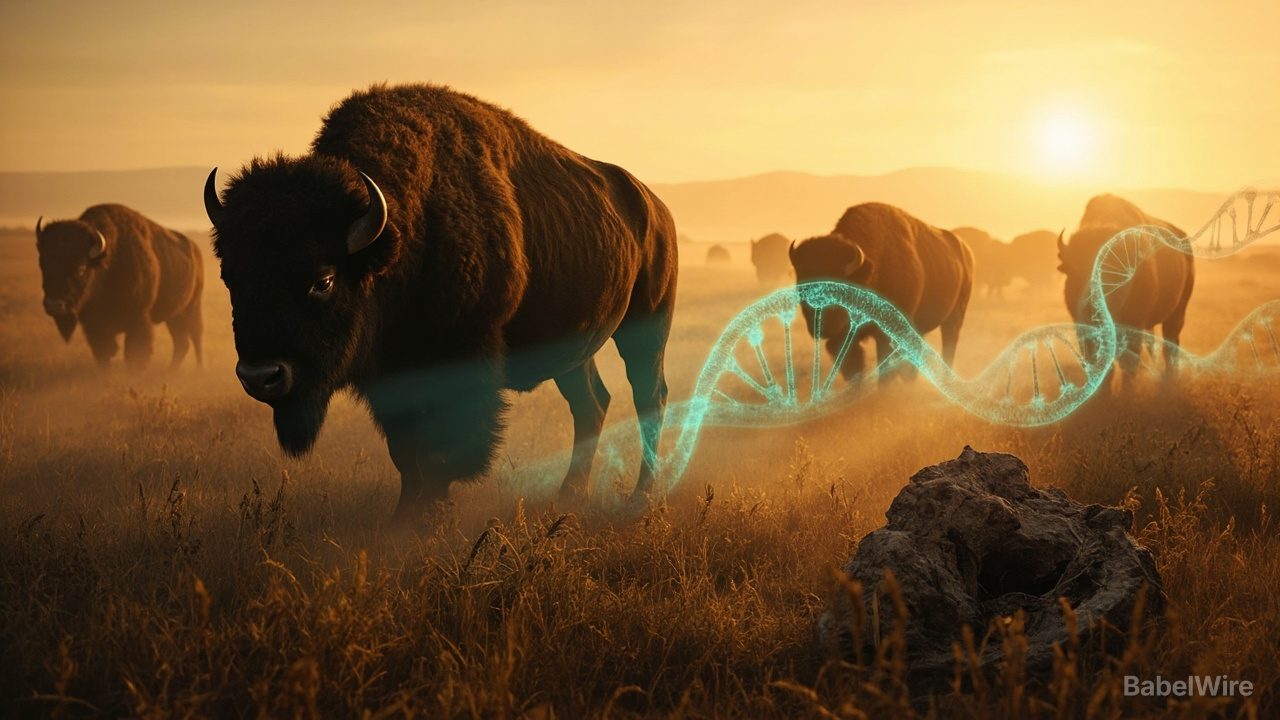
American bison were once tens of millions strong, roaming North America in herds that were — genetically speaking — one big family. Then European colonization reduced them to a few hundred animals in the late 19th century. Today's herds are recovering, but they are small, isolated and heavily managed.
A study published today in Science, led by Jonas Oppenheimer and Beth Shapiro, sequenced 115 ancient and 45 modern bison genomes spanning the past ~20,000 years to reconstruct exactly what was lost — and what remains.
The results overturn two long-held fears. First, past bison populations were highly connected across the Holocene, in stark contrast with the strongly differentiated herds of today — the fragmentation is the single biggest change between past and present. Second, cattle admixture is much less widespread than believed: 67% of the bison sampled had no cattle ancestry at all, and herds including Yellowstone's and all wood bison had none; where present, cattle DNA typically made up less than 1% of the genome.
The study also revealed that all wood bison today carry plains bison ancestry from 1920s translocations into Wood Buffalo National Park, and that genetic diversity actually remained stable through the collapse — before drift and isolation carved modern herds apart.
The authors' prescription: managing bison as one connected 'metapopulation,' with gene flow between herds, could mirror the structure that sustained them for millennia while preserving diversity — and keeping cattle alleles rare. 'Restoring gene flow across herds managed as a metapopulation could more closely mirror past population structure,' they write.