Apple ships its iPhone keyboard with a hidden list of more than 100,000 words and phrases that it will not offer as predictive text and will not reliably produce when you swipe to type. On November 6, Reuters reported that an independent researcher had extracted the list and published it, with The Verge and The Independent following within hours.
The list covers "every major language," according to the researcher, Kauffman. He told Reuters he found it "deep in the bowels" of iOS, stored as a hash table, and converted it back to plain text — using OpenAI's Codex and Anthropic's Claude Code to help locate and reverse it. A second researcher told Reuters they independently obtained the same list, and Reuters tested a subset of the phrases on an iPhone, finding they were difficult or impossible to enter by swipe.
Most of the entries are the unremarkable work of a trust-and-safety filter: slurs, sexual terms, drug references. Apple's position is exactly that. "Our keyboard is designed to avoid suggesting potentially inappropriate or offensive terms," the company told Reuters, adding that users can still type whatever they want and can override suggestions. Nothing here stops anyone from writing a sentence one letter at a time.
What makes the list worth reporting is the tail. Alongside the slurs sit phrases that are political rather than obscene: "dictator Trump," "sleepy Joe," "right wing conspiracy," "covid was a hoax," "illegal immigrant," "Tibetan independence," "United Ireland," "al-Qaeda." There are inconsistencies that look like nobody ever reviewed the whole file: "bad girl" is blocked and "bad boy" is not. And there are entries that are simply odd — "Santa isn't real," "iMessage isn't working."
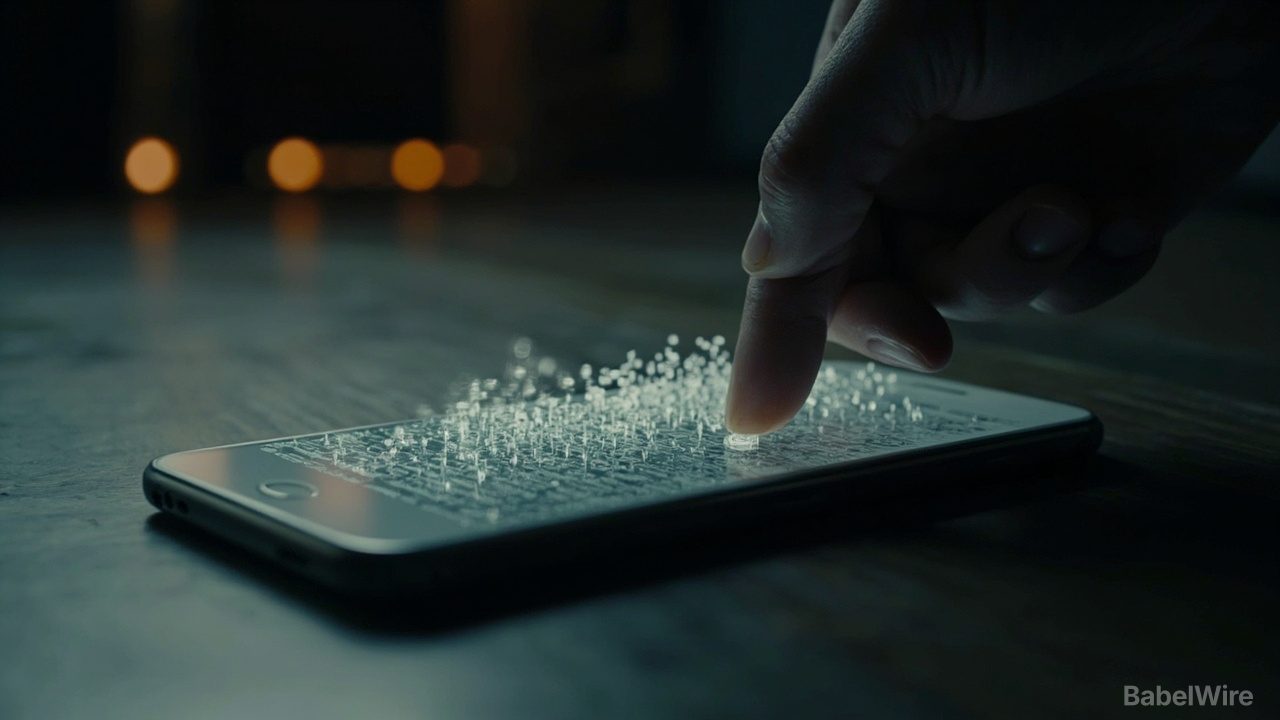
The mechanism matters more than the membership. Kauffman says that when you swipe-type a blocked phrase, iOS may silently substitute a different one — his example is "left wing conspiracy" becoming "left wrong conspiracy." That is the difference between a keyboard that declines to suggest something and a keyboard that rewrites you. Predictive text is an offer; autocorrect is an edit. A blocklist that reaches into autocorrect is doing the second thing, quietly, on a device that people use to talk about politics all day.
There is also a governance question that no regulator has a form for. Platform rules are supposed to be published, versioned and appealable — that is the whole architecture of the EU's Digital Services Act. A wordlist embedded in a binary is none of those things. It is policy expressed as a dataset, unversioned, unlocalised, and invisible to the user it acts on. Apple's general statement about offensive suggestions is true and also unfalsifiable: there is no published criterion by which anyone could check whether a given political phrase belongs on the list.
The discovery method is its own story. Reverse-engineering a shipped binary used to be a specialist's months-long project. Here a solo researcher used two commercial coding agents to locate a hash table and invert it. Whatever else that says, it says the audit cost of closed consumer software has fallen sharply, and that the people best positioned to inspect it are no longer only the ones with IDA licences.
Two caveats are worth stating plainly. Apple has not confirmed the list's provenance, how it is generated, or whether entries are hand-curated, machine-derived or inherited from a third-party dictionary — and reporting so far rests on one extraction, independently corroborated by one other researcher. And a keyboard that avoids suggesting a phrase is not the same as a platform that prevents you from saying it. The interesting failure is narrower and real: silent substitution during swipe typing, which most users will never notice because they never see the word they meant.