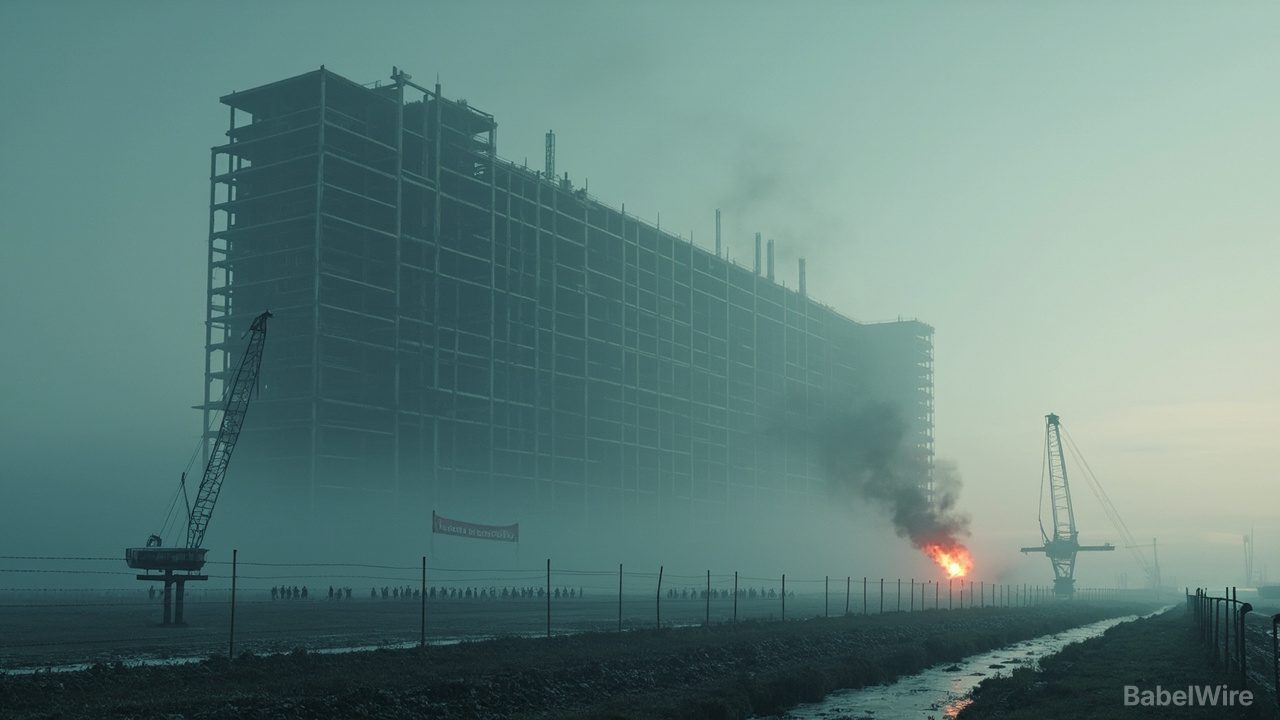
Around 100 demonstrators entered the construction site of a Microsoft data center in Amsterdam's Sloterdijk district on Friday, November 6, according to a Reuters reporter at the scene. The activist group Geef Tegengas told local broadcaster AT5 that roughly 500 people had got inside, with hundreds more outside. Some cut through the perimeter fence; others climbed a construction crane and set off flares. Riot police deployed to the site and made several arrests.
The sequence is itself part of the story. Police first halted the march as it approached the site, then the mayor banned the demonstration outright, prompting protesters to push against police barricades, Dutch news agency ANP reported. Organisers accused police of disregarding their right to protest. Two accounts of one afternoon, and both will be argued over.
The action was one node in a coordinated weekend: the "Stop Dirty Data Centres" campaign announced events in 16 countries on November 6 and 7, backed by more than 100 groups. Its demand is not transparency or compensation but an immediate moratorium on new large-scale data centers in Europe. A building freeze.
The specific site explains why. The project consists of three buildings, each 85 metres tall, which Microsoft will lease in its entirety. Plans were first submitted in 2016 — before Amsterdam banned new data centers inside the city limits. The provincial government approved the project in January. Critics argue it routes around Dutch rules for very large data centers. Geef Tegengas says the campus will draw as much electricity as all Amsterdam households combined and could delay the construction of 30,000 homes; city officials have warned for months that grid constraints threaten housing and school projects.
That is the real argument, and it is not aesthetic. On a constrained grid, a hyperscaler's long-term offtake contract is not an additional customer — it is a reservation. It occupies connection capacity that would otherwise go to apartments, schools or light industry. Whoever signs first gets the power. That ordering is what Dutch politics is now fighting over, not whether anyone likes data centers.
There is history. In July, Extinction Rebellion activists threw balloons filled with paint and acid over the site fence. What is new is breadth: a campaign running from Ireland and Poland to Denmark and Finland moves the fight from municipal planning offices to the European level, at the precise moment the European Commission is promoting data centers as AI infrastructure to be expanded.
For Microsoft the position is awkward rather than novel: the company markets climate and water commitments while its property arm leases shell space on a grid whose capacity is already spoken for. Whether it supplies power itself has not been publicly settled.
What to watch next: a second day of actions on Saturday, and whether the province reopens any part of the approval or lets construction proceed and moves the dispute into court. Dutch policy has a timing problem either way — every delay is read by industry as a competitiveness loss, every acceleration by residents as a betrayal on housing.
One caveat worth keeping: the crowd figures come from organisers and have not been independently verified, arrest counts were reported inconsistently, and whether a moratorium is even legally available is unresolved — permitting sits with the province and the state, not with the city that already passed its own ban.
Sources
- reuters.comReuters: Activists breach Microsoft data centre construction site as protests spread across Europe
- euronews.comEuronews: Protesters across Europe to call for freeze on energy-hungry data centres
- euronews.comEuronews: Netherlands — protesters storm Amsterdam data centre construction site
- timesofindia.indiatimes.comTimes of India: Climate activists storm Microsoft data centre site in Amsterdam, several arrested
- nhnieuws.nlNH Nieuws: Protest datacenter Microsoft — politie treedt op, meerdere aanhoudingen