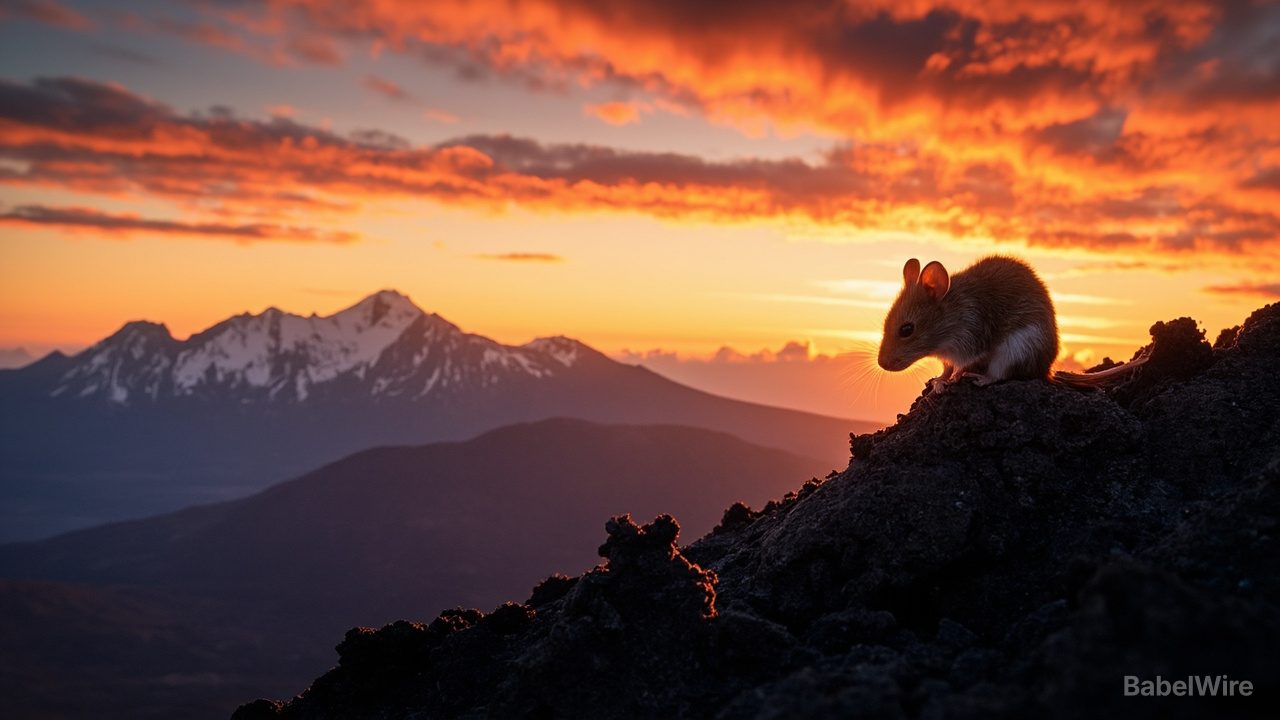
At extreme altitudes, nature does everything it can to keep mammals out. The oxygen thins to just 44% of sea level, temperatures never rise above freezing, and food is scarce. Yet one tiny mammal not only survives there — it thrives. The Andean leaf-eared mouse (Phyllotis vaccarum) has been found scampering at the summit of Llullaillaco volcano on the Chile-Argentina border, 6,700 meters above sea level — hundreds of meters higher than any other mammal.
Now, a team led by evolutionary biologist Jay Storz of the University of Nebraska–Lincoln has figured out how. Their findings, published July 9 in the journal Science, reveal a suite of unexpected adaptations that challenge long-held assumptions about high-altitude survival.
Fat-Burning Instead of Carbs
Most high-altitude rodents burn carbohydrates to produce body heat, since metabolizing carbs requires less oxygen. But the Andean leaf-eared mouse does the opposite: it primarily burns fats. This was a surprise to researchers, who expected to see the oxygen-conserving strategy common among other mountain-dwelling mammals.
Unique Blood Chemistry
Unlike other high-altitude animals whose hemoglobin binds oxygen more efficiently, these mice rely on increased ventilation to maintain oxygen saturation — but this disrupts the acid-base balance of their blood. Storz's team found the mice may have evolved changes in red blood cell enzymes that slow carbon dioxide excretion, solving the balancing act in a completely different way from other species.
Toxin Detoxification
Perhaps the most unexpected finding: the mice have developed genetic adaptations to detoxify heavy metals and other toxins absorbed by plants growing in volcanic soil. The volcanoes of the Atacama region emit heavy metals that accumulate in the vegetation the mice eat.
"Even when we think we understand what forces shaping selection in the environment might be, nature can still give us surprises," said Patricia Schulte, a zoologist at the University of British Columbia who was not involved in the study.
Storz's team collected 167 mice during five grueling high-altitude expeditions to volcanoes in the Puna de Atacama, comparing highland and lowland populations. They sequenced the mice's genomes and ran statistical analyses to identify genes that had been selected for in the high-altitude dwellers.
Genes related to metabolism and heat production were expected. But the detoxification genes were not. "It's surprising in the mice context," Schulte said.
Allie Graham, a comparative biologist at the University of Kansas not involved in the work, said the findings suggest that "surviving in extreme elevation is much more than just about oxygen."
Storz now plans to untangle which adaptations are due to altitude itself and which are responses to the broader volcanic environment. Studying the mice comes with a unique occupational hazard: "In the course of collecting the mice and doing the fieldwork, we are subjecting ourselves to the same environmental challenges as the research subjects," he said.