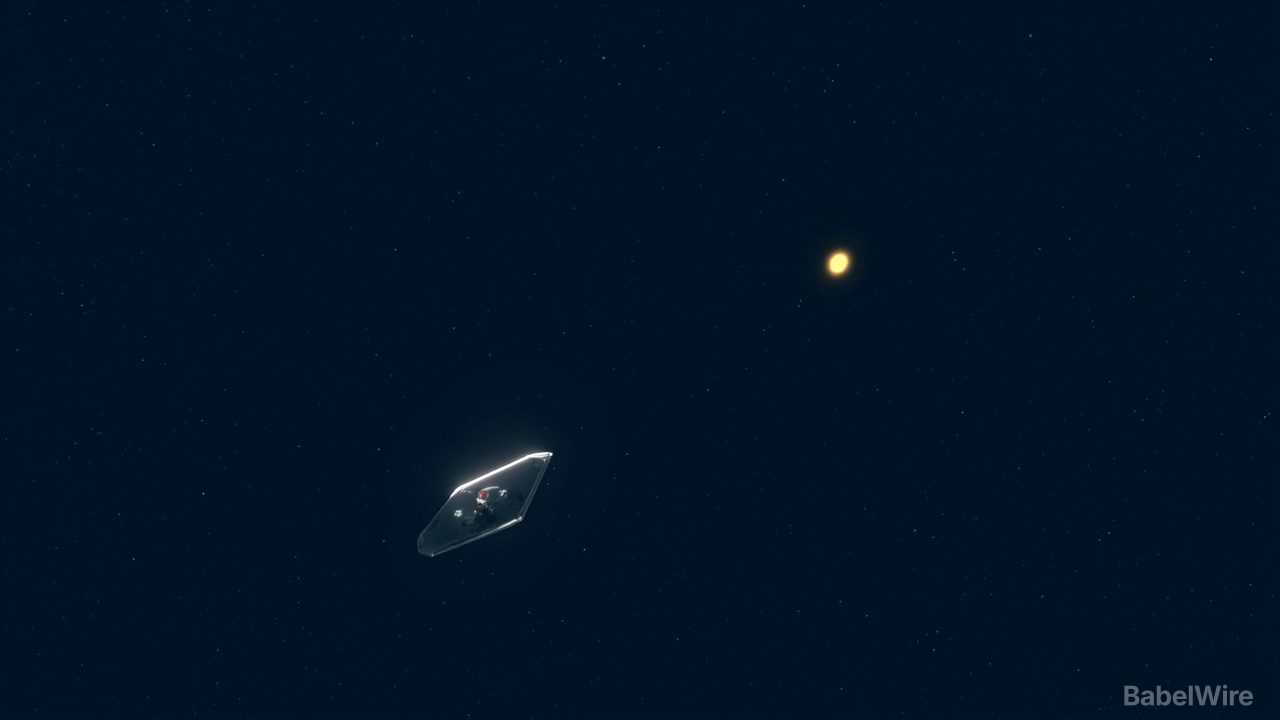
Two years to the day after launch, the European Space Agency's Hera spacecraft has photographed its destination for the first time. In a composite made from several exposures, the double-asteroid system Didymos and Dimorphos appears as a single, slightly brighter pixel against a star field — captured from roughly 236,500 kilometres away. Mission controllers had to stack the images and run a photometric analysis before the point could be identified at all.
The modest image marks the end of the cruise phase and the start of the mission's most demanding stretch. Hera's first major engine burn is scheduled for 15 October, a second for 22 October. Three smaller manoeuvres follow, designed to bring the spacecraft's relative velocity with respect to the asteroids to nearly zero. The ESA Space Operations Centre in Darmstadt, Germany, is responsible for flying the sequence.
For scale: Didymos is about 780 metres across; the moonlet Dimorphos, its companion, about 150 metres. Hera is chasing up the consequences of NASA's DART mission, which slammed into Dimorphos on 27 September 2022 at roughly 6.1 km/s. DART did not survive the impact, so Hera was launched in autumn 2024 to survey the aftermath.
The collision did more than nudge the two bodies around each other: it measurably altered their orbit around the Sun — the first time humanity has deliberately changed the path of a celestial body. That is why Hera's findings matter beyond asteroid science; they are the empirical basis for judging whether a kinetic impactor is a viable planetary-defence technique for deflecting a hazardous asteroid.
If the arrival goes to plan, Hera will begin characterising Dimorphos in November, with more detailed analysis in December. In early 2027, two small CubeSats will be released, one of which is intended to land on the moonlet. Hera itself will first survey the pair from a safe 25 to 30 kilometres, then close to 10, four and eventually one kilometre.