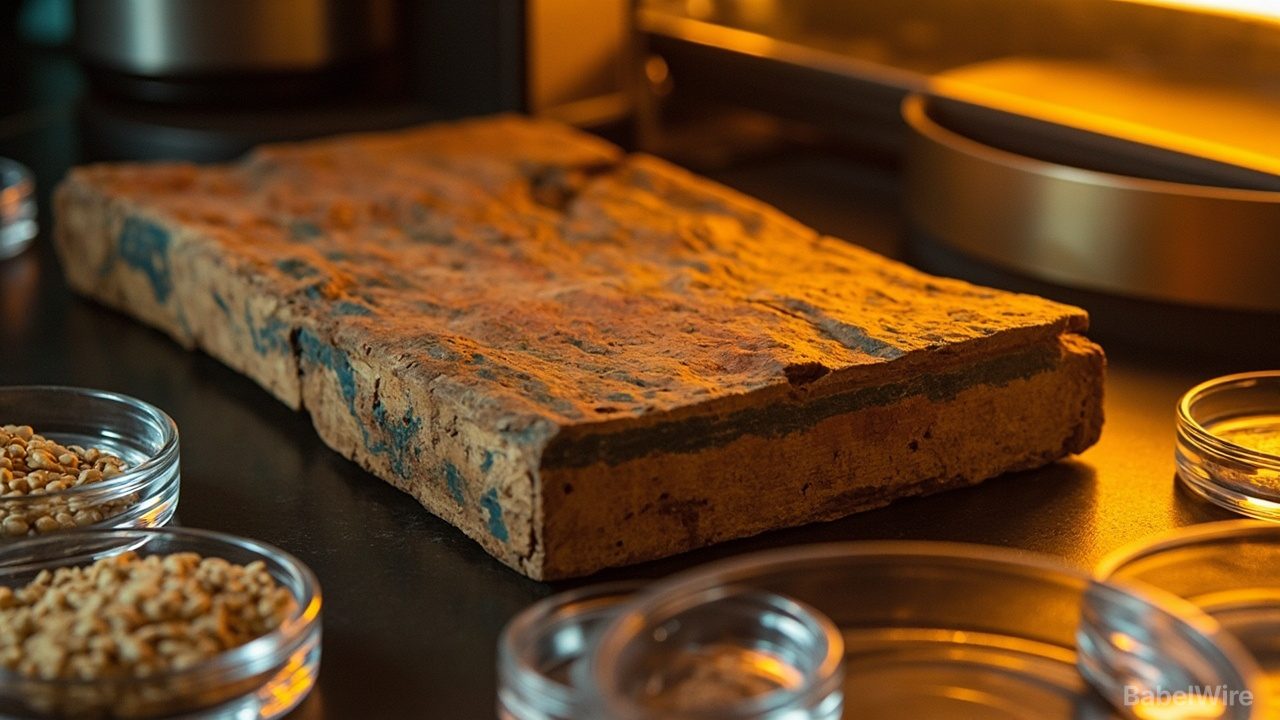
A team led by Clara Granzotto has published findings in Science Advances showing that mass spectrometry-based proteomics can identify proteins in ancient Egyptian paints, binders, and adhesives without destroying the artifacts. The technique is more sensitive than gas chromatography and can characterize all proteins in a sample regardless of mixture complexity.
The researchers took micro-samples from artifacts in Swedish, British, and Danish collections dating between 1425 BCE and 400 CE, including painted wooden coffins, wall painting fragments, mummy bust plaster, and painted limestone architectural elements. They confirmed the expected use of cow glue and collagens from sheep, goats, horses, donkeys, and antelope, likely prepared by boiling animal skin and connective tissue.
The surprise came with the detection of seed proteins from sesame and moringa. Sesame proteins were found in a red sample from a coffin fragment and a tomb wall painting, while moringa proteins appeared on a coffin sample. Both plants were common in ancient Egypt, with their oils used for cooking, medicine, cosmetics, and mummification.
The moringa finding is particularly significant: the tree was considered a manifestation of Ptah, the patron god of craftsmen. The authors suggest moringa may have been used as a devotional act to safeguard the artisan's work. The team notes that no correlation was found between animal species choice and object type, color, chronology, or use context.
The study demonstrates that proteomics can extract new cultural and religious information from artifacts that have been in museum collections for decades, without requiring destructive sampling.