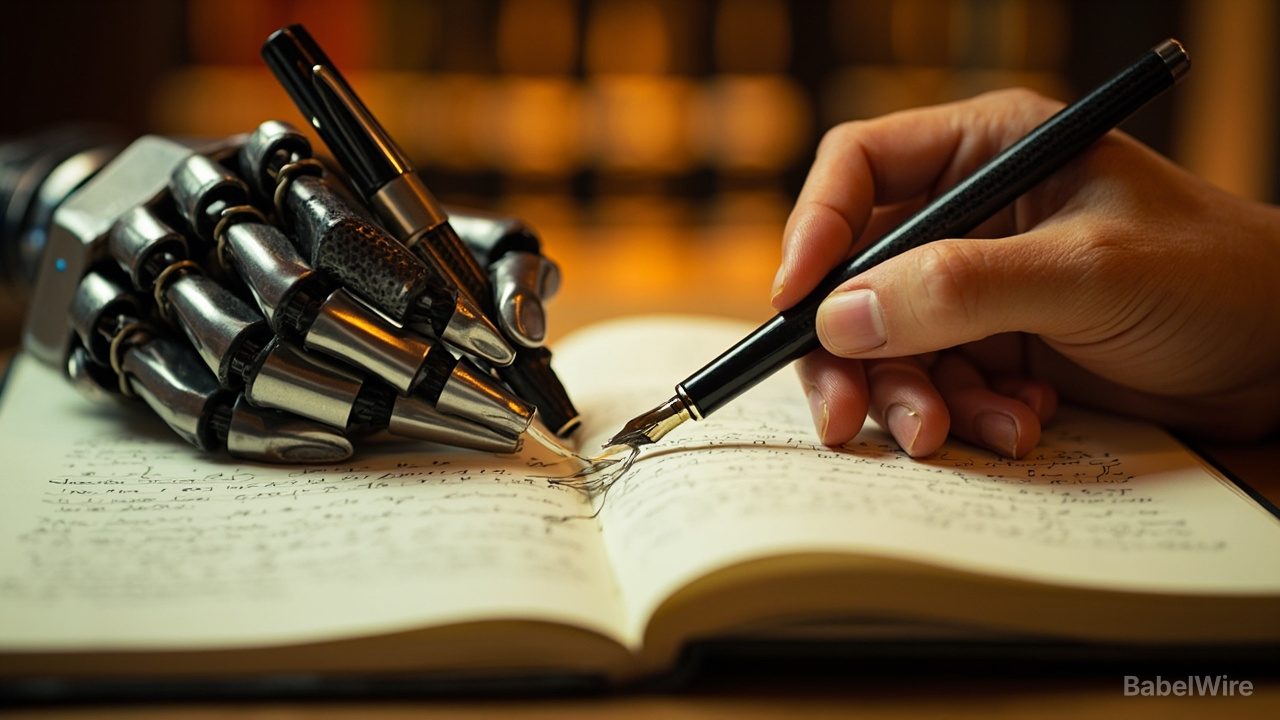
A new academic tool is dividing the scientific community. Dubbed an AI 'humanizer,' it can erase the telltale signs that a research paper or grant proposal was written with artificial intelligence — and it has sparked a fierce ethical debate published this week in Nature.
What the Tool Does
Developed by Jie Ding, a machine-learning researcher at the University of Minnesota, the tool instructs text-generation systems to remove constructions commonly associated with AI. Its GitHub page lists 'strip the AI tells without casualizing' as a core principle. Specifically, it targets phrases of the form 'not just X, but Y,' removes em dashes, and adds more evidence for unsupported scientific claims.
The tool is tailored for 'papers and grant proposals,' according to Ding. It can be used to 'match the author's own voice' by eliminating the stylistic tics that AI models tend to produce.
The Backlash
Some researchers rave about it. Francisco Maria Calisto, a health-informatics researcher at the University of Lisbon, calls it 'the best I have ever used,' mostly for e-mails and code documentation.
But others are deeply alarmed. 'I don't like it. It's deceiving,' says Miguel Angel Blazquez Rodriguez, a plant biologist at the Polytechnic University of Valencia.
Cassidy Sugimoto, an information scientist at Carnegie Mellon University, told Nature: 'I fear that the use case is harmful for science. I'm worried.'
Scientists increasingly use AI to write papers, grant applications, and even peer reviews. While many publishers allow limited AI use if disclosed, critics fear humanizers will tempt more researchers to use AI without disclosure — making it harder for journals and reviewers to detect unacknowledged AI assistance.
The Developer's Defense
Ding pushed back, telling Nature: 'I'd separate the tool from the behavior.' He noted that failing to disclose AI assistance when required is misconduct 'regardless of how a piece of text was produced.' After being asked about the potential for deceit, Ding updated the GitHub site, changing descriptions from 'removes the usual AI tells' to 'sharpens clarity and voice,' and added an ethics note clarifying that the tool 'does not remove the author's obligation to disclose AI assistance.'
The Detection Arms Race
Max Spero, CEO of AI-detection platform Pangram, says his system caught most 'humanized' text in initial tests — but not all. He says upgraded versions of Pangram are being designed specifically to detect humanizer use. The back-and-forth mirrors an escalating arms race between AI generation, humanization, and detection in academic publishing.
With AI-linked low-quality research papers already on the rise — and a major AI conference recently flooded with AI-written peer reviews — the humanizer controversy arrives at a moment when scientific publishing is grappling with how to preserve integrity in an AI-assisted world.