A Cosmic Cataclysm Beyond Compare
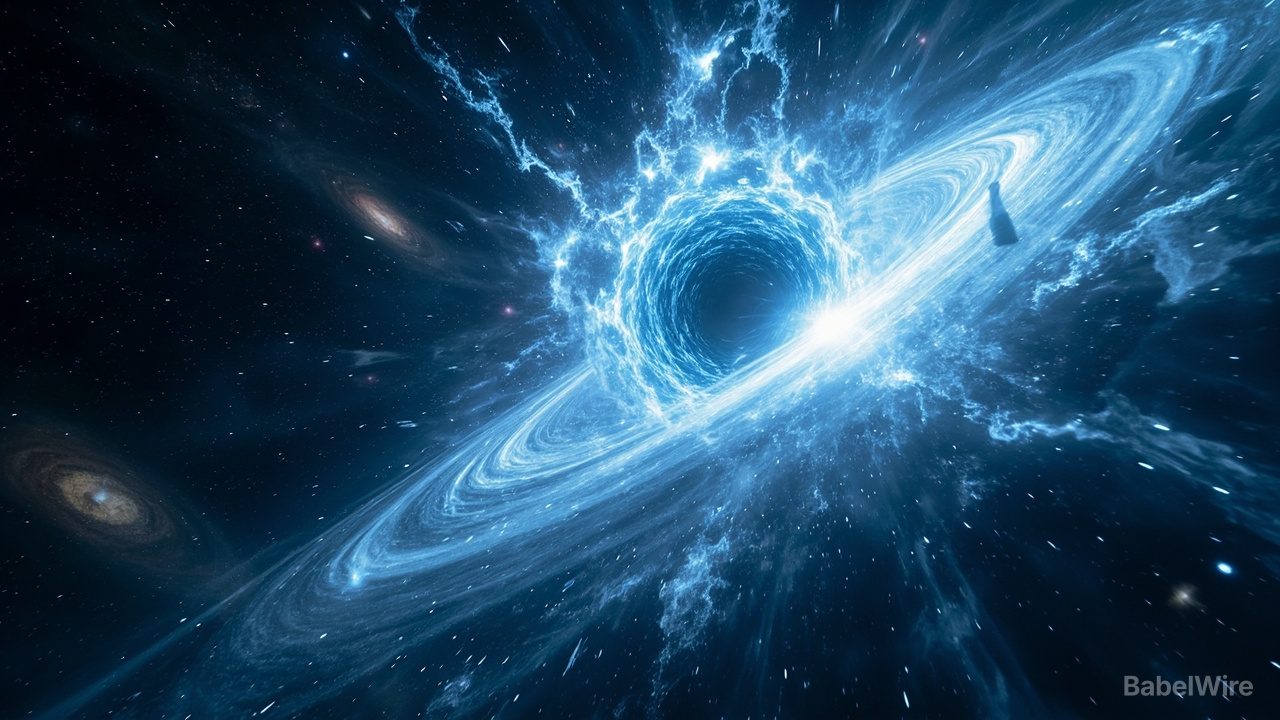
Astronomers have observed an extraordinarily powerful cosmic event — AT2024wpp, nicknamed \"The Whippet\" — when a black hole tore apart a massive companion star, releasing an amount of energy equivalent to 400 billion Suns. The explosion surpasses every known stellar-collapse explosion ever recorded.
The event belongs to a rare class called Luminous Fast Blue Optical Transients (LFBOTs), which flare brightly in blue and ultraviolet light and fade much faster than ordinary supernovae. What makes the Whippet unique is its sheer scale, speed, and brightness.
Discovery and Confirmation
Anna Ho, assistant professor of astronomy at Cornell University, first spotted the Whippet using the Zwicky Transient Facility at Palomar Observatory in California. Within a day, the Liverpool Telescope in the Canary Islands and NASA's Swift satellite confirmed the object was intensely blue and producing X-rays.
Distance measurements from UCLA and Caltech showed the blast was far too energetic to be a normal supernova — pointing instead to a star being shredded and swallowed by a black hole.
The Star's Final Moments
As the massive star ventured too close to the black hole, its immense gravity stretched and shredded the star. Debris spiraled into a superheated disk, emitting intense X-rays and driving a powerful wind into gas the star had previously shed. A shock wave raced outward at about one-fifth the speed of light, plowing into dense material before fizzling out after roughly half a year.
A Mystery Remains
Early observations from Keck Observatory, Magellan Observatory, and the Very Large Telescope showed almost no recognizable chemical fingerprints. Later, weak signs of hydrogen and helium emerged — helium moving toward Earth at over 6,000 km/s. The team suspects this is material pulled from the star's core as the black hole tore it apart.
Lead author Daniel Perley of Liverpool John Moores University described the scene: \"Even though we suspected what it was, it was still extraordinary. This was many times more energetic than any similar event.\"
The findings were published in Monthly Notices of the Royal Astronomical Society on April 10, 2026.