Using the James Webb Space Telescope, an international team of astronomers has discovered that dust and water can form and survive surprisingly close to the supermassive black hole at the center of the Milky Way.
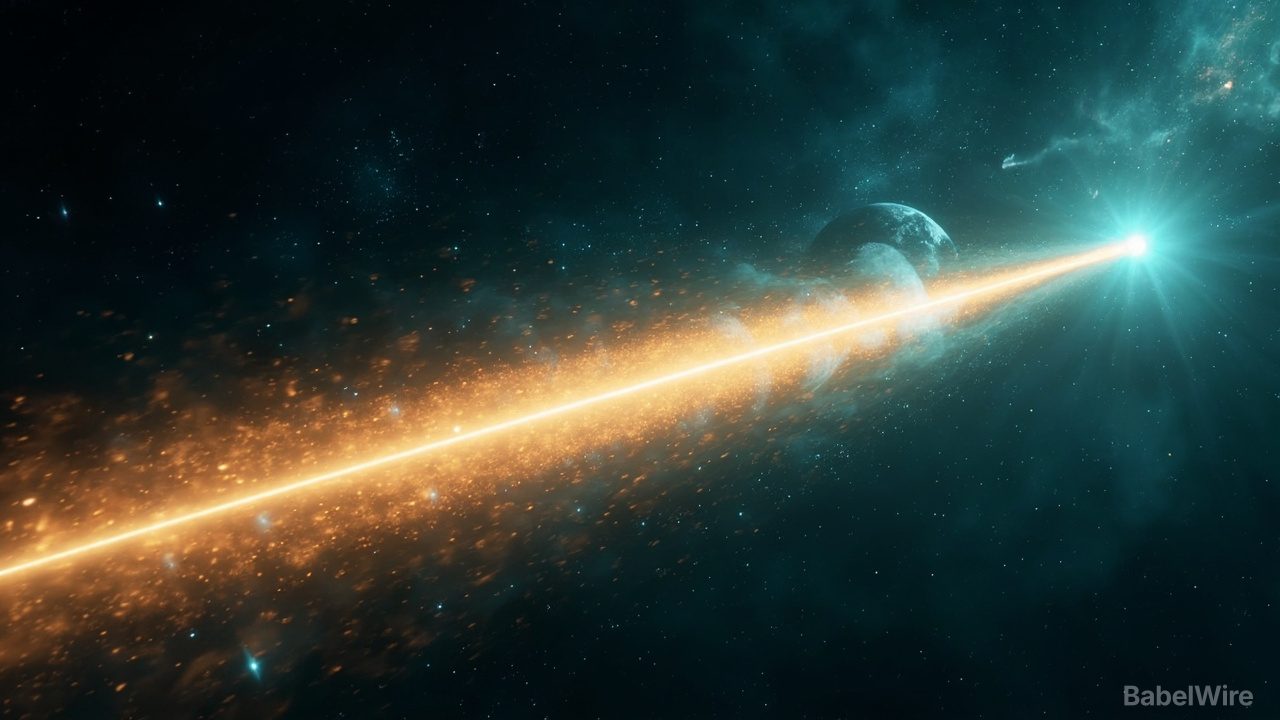
The observations zero in on IRS 3, a highly evolved star located just 0.55 light-years from Sagittarius A*, the black hole that anchors our galaxy. IRS 3 has entered the asymptotic giant branch phase — a late, dramatic stage of stellar life in which stars swell into huge, cool, luminous objects and shed gas into space through powerful stellar winds. That cast-off material is one of the most important sources of cosmic dust in the universe, but astronomers did not know whether a star so close to a supermassive black hole could still produce it.
By dissecting the star's infrared light with Webb's MIRI instrument, the team identified clear signatures of oxygen-rich silicate dust and — for the first time — detected water in the star's surrounding envelope. The data reveal a layered, shell-like distribution of dust extending roughly 10,000 astronomical units from the star, with temperatures falling from about 1,200 Kelvin near the star to around 100 Kelvin in the outer regions.
"Galactic centres are among the most extreme environments, so understanding whether stars can continue enriching their surroundings there is an important question," said lead author Florian Peißker of the University of Cologne in Germany. "With Webb, we can directly observe how stars behave under these conditions and see that dust production remains remarkably resilient."
Previous studies had suggested IRS 3 might be carbon-rich; the new observations paint a different picture. The two strong infrared signatures associated with silicate dust — composed of silicon and oxygen — identify IRS 3 as an oxygen-rich evolved star nearing the end of its life. The star is estimated to weigh about six times as much as the Sun and to be roughly 72 million years old, and it is undergoing intense mass loss.
"The detection of water is especially exciting because it shows that molecular material can survive in an environment dominated by intense radiation," said Macarena Garcia Marin of ESA, a co-author and principal investigator of the MICONIC programme. "This tells us that even close to a supermassive black hole, stars can continue contributing material back into their surroundings."
The results, based on observations collected in 2025 as part of the MICONIC guaranteed-time programme, suggest that evolved stars play a greater role in supplying dust to galactic centers than previously assumed — regions once thought to be especially hostile to such processes. The findings were reported in the journal Astronomy & Astrophysics.