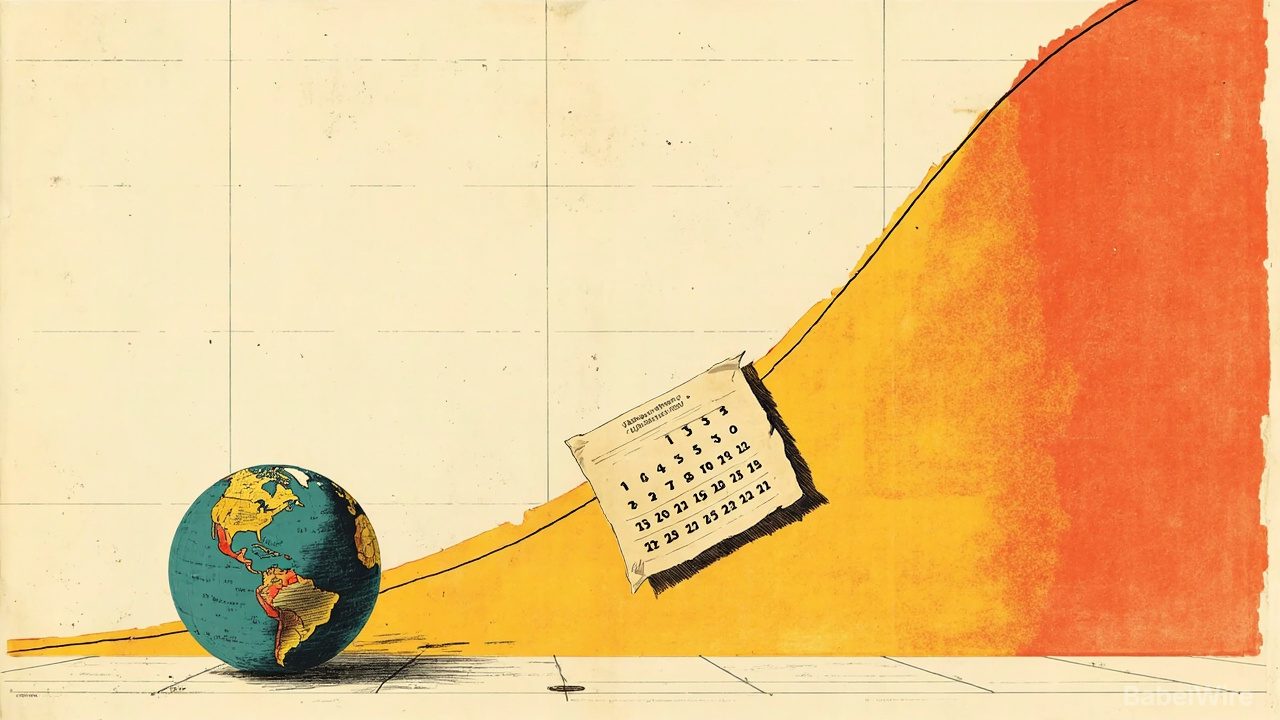
On November 4, 1960, the journal Science published a paper with an unusually precise title: 'Doomsday: Friday, 13 November, A.D. 2026.' Its author, the physicist and cybernetics pioneer Heinz von Foerster, working with Patricia Mora and Lawrence Amiot, fitted a curve to two millennia of human population growth and concluded that, if that growth held, the population would approach infinity on — precisely — today's date.
Friday, November 13, 2026, is here. The world's population is roughly 8.2 billion people: growing, but nowhere near infinity.
Von Foerster knew that. The paper was a deliberate provocation, not a prophecy: by extrapolating the trend line to its absurd endpoint he meant to show how dangerous it is to mistake a curve for a law. His real concern was the 'population explosion' and the social and ecological pressures of crowding — and, in the paper, a wry call for 'cheap and effective' remedies like better contraception and food from unconventional sources.
The point resonates in an era of its own runaway forecasts. Less than two years later, von Foerster co-founded the Biological Computer Laboratory at the University of Illinois, an incubator of cybernetics and second-order thinking — ideas that now inform debates over whether AI capabilities, too, will keep climbing in a straight line or bend.
Austria's Complexity Science Hub is marking the date with a conference on the sense and nonsense of end-of-world predictions. The lesson von Foerster left is less about a date than a habit: extrapolation is a tool, not a verdict — and the future usually bends before the line does.