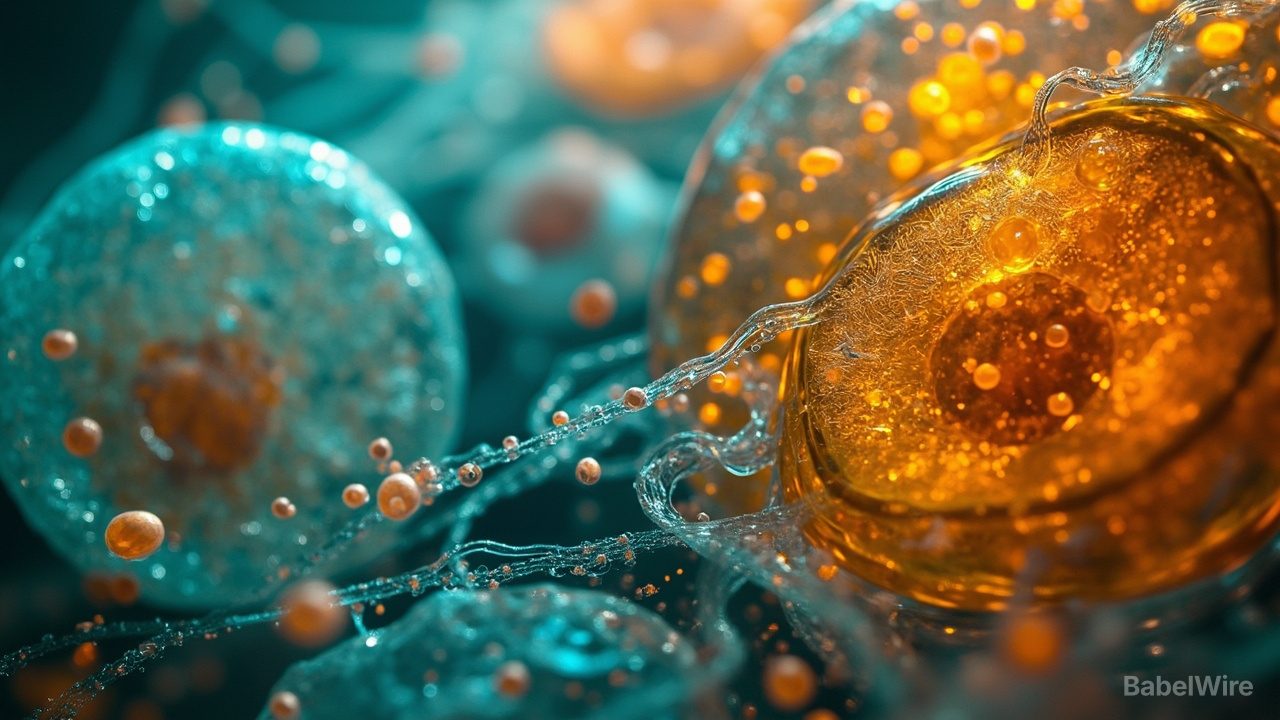
For decades, nutrient biology has assumed that cells detect food through signaling pathways activated by specific nutrients — leucine triggers growth, sugar triggers insulin. A new study in PNAS from RIKEN's Center for Biosystems Dynamics Research shows that the cells lining the gut use a far cruder, more physical gauge: how thick or watery their own insides have become.
The team, led by Sa Kan Yoo, was studying "erebosis," a newly described form of gut-cell death that drives the rapid renewal of the intestinal lining. They found that low-nutrient conditions triggered erebosis, while abundant amino acids suppressed it — but no single amino acid, metabolite, or metabolic pathway could explain the effect. "The project got stuck for a year," Yoo recalls.
The breakthrough came with a non-metabolizable amino acid analog that still suppressed erebosis — proof that cells were not "reading" the nutrients' chemistry but responding to their sheer accumulation. Amino acids thicken the cytoplasm, and when the cell interior turns viscous, cells behave as if fed. Feeding flies two metabolically inert molecules that produce the same thickening reproduced the effect exactly.
The researchers call the phenomenon "viscosatiety": gut cells sense their satiety or hunger based on the viscosity of the cytoplasm and adjust their fate accordingly. It suggests an entire sensing channel built on biophysics rather than biochemistry — nutrient quantity, not quality.
Yoo's lab is now investigating whether the same mechanism operates in mice and humans, whose gut linings renew themselves just as aggressively. If so, "viscosatiety" could reshape how we think about appetite, diet composition, and intestinal health.
Sources
- riken.jpRIKEN press release: Satiety games — it's nutrient quantity, not quality for gut cell turnover
- doi.orgPNAS: Cytoplasmic fluidity couples nutrient availability and enterocyte fate in vivo
- phys.orgPhys.org: Gut cells may measure hunger by how watery their insides become
- news-medical.netNews-Medical: Fruit fly gut cells track hunger using internal cell viscosity