For decades the search for extraterrestrial intelligence has mostly pointed radio dishes and optical telescopes at the sky, listening for a signal or looking for a flash of laser light. A newer strand of the field argues the evidence may already be closer to home — and that the best place to look for it is not Earth, but the Moon.
The logic is geological. Earth's surface is a recycling machine: plate tectonics, weather, ice ages and biology have churned the crust so thoroughly that almost nothing from billions of years ago survives intact. The Moon has no atmosphere, no plate tectonics and almost no erosion. Its surface is a nearly undisturbed archive, recording impacts and deposits that date back to the solar system's earliest days. If an alien civilisation ever visited our neighbourhood, or if its technology ever drifted through it, microscopic traces — particles, alloys, manufactured structures too small to notice — could have settled into lunar soil and stayed there, essentially frozen, for eons.
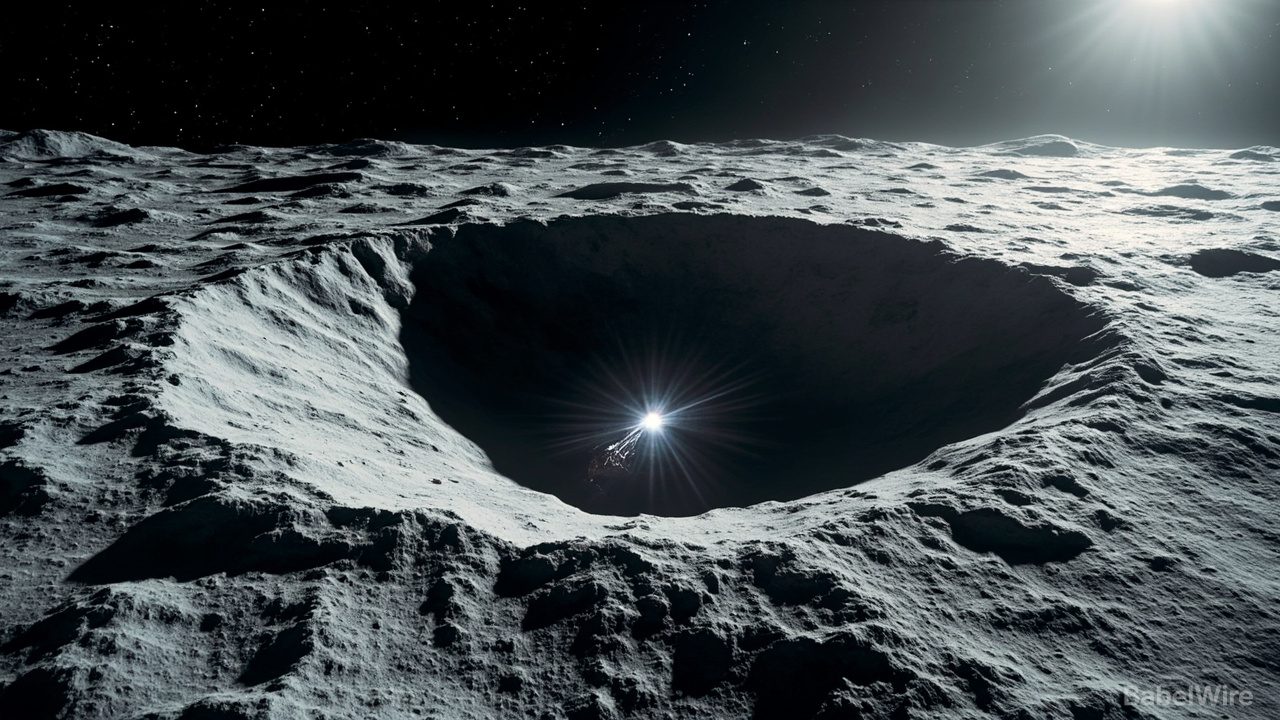
That is the case for hunting microscopic technosignatures on the Moon, an idea now under discussion among researchers and reported by Golem. Rather than scanning the sky for signals, the approach would examine lunar material itself: dust and regolith at the surface, samples returned by spacecraft, and the cold, permanently shadowed craters at the poles where volatiles and any embedded artefacts might be preserved most faithfully. Proposed tools include high-resolution microscopy, spectroscopy and techniques used to spot anomalies in materials — the same search that planetary scientists apply when studying meteorites.
The strategy comes with obvious difficulties. Distinguishing a genuine artefact from a natural mineral grain is a formidable task, and contamination is a constant risk — lunar samples have been handled by humans and hardware, and any future rover would carry its own material. Critics also note that the search space is enormous and the prior probability unknown. Still, the appeal is that the Moon offers something the sky cannot: a physical place to dig, with a timescale of billions of years. As missions return to the lunar surface in growing numbers, the idea is shifting from thought experiment to something that could, at least in part, actually be tested.