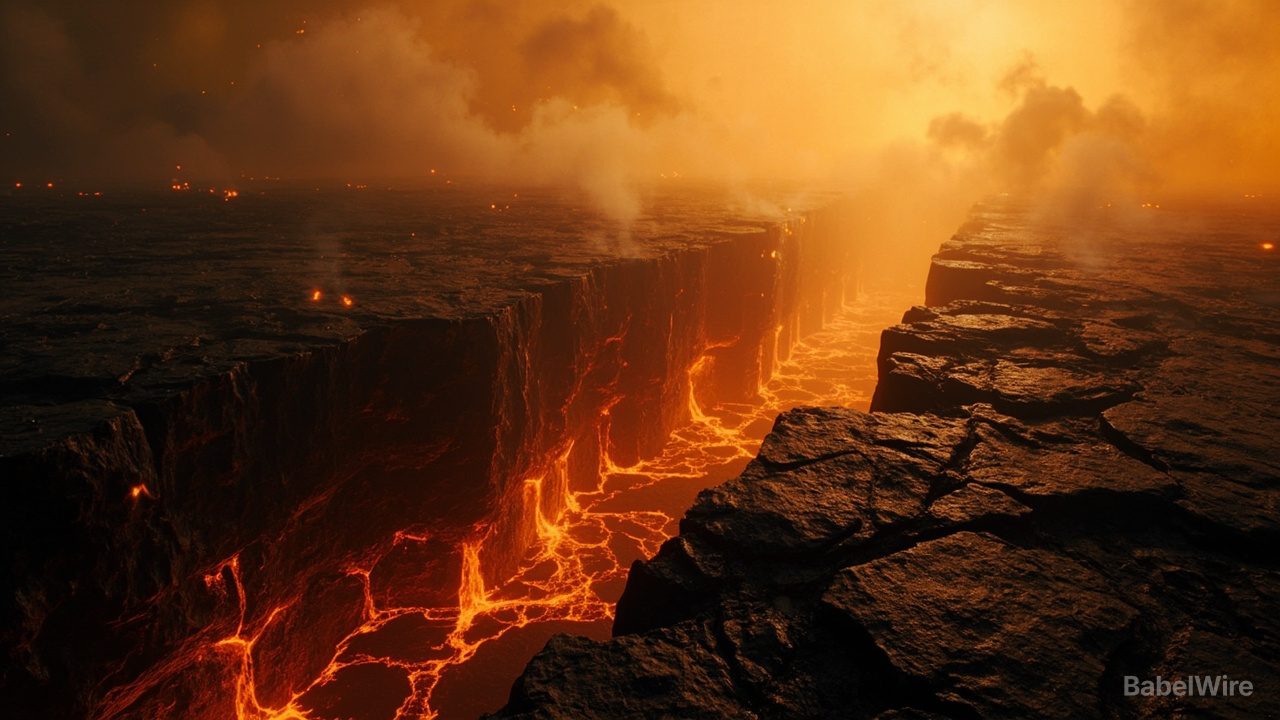
Venus, long considered a geologically dead world shrouded in thick volcanic plains, may be far more active than scientists believed — and its surface may be reshaping itself right now.
New 3D simulations published in Nature Communications by researchers at ETH Zurich suggest that some of Venus's massive rift valleys and circular geological features called coronae formed relatively recently and could still be actively expanding.
The research team used advanced Monte Carlo modeling to simulate the behavior of hot rock plumes rising from Venus's mantle into its lithosphere. They found that these plumes can create enormous surface deformations within tens of millions of years — a blink of an eye in geological terms — and that some features observed by NASA's Magellan probe in the 1990s may be younger than previously thought.
The findings challenge the long-standing view that Venus's surface is essentially frozen in time, with no significant tectonic activity. Instead, the planet appears to experience episodic resurfacing driven by mantle plumes, somewhat analogous to how hotspots drive volcanic activity on Earth.
The results will help scientists prepare for ESA's upcoming Envision mission, which will use advanced radar to map Venus's surface and subsurface in unprecedented detail. The mission is expected to launch in the early 2030s.
The study was also covered by Science News, SciTechDaily, and ScienceDaily.