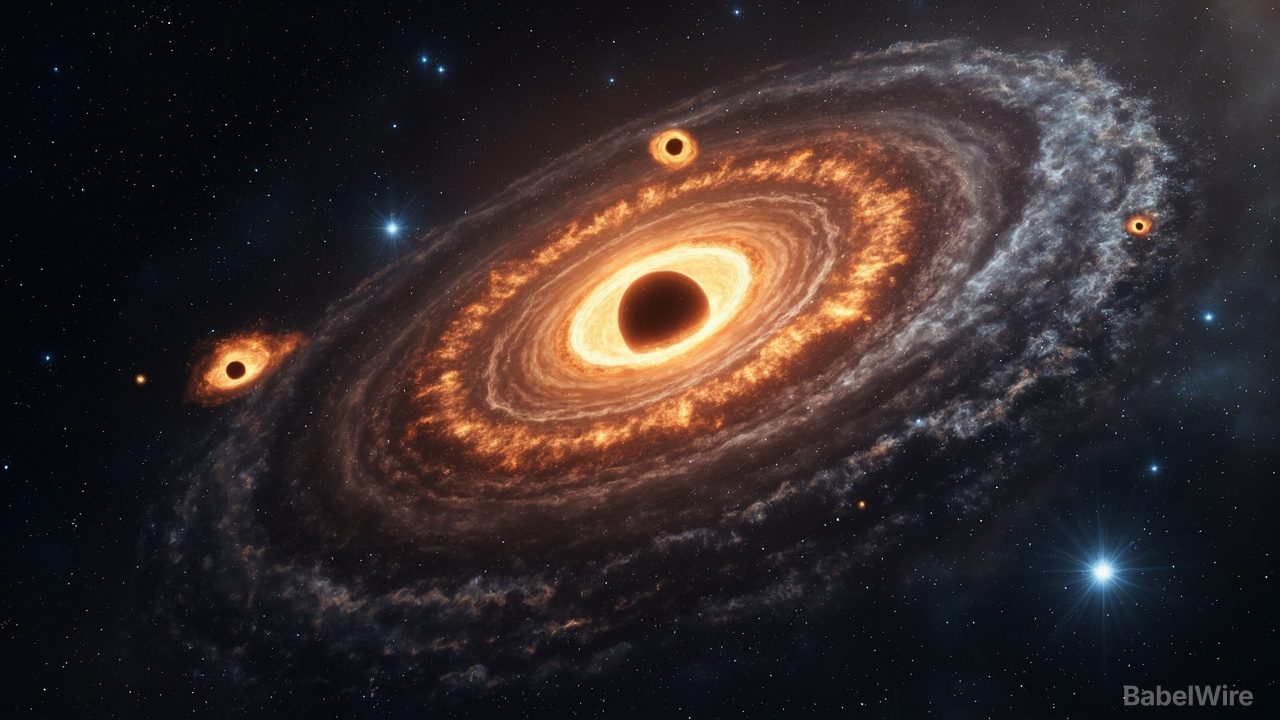
Astronomers have found three actively feeding supermassive black holes inside a single galaxy in the distant universe — the first time such a triple has been seen.
The galaxy, J0148-4214, lies more than 12.5 billion light-years away and is seen as it appeared just 1.2 billion years after the Big Bang. An international team led by the Max Planck Institute for Extraterrestrial Physics used the James Webb Space Telescope's NIRSpec instrument to map the galaxy in detail.
Two of the black holes sit close together at the galaxy's center, separated by just 620 light-years in projection, while a third lies roughly 5,500 light-years out in the galaxy's outskirts. Their masses span from about 0.6 million to 80 million times the mass of the Sun. The smallest, which is feeding voraciously, appears to be accreting matter at a rate that exceeds the theoretical Eddington limit.
"This is the first evidence of three active black holes in a single galaxy in the distant Universe," said Hannah Übler of MPE, lead author of the study.
The finding suggests that mergers and interactions in the early universe were efficient at bringing massive black holes together, helping them grow rapidly. The central pair is expected to merge within the next few hundred million years — the kind of event future gravitational-wave observatories may one day catch.
The third, off-center black hole may be the remnant of a previous merger, displaced by a gravitational recoil kick, or still migrating inward. The results are published in Astronomy & Astrophysics.