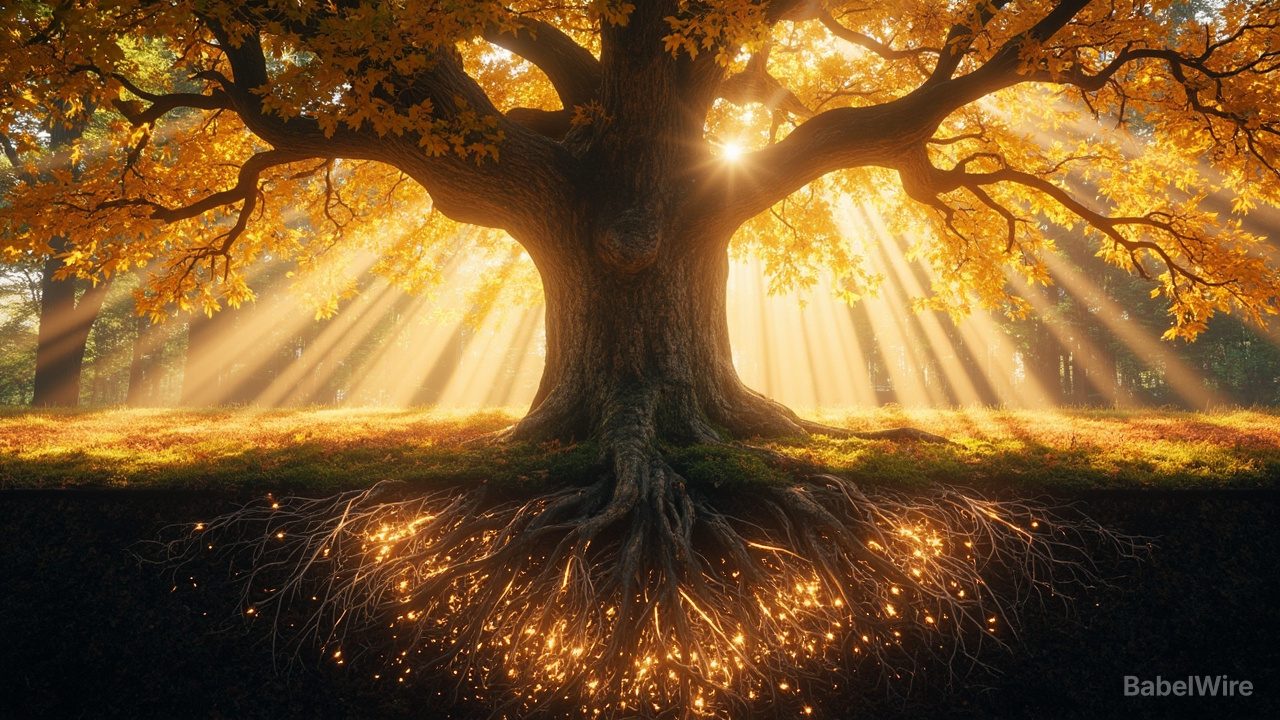
Oak trees continue absorbing carbon dioxide for months after their annual growth has stopped, according to a new study published in Science Advances that challenges a foundational assumption in climate science.
Researchers at Columbia University's Lamont-Doherty Earth Observatory found that photosynthesis and wood production are not as tightly linked as scientists had long believed. The discovery could force a significant rethink of how much carbon forests will be able to store in a warmer, CO2-rich world.
Most climate models assume that increased photosynthesis from rising CO2 levels naturally leads to more tree growth and greater long-term carbon storage. But the new findings show the relationship is far more complex.
'Right now, most models assume that if you have photosynthesis, you have growth. We find that's not the case,' said lead author Mukund Palat Rao. 'Just because there is more photosynthesis might not necessarily mean more tree growth in the future.'
The team combined satellite imagery tracking photosynthesis at 137 oak forest sites across the eastern United States and California with ground-level CO2 sensors, tree trunk measurements, tree ring records, and temperature data spanning from 1950 to the present.
At eastern U.S. sites, oak trees grew from May through July but continued photosynthesizing into October — meaning about 36% of their annual carbon assimilation occurred after growth had finished. In California, the same pattern emerged: 26% of yearly carbon uptake happened after growth had stopped by August.
The reason, Rao explained, is simple: tree growth requires internal water pressure, which drops quickly during hot, dry conditions. 'The moment you have dry and hot conditions, growth activity stops pretty instantly while photosynthesis seems to continue at a slightly decreased rate,' he said.
Some of the extra carbon captured after growth ends is stored as fuel for the next growing season. The rest goes into producing new roots and leaves or is oxidized to keep cells alive through winter. The question of how much of this carbon eventually becomes long-term woody biomass versus returning to the atmosphere remains open.
The disconnect between photosynthesis and growth became even stronger during years with unusually wet-dry swings. Since climate change is expected to increase such variability, the pattern could become more pronounced in the future.
Rao and his team are now investigating whether other tree species and forest ecosystems show similar patterns. 'There are many questions still left to address,' he acknowledged.