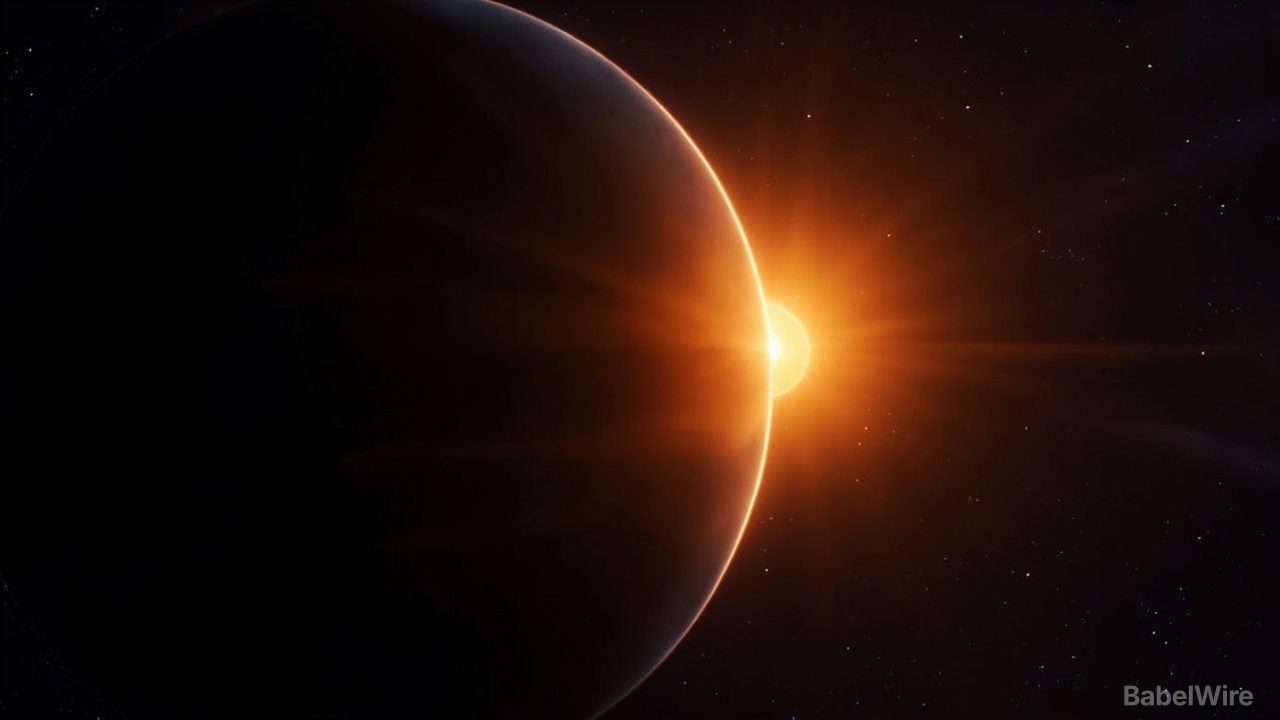
An exoplanet roughly 1,000 light-years away has stopped passing in front of its star, and astronomers think an unseen neighbour is to blame.
TOI-2535b is a "hot Jupiter" — a gas giant about the size of Jupiter orbiting close to its star. It was found by NASA's TESS mission around TOI-2535, a K-type dwarf somewhat smaller than the Sun, and completes an orbit every 8.25 days. For about seven years it transited on schedule, dimming its star's light like clockwork.
Then the clock broke. Reported Monday in The Astrophysical Journal Letters by a team led by UCLA astronomers, the planet's transits drifted: the timing of individual transits shifted by as much as six hours, a large variation for such a short orbit and a classic signature of gravitational tugging by another planet. At the same time the transits grew steadily shorter, as if the planet were crossing the star near one of its poles instead of the equator. Eventually the transits stopped altogether.
"This is the fastest rate of inclination change observed for an exoplanet orbiting a single star," the researchers note — the plane of TOI-2535b's orbit is tilting away from our line of sight fast enough to remove the planet from view within a human lifetime of observation.
The hidden companion never appears in the TESS data, which suggests it orbits in a slightly different plane and therefore never passes between the star and Earth. To work out what could produce such a rapid tilt, the team generated 300,000 different starting configurations and ran them forward in time. No single arrangement stood out, so they took the 100 best solutions and simulated them for a million years. About two-thirds fell apart, ruling out several possible orbital resonances. The survivors shared two features: the hidden planet must be massive — at least Saturn-sized — and the angle between the two orbits cannot be large, or the pair would eventually destabilise.
The model also makes a prediction: TOI-2535b should re-enter our line of sight in roughly 30 to 50 years, and the unseen companion may begin transiting before then. That is a forecast from simulation, not a scheduled event.
The discovery is less a single oddity than a reminder of how much of a planetary system can hide. Transit timing variations are one of the few handles astronomers have on worlds they cannot see directly, and this system is an unusually loud example. A third planet cannot be excluded either — there is enough noise in the timing data that the team declines to rule it out.
The harder question is how the system got this way. Large planets are thought to form farther out and migrate inward on the friction of the gas disk, a process that normally keeps planetary orbits close to coplanar. Something extra — a scattering event, a warped disk, an early instability — is needed to tilt the survivor's orbit enough to make it vanish. Follow-up radial-velocity measurements, which could detect the companion's pull on the star itself, are the obvious next test; current data are too noisy to make the case either way.