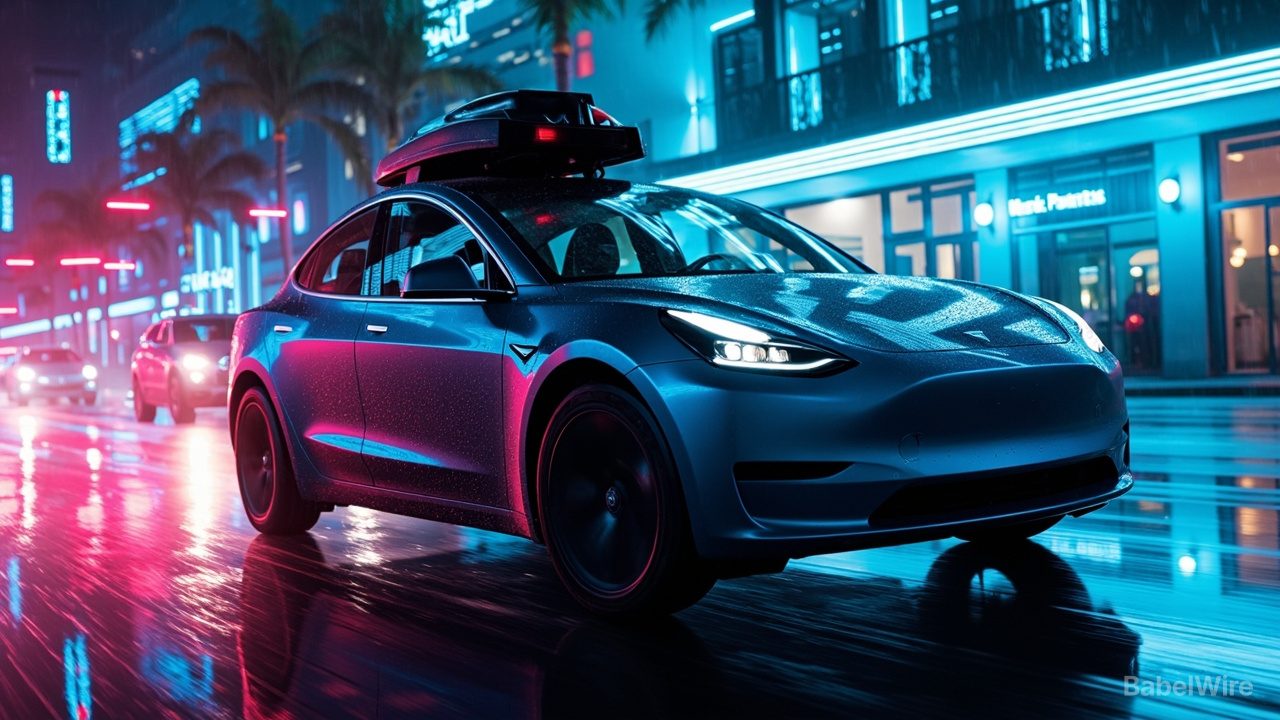
Tesla has launched its fully unsupervised Robotaxi service in Miami, Florida — the fifth US city to receive the service and the first outside of Texas, marking an aggressive acceleration of CEO Elon Musk's bet on autonomous ride-hailing at scale.
Fully Unsupervised From Day One
The Miami deployment is notable because, unlike earlier rollouts in Austin, Houston, Dallas, and Phoenix — which began with supervised operation before moving to driverless — Miami is fully unsupervised from the start. No safety monitor sits in the vehicle. Tesla VP of AI Software Ashok Elluswamy confirmed the milestone within hours of the July 3 announcement.
Riders access the service through Tesla's dedicated Robotaxi app on iOS and Android and join a waitlist, consistent with the company's established rollout pattern. The initial geofenced zone covers roughly 10 to 14 square miles in western Miami-Dade County — West Miami, Doral, and Sweetwater — bounded by the Palmetto Expressway to the north and Tamiami Trail to the south. The zone does not include downtown Miami, Brickell, Wynwood, the Design District, or Miami Beach.
The Technical Challenge: Camera-Only FSD in Tropical Weather
Miami's launch is not merely a geographic expansion — it is a live, uncontrolled experiment testing the limits of Tesla's vision-only autonomous driving architecture in tropical conditions. South Florida's sudden intense downpours, high humidity, and sharp sun glare directly challenge Tesla's camera-based system.
Tesla's FSD relies exclusively on eight cameras paired with an end-to-end neural network — no LiDAR, no radar. The approach differs fundamentally from Waymo's, which combines 13 cameras, four LiDAR units, and six radar sensors. Waymo's LiDAR generates usable 3D data in rain and glare where cameras degrade; its radar provides velocity and distance data in all lighting.
This architectural difference sits at the center of an active regulatory investigation. In March 2026, NHTSA escalated a probe into Tesla's FSD to an engineering analysis — the final step before a potential recall — finding that the camera-only system "fails to detect and/or warn the driver appropriately under degraded visibility conditions such as glare and airborne obscurants." That investigation covers approximately 3.2 million Tesla vehicles.
Fleet Reality: Tiny Compared to Waymo
Tesla's physical fleet remains minuscule compared to its rival. In Texas, Tesla's registered unsupervised fleet stood at roughly 42 vehicles — with only about 20 operating at any given time across Austin, Dallas, and Houston. By contrast, Waymo maintains approximately 577 registered driverless vehicles in Texas alone and roughly 3,000 nationwide, completing more than 500,000 paid trips per week.
Waymo has been operating in Miami since January 2026 and opened to all riders without a waitlist in April. Its coverage zone spans 60 square miles — roughly four to six times larger than Tesla's launch footprint — and includes the urban core neighborhoods Tesla's geofence excludes.
What's at Stake
Tesla's expansion strategy relies on scaling FSD software rather than building large dedicated fleets. Elon Musk has tied meaningful fleet growth to FSD v15, a planned architectural rewrite increasing the driving model from ~1 billion parameters to ~10 billion. No release date has been set. The purpose-built Cybercab, with no steering wheel or pedals, began rolling off Giga Texas lines in February 2026, but volume production remains uncertain.
Tesla has named Phoenix, Orlando, Tampa, and Las Vegas as target expansion cities. The company has also filed for permission to deploy up to 5,000 autonomous vehicles in Clark County, Nevada, covering Las Vegas and Harry Reid International Airport.
For now, Miami is the proving ground. How FSD performs in the rain and glare of a South Florida summer — under the watch of an active NHTSA engineering analysis — will produce some of the most consequential data in the robotaxi industry's short history.