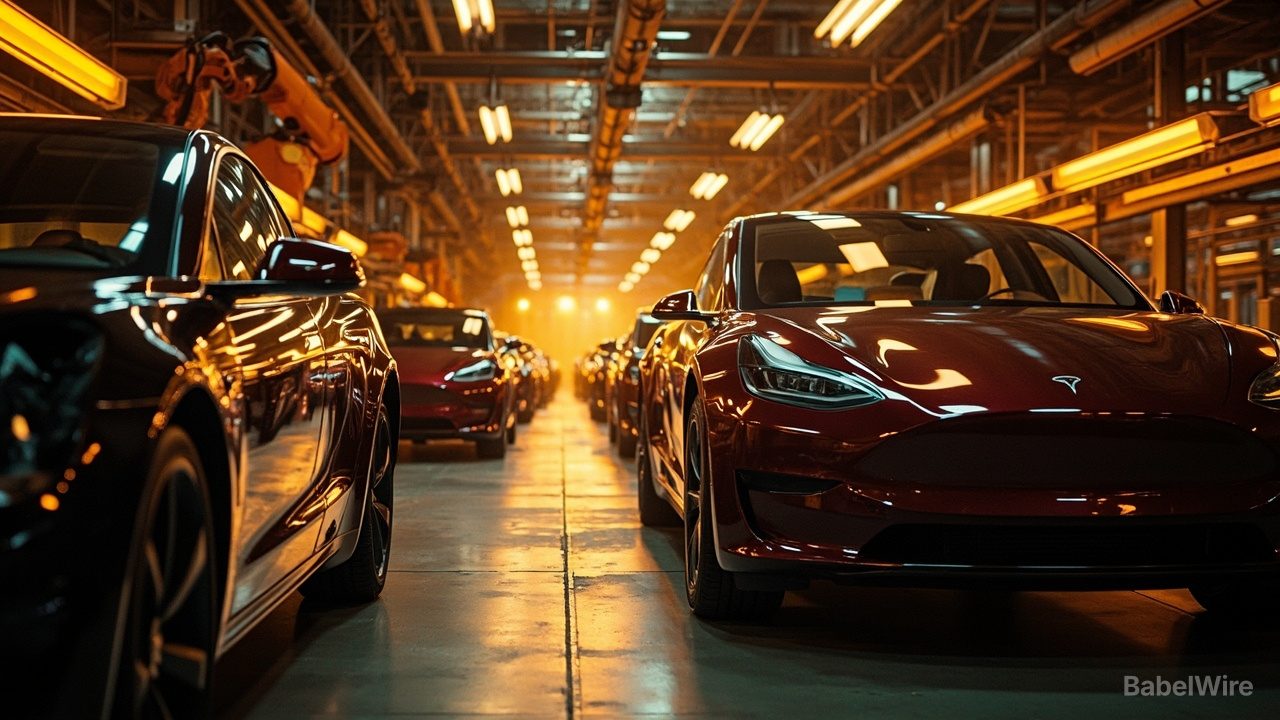
Tesla has built its 10 millionth all-electric vehicle, the company announced this week — a milestone no other automaker has achieved. But the achievement is arriving later than Tesla once projected, and the context around it tells a more complicated story.
For years, Tesla guided investors toward roughly 50% average annual growth in production and deliveries. That trajectory held until 2023, when deliveries peaked at 1.81 million vehicles. In 2024, Tesla posted its first-ever annual decline, dropping to about 1.79 million. In 2025, deliveries fell again to 1.636 million — a 9% year-over-year decline. That's two straight years of falling output, and 2026 is not showing a meaningful rebound.
In Q2 2026, Tesla produced 451,758 vehicles and delivered 480,126. At that quarterly rate, the company is on pace for roughly 1.8 million vehicles this year — still short of its 2023 peak.
The deeper issue is capacity utilization. By Tesla's own accounting, it has built manufacturing capacity for well over 2.375 million vehicles annually across its Fremont, Shanghai, Berlin, and Texas facilities. That means the company is running hundreds of thousands of units below what its own factories can produce.
Tesla has attributed the slowdown to being "between two major growth waves" — the first driven by Model 3 and Model Y, the second expected from a cheaper next-generation vehicle. But more than two years after that framing, the second wave still hasn't materialized. Meanwhile, the company has shifted strategic focus toward robotaxis and its Optimus humanoid robot program, neither of which directly boosts vehicle sales.
Ten million all-electric vehicles remains a genuinely impressive milestone — no legacy automaker is close, and Tesla did more than anyone to prove EVs could be built at scale. But it also underscores that the growth story which carried Tesla's valuation for a decade has flatlined, and the company's future increasingly depends on bets beyond its core EV business.