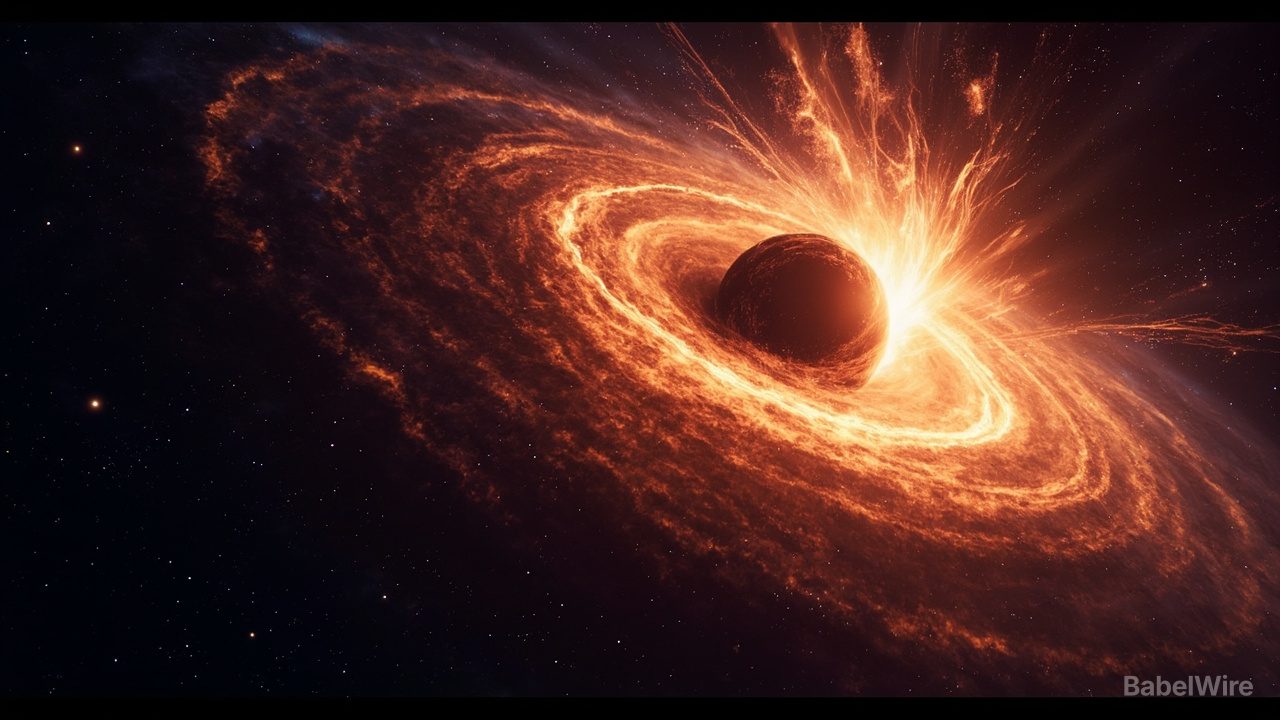
A wandering supermassive black hole has revealed itself in spectacular fashion: it tore apart a star and briefly blazed brighter than the entire galaxy whose outskirts it called home. The outburst was caught by NASA's Neil Gehrels Swift Observatory.
The event, a tidal disruption, happened more than 30,000 light-years from the galaxy's center — a place where astronomers would not normally expect to find a supermassive black hole. Such "wandering" black holes are predicted by gravitational dynamics but are rarely observed directly.
When the star drifted too close, the black hole's gravity ripped it apart. The shredded material heated up, producing a flare equivalent to about 10 billion suns — bright enough to reveal the otherwise invisible black hole to Swift.
The observation confirms that supermassive black holes can wander in the outskirts of their host galaxies rather than sitting only at galactic centers, likely as a result of past galaxy mergers.
Researchers are now analyzing the flare's light curve to pin down the black hole's mass and properties.