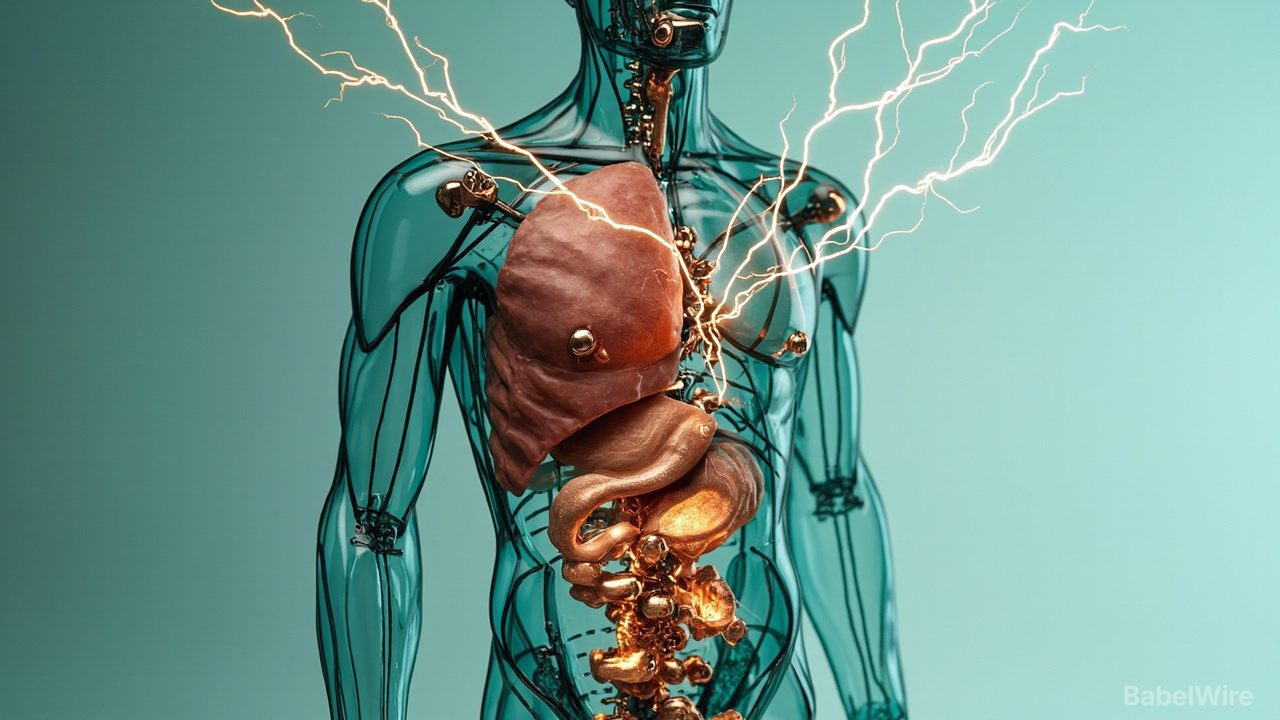
Most implants — pacemakers, insulin pumps, neurostimulators — work alone. A team at Georgia Tech has built a networking scheme that lets many of them coordinate by sending electrical signals through the body itself instead of through radio.
WHY NOT RADIO. Bluetooth Low Energy and NFC are poor fits inside tissue, says co-author Alex Abramson. Bluetooth components can cut an implant's battery life by up to 90 percent when active, and radio signals attenuate badly: implant-to-implant communication runs into trouble beyond about one centimetre of tissue. Antennas also impose size — commercial Bluetooth parts need devices at least five millimetres wide, while implants thinner than three millimetres can be injected with a syringe in an outpatient clinic rather than implanted surgically.
HOW SWANS WORKS. The system, described in Science, borrows the body's own signalling: ionic conduction, the mechanism neurons use. A wearable hub — a flexible circuit board that reads sensor data, runs decision algorithms and emits pulses of up to 12 volts — drives a patch of stainless-steel microneedles that delivers those pulses past the skin's poorly conductive outer layer. Syringe-injectable implants each carry two receiving pads, a transistor switch, a battery and either a sensor or an actuator such as a nerve stimulator. All the intelligence sits in the wearable, which has more room and more battery; the implants stay small and largely passive, drawing almost no power while listening — more than 15 times less than Bluetooth or NFC.
THE TRICK IS ADDRESSING. A voltage pulse spreads in all directions, so selectivity comes from threshold tuning: each implant's transistor switches on only when a pulse crosses a specific combination of strength and duration. A resistor in front of the transistor raises the voltage needed; a capacitor means the pulse must last long enough to charge it first. The authors concede in the paper that thresholds must be tuned for each body and each implant placement.
WHAT THE TESTS SHOWED. In skin-on, bone-in pork belly, a single 10-volt pulse produced a detectable voltage gradient more than 30 centimetres across the tissue and up to 14 centimetres deep — more than ten times the coverage of Bluetooth or NFC. In live rats, signals reached implants under the skin, in the abdominal cavity and in the stomach, and a hub placed on the stomach actuated an implant on the back. The most advanced experiment used strain sensors on the rats' forelegs: a movement triggered a limb-specific pulse that reached the corresponding hind-leg implant, stimulated the sciatic nerve and made that leg twitch. A relay implant passed a signal to a second implant only when a temperature sensor registered a fever above 40 °C.
LIMITS AND SAFETY. SWANS carries little data by design; it is meant for key values such as a temperature reading, not streams. It has not been tested in large animals or humans, though the team says preliminary large-animal work looks promising. A two-month rat study found scar tissue up to a millimetre thick, which the researchers worked around by raising voltage within safe limits; the pulses did not stimulate untargeted nerves, did not alter cardiac electrical activity, and caused no more cell death or oxidative stress than non-electrified implants. Because the protocol is agnostic to the sensor or actuator, the authors argue it can be bolted onto existing implants — for instance linking a drug pump to a neurostimulator for conditions such as epilepsy, which today are managed by completely separate devices.