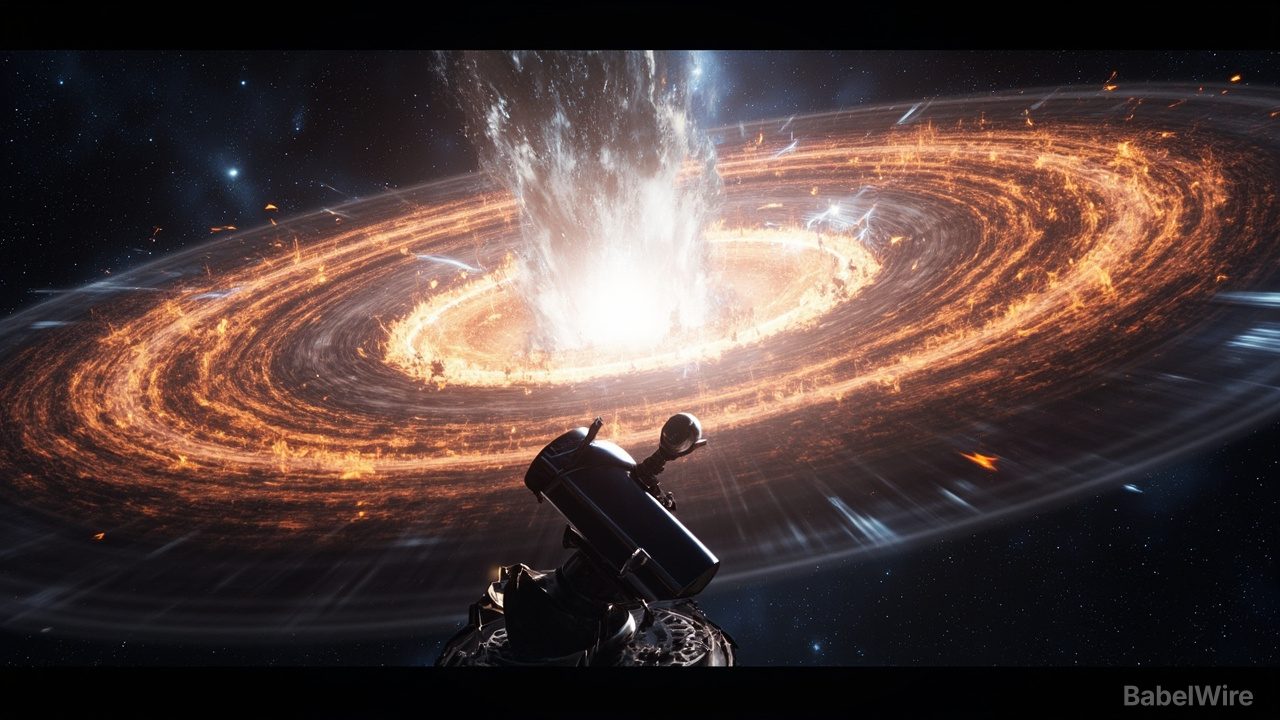
Astronomers have watched a massive star die from its very first explosive flash — a rarity that has produced one of the most complete records of a stellar death ever assembled. The event began in March 2026, when China's Einstein Probe space telescope caught a brief burst of X-rays from a galaxy about 500 million light-years away. A Carnegie Mellon University-led team quickly identified it as a 'shock breakout' — the first light released when the blast wave from a collapsing stellar core tears through the star's surface. Such breakouts last only seconds to hours, and this is only the second clear X-ray shock breakout observed in more than two decades.
Within an hour, telescopes around the world turned to the source. The supernova, designated SN 2026gzf, brightened rapidly and revealed itself as a broad-lined Type Ic supernova — an energetic class of explosion often associated with gamma-ray bursts, the most powerful blasts in the universe. But follow-up observations told a different story. NASA's Chandra X-ray Observatory found no fading X-ray afterglow, and radio observations with the Very Large Array ruled out the powerful relativistic jets seen in gamma-ray-burst events. The jet, it seems, was 'choked' — strangled either by the star's surface or by the material surrounding it.
Reported in The Astrophysical Journal Letters, the finding makes EP260321a/SN 2026gzf the first high-energy breakout flash tied to a broad-lined Type Ic supernova with no evidence of a relativistic outflow. 'Stripped massive stars can die in more ways than astronomers previously thought,' said first author Brendan O'Connor of Carnegie Mellon, whose team marshaled facilities from the Rubin Observatory's LSST to the Hobby-Eberly and Southern African Large Telescopes.
Sources
- cmu.eduRare Stellar Explosion Gives Astronomers a Front-Row Seat to a Massive Star's Death (Carnegie Mellon University)
- reuters.comAstronomers watch the whole process as a huge star dies (Reuters)
- mcdonaldobservatory.orgAstronomers Catch Massive Star's Death from the First Explosive Moment (McDonald Observatory)
- space.comAstronomers witness the strange final moments of a massive star's supernova death (Space.com)