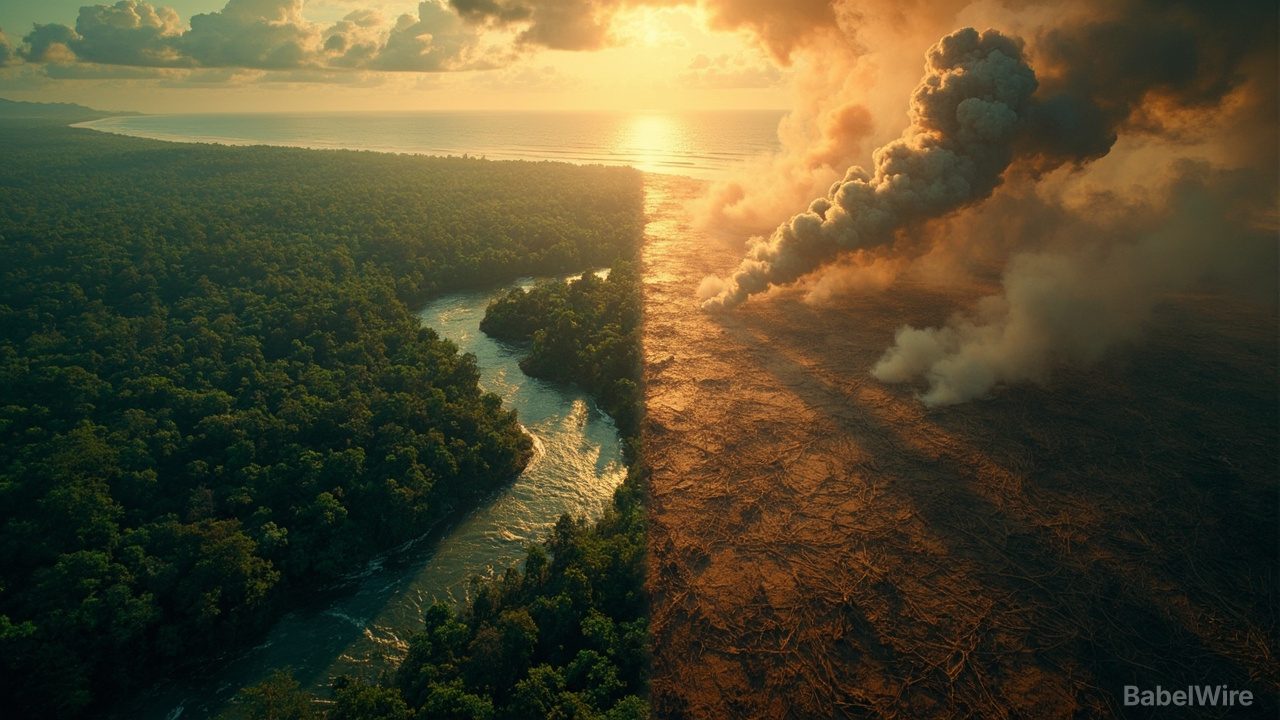
The El Niño brewing in the Pacific could become one of the strongest in 150 years — and it is arriving just as the Amazon rainforest is at its most vulnerable, according to scientists interviewed for a Nature news feature published August 11, 2026.
NOAA puts four-in-five odds on the event becoming "very strong" by the end of the year, and some forecasters say it is on track to be the strongest in at least 150 years. For the Amazon, the timing could hardly be worse: large areas of the forest may still be recovering from the severe droughts of 2023–24, which shrank major rivers to historic lows and fueled the worst fire season in more than two decades.
A team led by Hao Bai of Peking University analyzed 33 years of radar satellite data tracking forest moisture and living plant matter. During the 2023–24 droughts, both indicators fell to their lowest levels since satellite records began in 1992, and the team estimates that less than half of the affected forest will return to pre-drought conditions within seven years — the slowest recovery from a major Amazon drought in the satellite record.
Modeling led by Nico Wunderling of Goethe University Frankfurt adds a stark warning: without deforestation, the Amazon would remain relatively stable under global warming of up to 3.7–4 °C above pre-industrial levels. But if deforestation clears 22–28% of the rainforest, warming of just 1.5–1.9 °C could trigger a collapse that would eventually turn up to 80% of the forest into degraded woodland and savanna-like ecosystems. The world is fast approaching 1.5 °C of warming, and the Amazon — depending on how it is measured — is about 17% deforested.
"We're not too far away," Wunderling says. Bernardo Flores of the Juruá Institute in Manaus warns the picture may be even grimmer, because the models don't fully account for wildfires — which El Niño intensifies and which leave burned forest flammable for decades. "The area of flammable forest just increases and increases, and it can become exponential," he says. "It could basically cross the tipping point. We may have already crossed it. We don't know."
Luciana Gatti of Brazil's INPE, who has measured the Amazon's carbon balance from small aircraft for more than two decades, notes that the southeastern Amazon has already flipped from a carbon sink to a carbon source — and that the 2023–24 wildfires produced the region's strongest emissions since 2010. If a super El Niño arrives before the forest has recovered, researchers fear the damage could cascade across the basin.