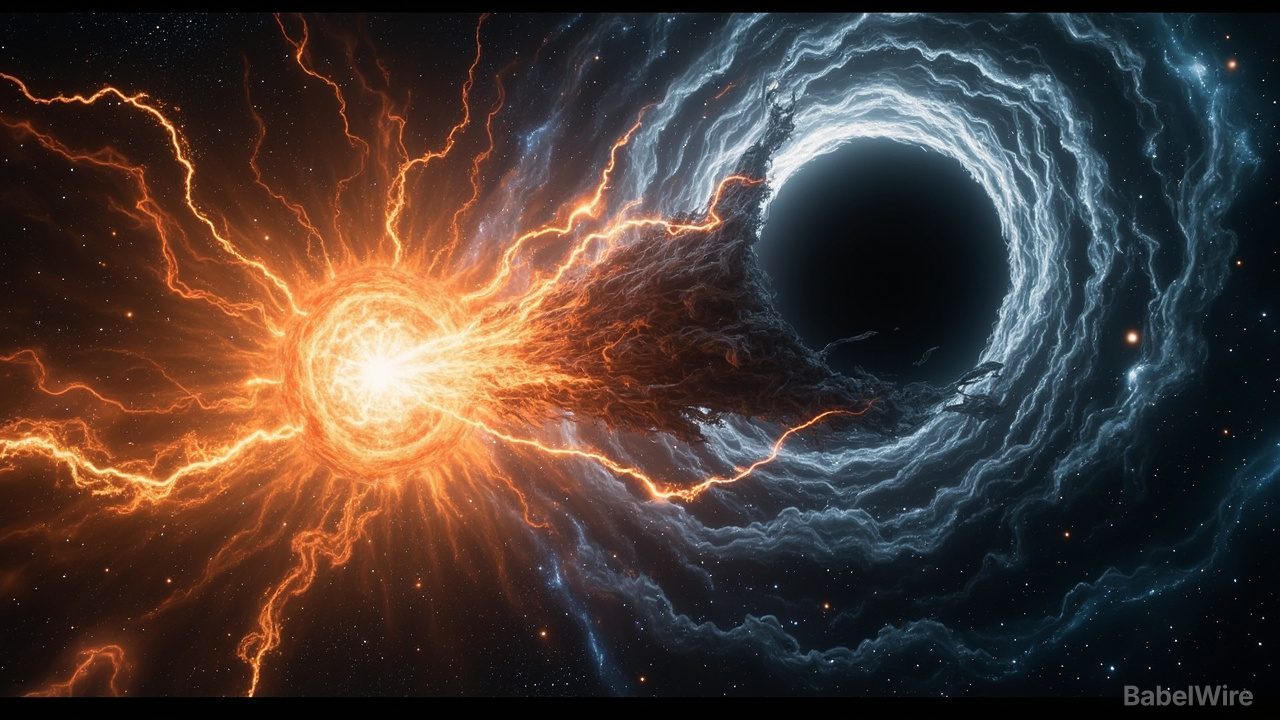
Most galaxies harbor a supermassive black hole at their center. When a star passes dangerously close, it is not always destroyed. Some stars survive partial tidal disruptions and return for additional close passes, generating a fresh burst of light each time.
Yet a puzzle persisted: of roughly 10 repeating systems identified so far, four showed flares that became progressively dimmer. Previous hydrodynamical simulations could not explain this.
The breakthrough came from adding a new ingredient: a star that was already rotating rapidly before its first encounter with the black hole. In the new simulations, such a star cannot be spun up nearly as much during later passages. Without a large increase in rotation after each encounter, progressively less stripped material translates into a fainter predicted flare, matching what astronomers observe.
The Hills mechanism offers a unified answer. A binary star system approaches a supermassive black hole. The gravity tears the binary apart, ejecting one star while capturing the other. Stars in a very close binary can become tidally locked, meaning each star rotates at the same rate the pair orbits.