A star like no other
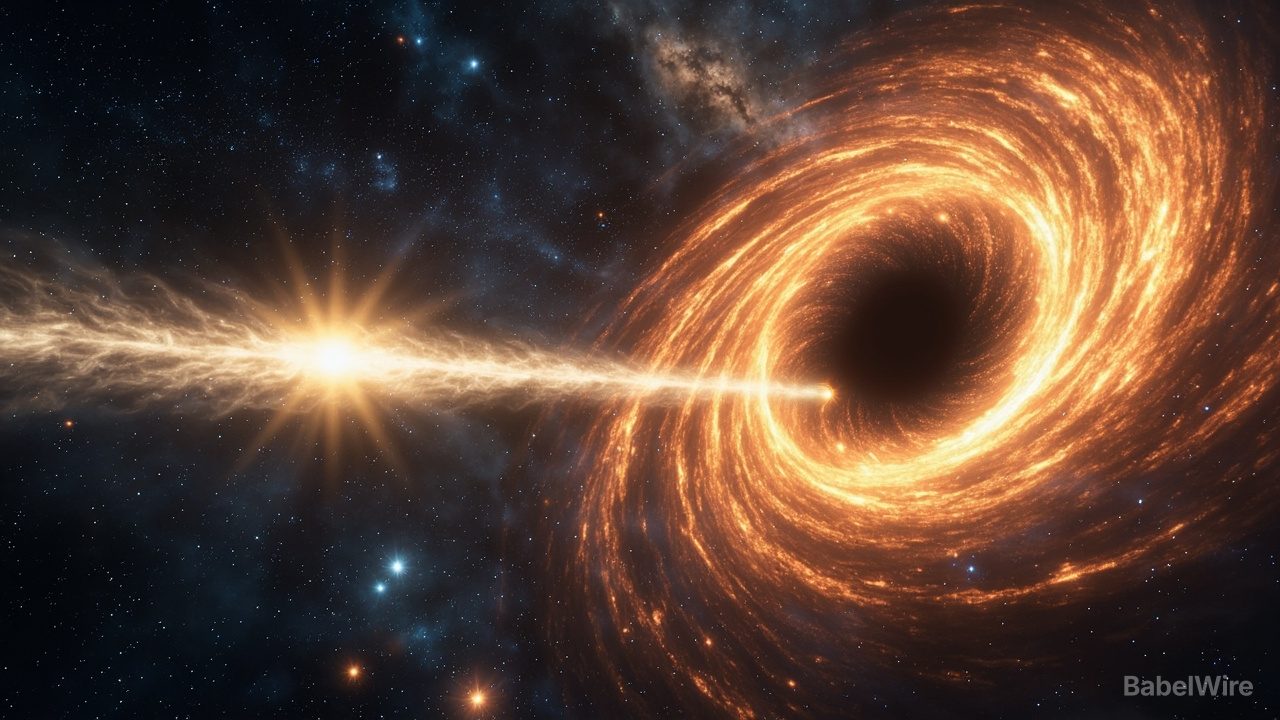
A recently identified star near the Milky Way's central black hole could test gravity under the most extreme conditions ever observed. Called S301, it is the 301st recognized member of the S-stars, a group that orbits Sagittarius A (Sag A), the supermassive black hole at the center of our galaxy.
Slightly more massive than the Sun, S301 completes one orbit every 8.7 years — the shortest period known for any S-star — and follows a highly elongated path. At its closest point, it passes within roughly 140 Sag A* radii and reaches more than 8% of the speed of light.
The most relativistic star observed
This makes S301 the most relativistic star we have observed, allowing us to test some of the limits of general relativity. The orbit of S301 precesses — similar to Mercury's perihelion precession, which was one of the classic tests of Einstein's theory. But while Mercury's precession is tiny (less than the span of a human heartbeat with each orbit), S301's perihelion advances about 2 degrees with each orbit.
This motion is so extreme that secondary relativistic effects come into play, including gravitational redshift and the transverse Doppler effect. "We've observed these effects in the lab, but S301 gives us a chance to study them in nature," the researchers noted.
Testing alternatives to general relativity
One of the big challenges with general relativity is that it doesn't play well with quantum theory. Several models try to unify the two, but they only differ from GR in extreme cases — some of which might be seen at relativistic speeds since the effects are at the order of (v/c)² or (v/c)³.
The effects of the black hole's spin and its interaction with the rotation of the star also come into play. Future large telescopes such as the Giant Magellan Telescope (GMT) will be able to observe the spectra of S301 with enough precision to measure second- and third-order effects.
Challenges of observation
For now, observing S301 remains a challenge. The center of our galaxy is veiled in cloud and dust, making optical observation impossible. Since S301 is a Sun-like star, it isn't particularly bright even in the infrared. We can observe its motion, but we can't yet gather significant spectral data.
"But as with all things relativity, it's only a matter of time," the researchers conclude.