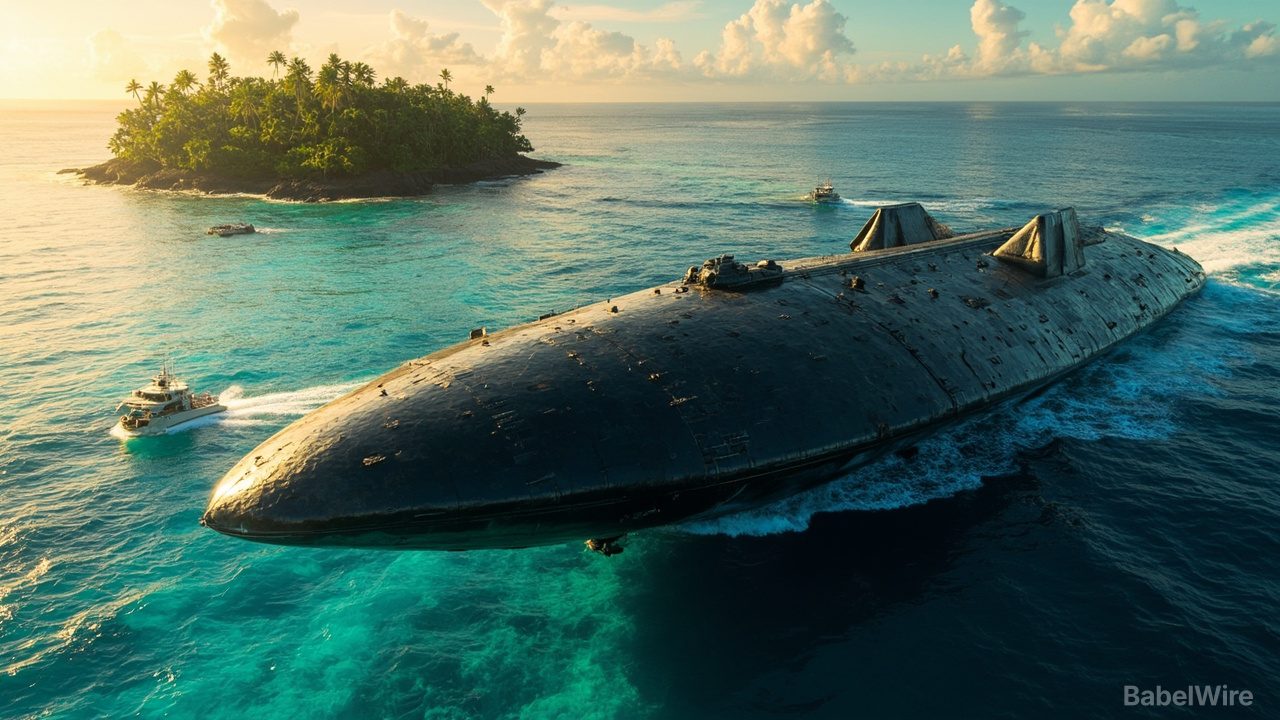
SpaceX has achieved an unexpected milestone in its Starship development program. After 24 days battling turbulent seas in the Indian Ocean, the company's recovery team has successfully towed Ship 40 — the upper stage from Starship's Flight 13 test launch — to calmer waters off the coast of Christmas Island, an Australian territory about 1,200 miles northwest of Broome.
Ship 40 performed the first successful intact ocean splashdown in Starship history on July 24, after lifting off from SpaceX's Starbase facility in South Texas. Unlike previous Starship upper stages that exploded upon hitting the water, Ship 40 survived the landing burn and remained floating in the Indian Ocean, giving SpaceX an unprecedented opportunity to study the spacecraft up close.
"After approx. 24 days at sea, the SpaceX Recovery team successfully guided Starship to a location just off the coast of Christmas Island," the company said in an August 18 update. "A team of SpaceX engineers is on their way to conduct additional analysis on the vehicle in calmer waters before attempting to return it to Starbase."
The recovery operation faced significant challenges. SpaceX described encountering "challenging conditions and increasingly rough seas" throughout the tow. At one point, Elon Musk acknowledged the situation was "not looking good" and that Ship 40 might be lost at sea. However, the team persisted and ultimately succeeded in reaching calmer waters.
The 171-foot-tall (52 meters) spacecraft now floats just offshore of Christmas Island, awaiting inspection by SpaceX engineers. The intact vehicle provides invaluable data for SpaceX's iterative design process, as engineers will study the spacecraft's aerodynamics, hydraulic systems, heat tile efficiency, and overall structural integrity after its journey through space and splashdown.
Ship 40 was part of Starship's Flight 13, the second launch for the Version 3 (V3) design of SpaceX's towering megarocket. Flight 13 followed the partially successful Flight 12 in May, which saw the Super Heavy booster crash into the Gulf of Mexico due to engine issues, while Ship 39 exploded after splashing down in the Indian Ocean.
The recovery has significant implications for NASA's Artemis program. SpaceX has contracted to build a version of Starship to land astronauts on the moon as part of the Artemis IV mission in 2028. The vehicle will also fly a compatible V3 Starship to practice rendezvous and docking maneuvers with the Orion spacecraft in Earth orbit during Artemis III next year.
SpaceX is already preparing Ship 41 and its Super Heavy booster for Flight 14, which the company plans to launch before the end of August. During that flight, SpaceX aims to not only deliver the upper stage to orbit but also return Ship to Starbase using the "Mechazilla" launch tower's chopstick arms — a major step toward full reusability.
Sources
- space.comStarship lives! SpaceX craft arrives at Christmas Island after 24-day ocean ordeal - Space.com
- abc.net.auSpaceX rocket splashes down off Christmas Island - ABC News
- floridatoday.comSpaceX Starship recovery spotted by photographer - Florida Today
- news.com.auElon Musk's SpaceX Starship towed to Christmas Island - News.com.au