In early 2026, Thailand's datacentre industry was on a roll. The country's Board of Investment had just approved projects from TikTok, UAE-based Skyline and Singapore's Bridge, a planned $27 billion in investment between them.
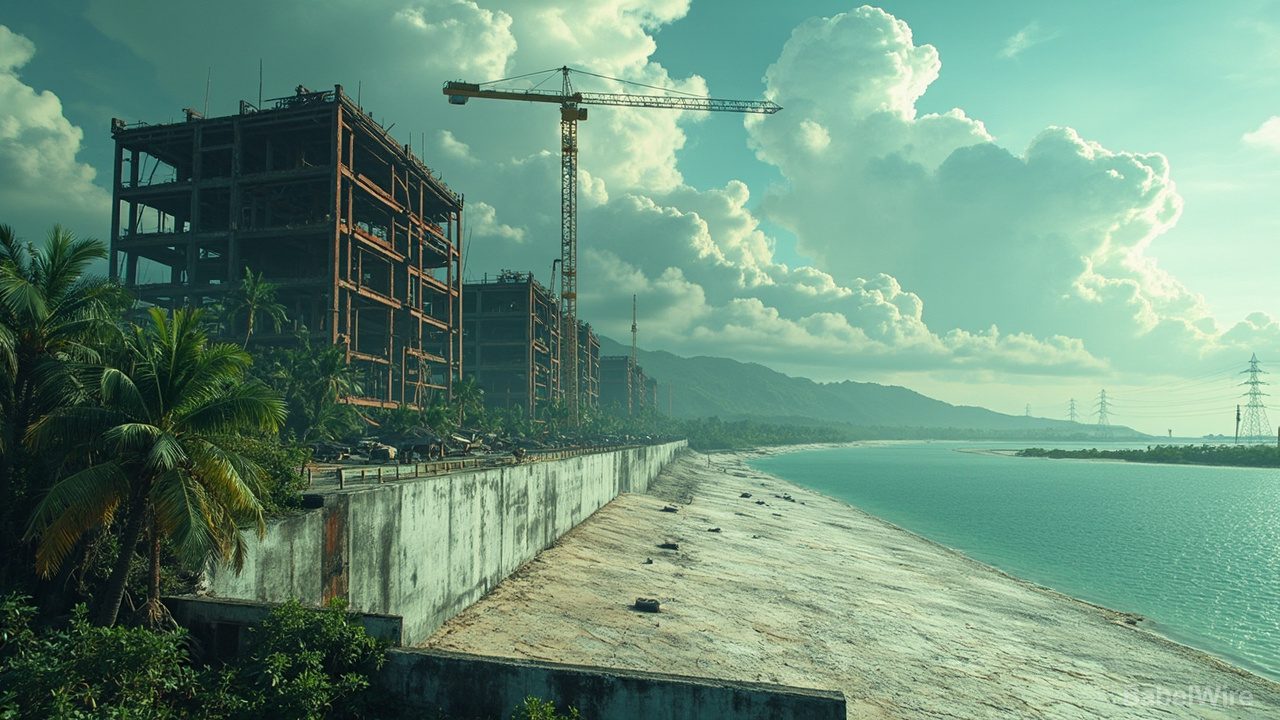
Nine months later, the industry has stopped. Thailand paused construction on 49 projects and froze approval decisions on 117 more in September, as the Guardian reported. The reason is not a shortage of capital but a shortage of certainty that power, water and oversight can keep pace with the commitments. In Indonesia, the governor of West Java halted construction on a datacentre over missing permits and an incomplete environmental assessment.
The region was the boom's surprise venue. China has the largest operational capacity in Asia-Pacific, but a 2026 report by real estate firm Cushman & Wakefield found that South-East Asia holds roughly half of all datacentre capacity under construction in the region. Malaysia and Thailand account for much of it.
Malaysia's rise shows how fast this moved. Operational capacity in the southern state of Johor grew from 94 megawatts in 2023 to 1,110 megawatts in 2026 — more than tenfold. Another 3,088 megawatts are under construction or planned. Johor is now South-East Asia's largest datacentre hub, with $40 billion of investment as of 2026, according to the state's chief minister, Onn Hafiz Ghazi. Microsoft announced $2.2 billion for cloud and AI infrastructure across Kuala Lumpur and Johor; AirTrunk plans $3 billion to double its Johor sites from two to four.
Singapore, the region's original hub, had imposed a moratorium from 2019 to 2022 on the grounds that datacentres were "intensive users of water and electricity", as its trade ministry put it. Approvals since then have been selective: just 95 megawatts of operational capacity was added between 2023 and 2026.
The bill is arriving. Energy consultancy Wood Mackenzie estimates datacentres in Johor already account for 24% of the state's total power consumption, rising to 40% by 2035. "The rapid growth of datacentre developments in Johor has the potential to create localized grid connection bottlenecks and increase the need for transmission network upgrades as well as new power supply capacity," said analyst Alvin Tan.
Water is the second wall. Johor is drought-prone, and the state has said it will no longer approve Tier 1 and Tier 2 datacentres — the category that consumed up to 50 million litres of water a day, equivalent to the daily drinking water needs of 25 million people. In Indonesia, a report by research firm Tenggara Strategics found many facilities are water-cooled and sited in hot, humid lowlands, raising consumption compared with cooler locations. In Thailand's Eastern Economic Corridor, residents worry about already depleted reservoirs. "The Khlong Luang Reservoir in Chonburi is a primary flashpoint," said Somnuck Jongmeewasin of the research and advocacy group EEC Watch. "Despite the reservoir being shallow and under strain, authorities are piping its water to industrial estates."
Thailand's energy minister, Akanat Promphan, has said datacentres require large amounts of expensive imported gas and called for a separate electricity user category with higher tariffs. The country has announced an approval framework weighing energy and water use, power guarantees and higher tariffs. Malaysia set up a datacentre taskforce to review new projects with an eye on energy and water security.
The pushback is no longer only regulatory. In February, Johor saw its first public protest against a datacentre build, outside a project by China's ZData Technologies, with demonstrators citing construction dust and risks to water supply.
Operators point to efficiency work. Bridge built a water reclamation plant and pipe network in Johor to cool its upcoming facility; AirTrunk agreed in April with sewage operator Johor Special Water to recycle unused wastewater. Microsoft says it is looking at South-East Asian clean energy projects, but its published Power Usage Effectiveness figures show its Asia-Pacific facilities are the least energy efficient in its global estate.
"While datacentres may create substantial investment and construction activity, they generally generate fewer long-term jobs than many other industries requiring comparable amounts of land, electricity and water," said Jie-Sheng Tan-Soo, an assistant professor at Singapore's Lee Kuan Yew School of Public Policy. "Communities may therefore reasonably ask whether they are receiving a proportionate share of the benefits while bearing the environmental and infrastructure costs."
For the region, the pause is an unwelcome correction. Announced investment is not built capacity, and built capacity is not powered capacity. Buyers of compute in South-East Asia are increasingly buying projects whose grid connections, water rights and permits are still unresolved.
Why it matters: South-East Asia was the proof that the AI buildout continues wherever the West pushes back. Governments now braking means the geography of compute shifts again — and shows the binding constraint is no longer the chip but the power plant and the reservoir beside it.



