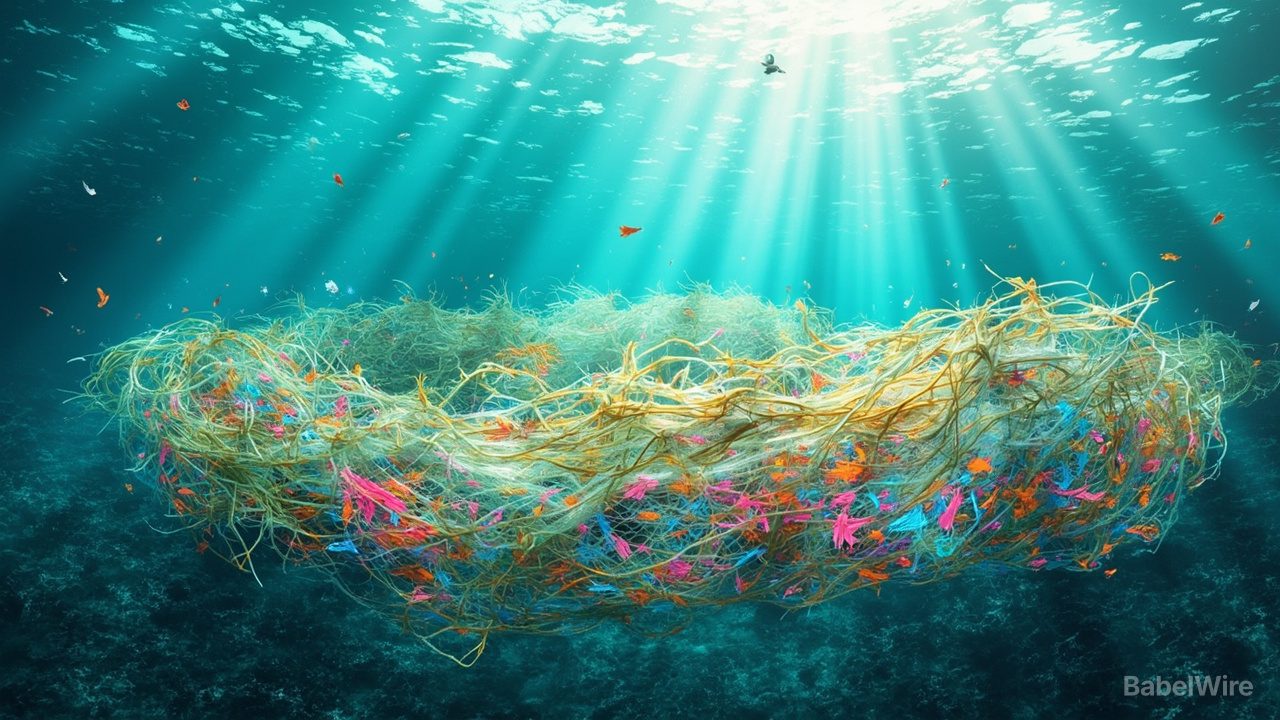
Nature already cleans up microplastics — seagrasses and drifting seaweed tangle them up. A team at North Carolina State University has turned that trick into an engineered material: a 'fluffy mesh' of natural biopolymers that captures plastic particles of every size, from visible fragments down to tens of nanometres.
The mesh mimics two natural collectors: sargassum rafts, the floating brown-algae mats that snag plastic debris, and 'Neptune balls' — fibrous clumps formed from shredded seagrass leaves, which Spanish scientists showed can trap hundreds of plastic fragments each.
Led by researcher Hong Hye-rin and professor Orlin Velev, the team built the mesh from alginate (derived from brown algae) and chitosan (from shellfish chitin), recycling seafood-processing waste. A branched, resinous colloid is freeze-thawed into a dense, firm net whose exposed micro-branches are coated with positively charged chitosan, creating a gecko-like adhesive surface that bonds to passing particles.
In tests with seawater collected from a real beach, the mesh captured particles from 1 millimetre and larger down to tens of nanometres — the tiny sizes most hazardous to health, small enough to cross the blood-brain barrier. The work, published as the cover paper of Science Advances, follows Hong's earlier 'robot vacuum' concept that dives, captures particles and resurfaces. 'If last year we proposed the concept of a robot vacuum that captures microplastics, this time we increased commercialization potential further by using a net that mimics natural structures,' Hong said. An estimated 8 million tonnes of plastic waste enter the ocean each year.
Remaining hurdles before real-world cleanup: proving the net survives long-term use in rivers and oceans, testing performance once biofilms grow on particles, and scaling up production.