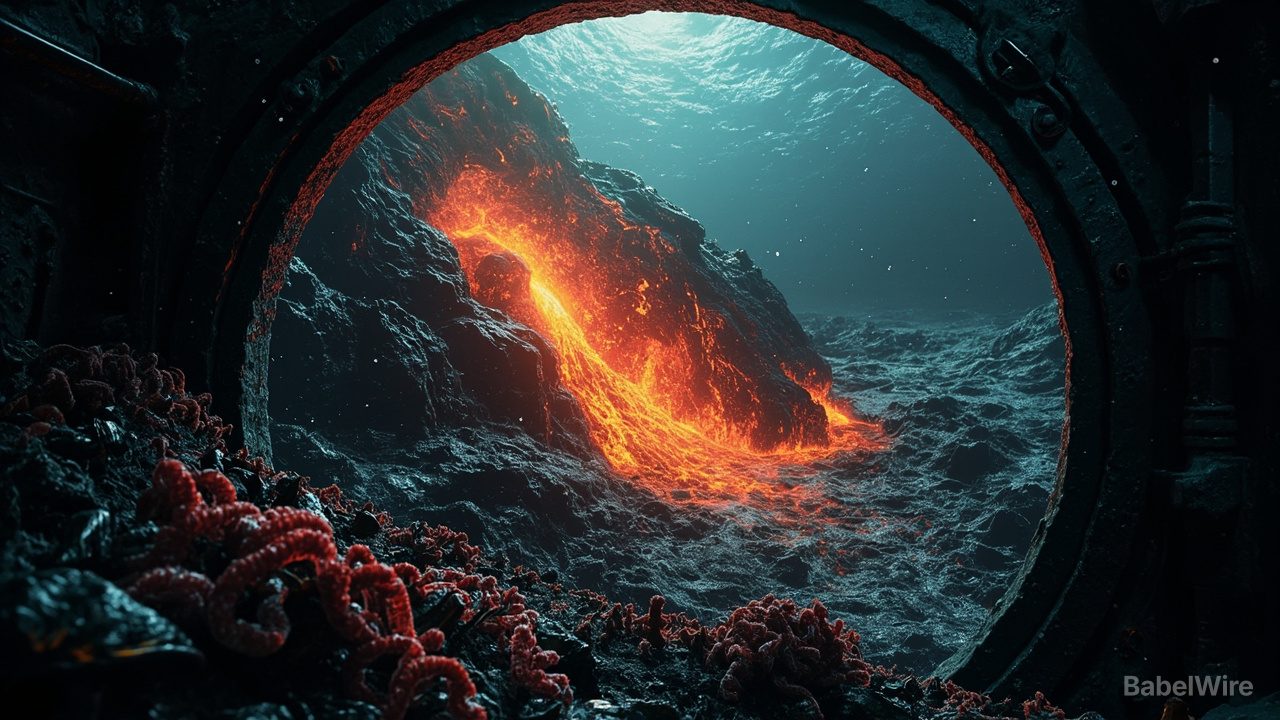
In April 2025, the legendary deep-sea submersible Alvin was on a routine dive 2,500 meters down at the East Pacific Rise, about 2,000 kilometers west of Costa Rica, when the ocean floor started to tear open in front of the scientists inside. It was the first time anyone had directly witnessed a mid-ocean ridge eruption — and new analyses presented at the Goldschmidt geochemistry conference last month reveal just how dramatic the event was.
The team, led by geochemist Andrew Wozniak of the University of Delaware, found that a hydrothermal field teeming with tubeworms and mussels had been paved over with lava. In just 10 hours, the eruption pumped out an amount of iron equal to 8% of what all hydrothermal systems deliver to the oceans in an entire year, according to Rensselaer Polytechnic Institute geochemist Sasha Wagner. Seafloor temperatures, normally near freezing, briefly reached 10°C.
A separate instrument campaign on the Southeast Indian Ridge, published last month in Nature, caught seafloor spreading in action over two weeks: plates moved at least 2 meters apart, the seafloor dropped 4 meters as a magma chamber emptied, and 160 million square meters of new lava poured out. The findings suggest the seafloor spreads in abrupt bursts rather than a steady creep — and that earthquakes are a poor gauge of the process.
The observations carry profound implications for ocean chemistry: if eruptions like these are more common and more iron-rich than believed, researchers say they have underestimated how much carbon and nutrients subsea volcanism pumps into the oceans — and how quickly life recovers. Bacterial mats were already growing on the quenched lava just 1.5 days after the eruption.
Sources
- whoi.eduWHOI: Scientists in Alvin witness seafloor eruption on the East Pacific Rise
- smithsonianmag.comSmithsonian Magazine: Scientists Stumbled Upon an Active Volcanic Eruption at a Mid-Ocean Ridge for the First Time Ever
- doi.orgScience (Aug 4, 2026): With lucky dive, scientists get a front-row view of the creation of Earth's surface