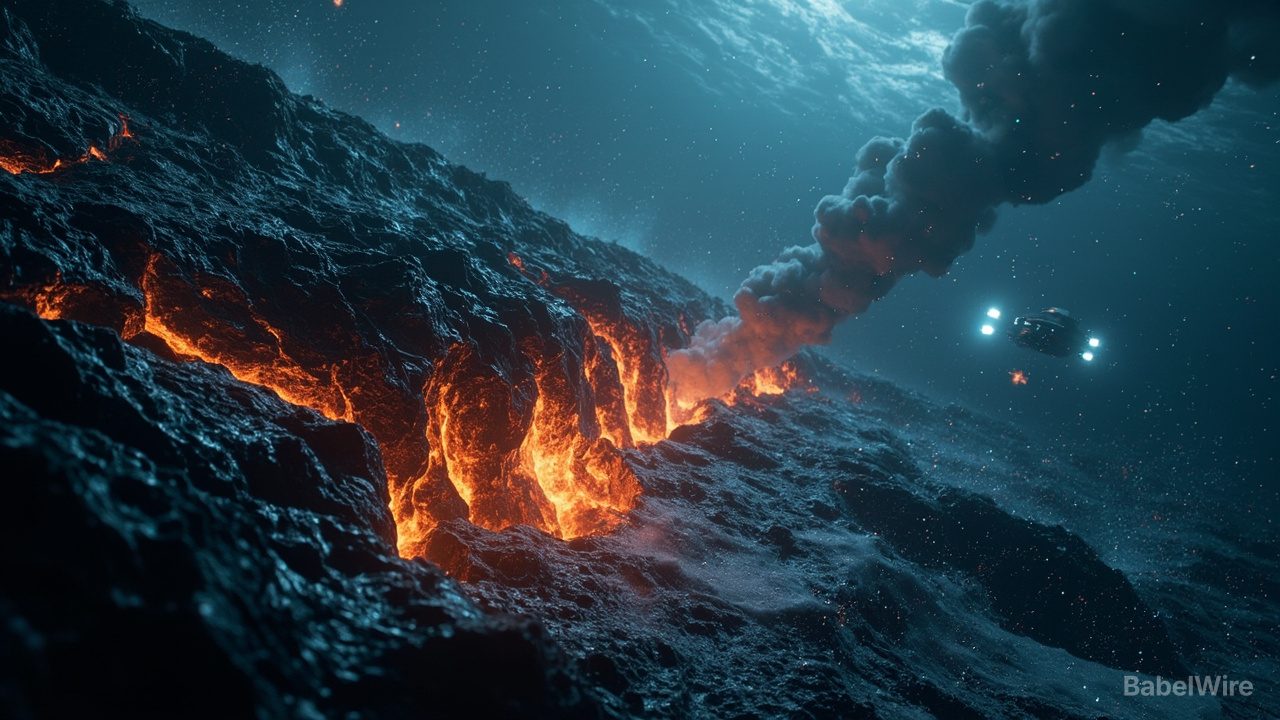
In April 2025, the legendary submersible Alvin was on a routine dive 2,500 meters down at the East Pacific Rise, a midocean ridge 2,000 kilometers west of Costa Rica — when the crew saw something no one had ever witnessed: an eruption of the seafloor itself. Tubeworms appeared paved over in ash, the water ran unusually warm, and bright yellow flashes of lava lit the distance. It was the first time scientists had directly witnessed an eruption at a midocean ridge, and only the second glimpse of seafloor spreading in action.
The team scrambled to follow up with jury-rigged instruments — cameras lashed to sediment corers, galley Crisco used as drill lubricant. Initial analyses, presented at the Goldschmidt geochemistry conference, show the eruption pumped a staggering amount of material into the ocean: over 10 hours it released iron equal to about 8% of what hydrothermal systems deliver in a whole year, while seafloor temperatures spiked from near-freezing to 10°C. Bacterial mats appeared on the quenched lava within 1.5 days — among the first visual evidence of how life recolonizes these sites.
A year earlier, a French team's hydrophones and pressure sensors on the Southeast Indian Ridge had caught spreading in action with equally dramatic results, published last month in Nature: plates spread at least 2 meters apart over a couple of weeks, the seafloor dropped 4 meters as an eruption emptied an underground magma chamber, and some 160 million square meters of new lava poured out. Together, the observations suggest the ocean floor does not creep apart steadily — it lurches — and that scientists have underestimated how much subsea volcanism shapes the chemistry of the world's oceans.