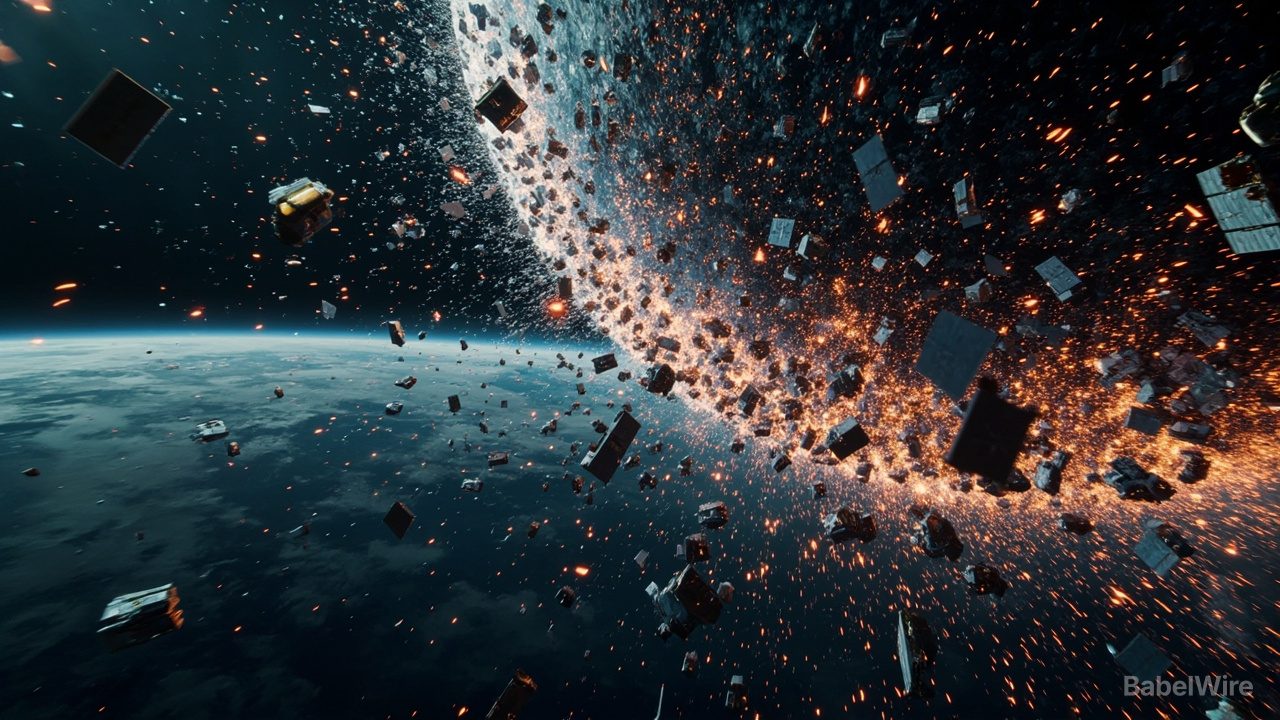
Planned satellite megaconstellations could trigger runaway space debris, according to a new analysis posted on the preprint server arXiv and reported by Science. The study finds that swarms of internet and telecoms satellites would push through the threshold known as Kessler syndrome — a self-sustaining cascade of collisions generating debris faster than it falls out of orbit — making the constellations themselves unsustainable.
Space debris scientist Hugh Lewis of the University of Birmingham, a past collaborator of the late NASA physicist Donald Kessler who proposed the syndrome in 1978, compiled data from the Federal Communications Commission, the European Space Agency and satellite tracker Jonathan McDowell on 16 planned or deployed constellations. He modeled how often each constellation's satellites — nearly 1.7 million in total — would pass through a point in the atmosphere, how fast their orbits would decay, and how well they could maneuver or de-orbit safely.
Six of the 16 proposals crossed into runaway debris generation, including China's Guowang, Cowboy Space Corp.'s Stampede, and Blue Origin's Project Sunrise. The most notable would be Starmind, SpaceX's plan for 1 million satellites serving as orbital data centers. Three more constellations reached an unstable state, where debris grows but not endlessly. Even less ambitious projects were not safe: one Eutelsat constellation became unstable with just 528 satellites, and E-Space's 10-kilogram nanosatellites would induce Kessler syndrome because they lack propulsion for collision avoidance.
"In the absence of having perfect information about what these satellite operators are planning, this is as good as it gets," said astronomer Samantha Lawler of the University of Regina, who was not involved in the work. "It just so nicely shows how detached from reality these proposals are." Lawler notes the true risk may be worse, since the study evaluated each constellation independently, ignoring the hundreds of thousands of other planned satellites already on the books.
Around 16,000 satellites currently orbit Earth, a number that could grow tenfold within a decade — and toward 1 million if SpaceX's ambitions prevail. Policy researcher Clayton Swope of the Center for Strategic and International Studies is skeptical of the simplified model, but University of British Columbia researcher Aaron Boley says the analysis highlights how few rules exist for operating in space, including who must maneuver in a collision course. With SpaceX satellites conducting one avoidance maneuver every 75 seconds on average, Boley says it is "really hard to see" how hundreds of thousands of satellites avoid serious catastrophes. Lewis's model also suggests small design tweaks — larger drag surfaces or longer satellite lifetimes — could pull proposals back from the brink.