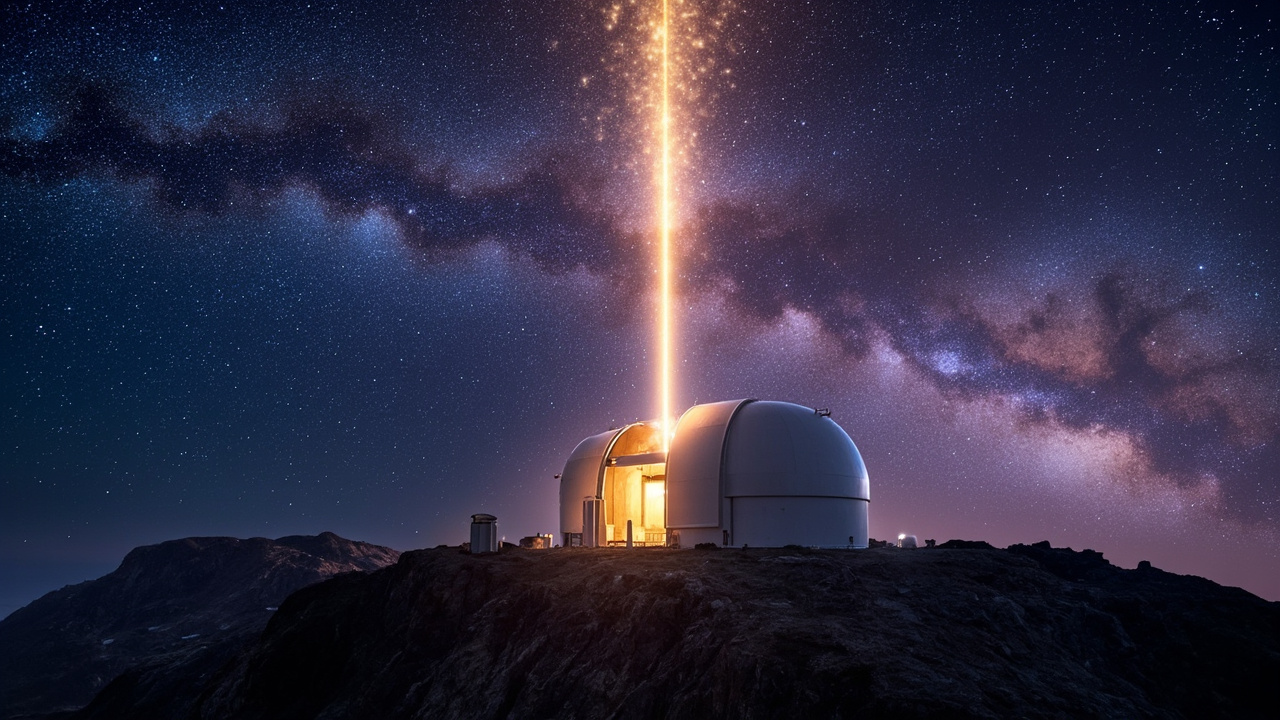
The Vera C. Rubin Observatory, perched atop Cerro Pachón in the Chilean Andes, has officially begun its Legacy Survey of Space and Time (LSST) — a decade-long mission that will capture the most comprehensive record of the universe ever created.
"Today, we begin filming the greatest cosmic movie ever made," said Brian Stone, performing the duties of NSF director, in a statement marking the start of operations on June 29, 2026.
The World's Largest Digital Camera
At the heart of the observatory is a 3,200-megapixel camera — the largest digital camera ever built for astronomy — coupled with an ultra-sensitive 28-foot (8.4-meter) primary mirror. Every 30 seconds, the camera captures a wide-field image covering an area roughly 45 times the size of the full Moon. With its unique three-mirror design, Rubin will observe the cosmos on an automated schedule, stitching together the images to create a complete view of the southern sky every three nights.
Unprecedented Scale
During its first year alone, Rubin is expected to observe more objects than all other optical observatories combined. The final dataset, accumulated over the full decade, will contain billions of objects with trillions of measurements — all accessible to scientists worldwide through regular data releases.
"With the launch of the 10-year Legacy Survey of Space and Time, NSF–DOE Rubin Observatory is opening a new window on the universe," said Darío Gil, under secretary for science at the U.S. Department of Energy. "It is embarking on a mission that will redefine modern cosmology and astrophysics."
Scientific Goals
The LSST will enable groundbreaking discoveries across multiple domains: - Dark Matter and Dark Energy: Mapping the distribution of dark matter and measuring the expansion history of the universe - Near-Earth Asteroids: Detecting and tracking potentially hazardous asteroids with unprecedented sensitivity - Supernovae and Transients: Capturing explosions and variable objects in real-time - Milky Way Structure: Creating the most detailed map of our own galaxy's structure
Already Delivering
Rubin has already demonstrated its capabilities. During testing, the telescope captured millions of galaxies and stars along with 2,104 previously unknown asteroids in just 10 hours of observations. Earlier this year, its Alert Production Pipeline sent 800,000 alerts to astronomers worldwide in its first wave — a system designed to eventually deliver up to 7 million alerts per night, notifying scientists of real-time changes in the sky.
The observatory's first public composite image, "The Cosmic Treasure Chest," compiled from 1,185 individual exposures, revealed a field of view brimming with celestial detail rather than the usual dark voids between objects — a testament to Rubin's extraordinary sensitivity.
Nearly two decades in the making, the Rubin Observatory's LSST marks a new era of astronomy, where the universe will be recorded in moving, data-rich detail for the first time.