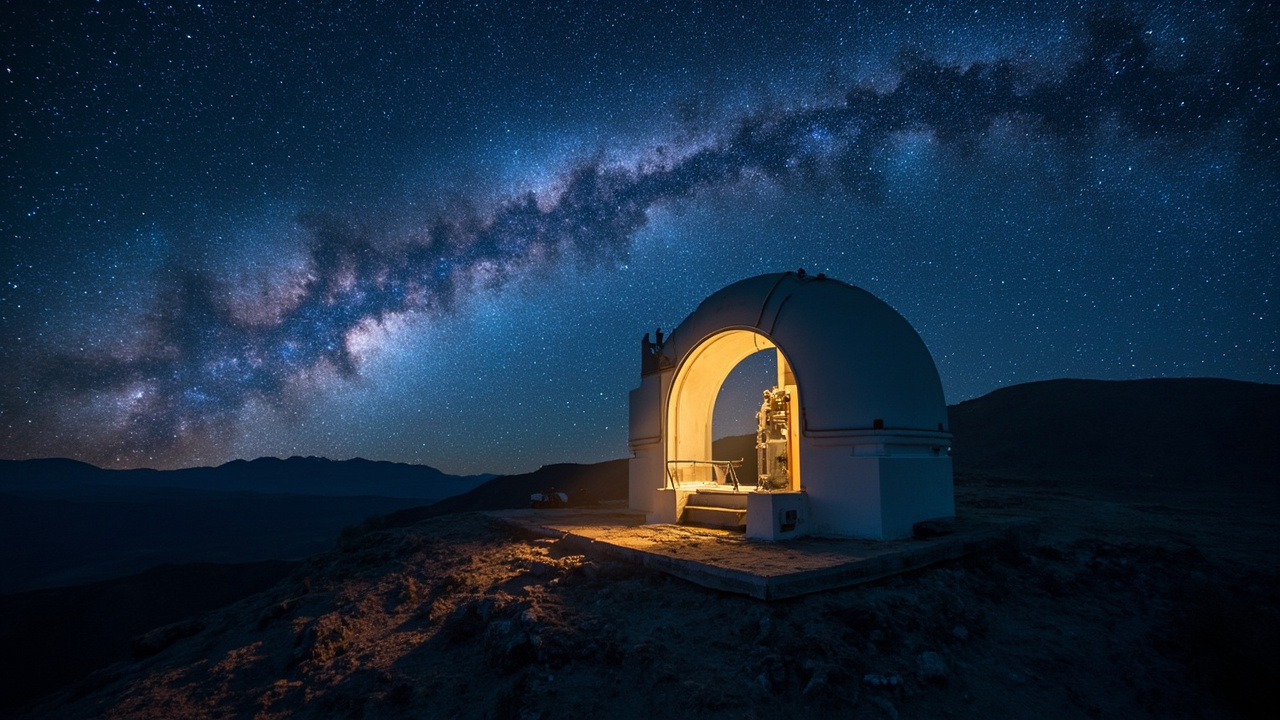
The universe is ready for its close-up. From a mountaintop in northern Chile, the Vera C. Rubin Observatory has officially begun its 10-year mission to create what scientists are calling "the greatest cosmic movie ever made."
The project — known as the Legacy Survey of Space and Time (LSST) — uses the largest digital camera ever built, a 3,200-megapixel giant, to repeatedly scan the entire southern sky every few nights. Over the next decade, every point in the sky will be imaged approximately 800 times, producing an ultra-wide, ultra-high-definition time-lapse record of the cosmos.
"Today, we begin filming the greatest cosmic movie ever made," said Brian Stone, director of the U.S. National Science Foundation. "Every night, Rubin Observatory will expand the frontiers of knowledge and strengthen America's global leadership in science and innovation."
The main scientific targets include the dual mysteries of dark energy — the force accelerating the universe's expansion — and dark matter, the invisible substance holding galaxies together. But the survey will also revolutionize our understanding of the solar system.
In its first few months of operation, Rubin has already discovered 11,000 never-before-seen asteroids, including 33 near-Earth objects and 380 icy trans-Neptunian objects. It is expected to discover millions more over its lifetime.
"It's taken 20 years of hard science, engineering, and more to get to the point where we can call 'action'," said Phil Marshall, Deputy Director of Rubin Operations at SLAC. "Millions of alerts in just the last couple of months show that Rubin is up and running as a discovery machine."
The final dataset is expected to contain billions of objects, with results made freely available to all scientists and the public — truly opening a new era in astronomy.