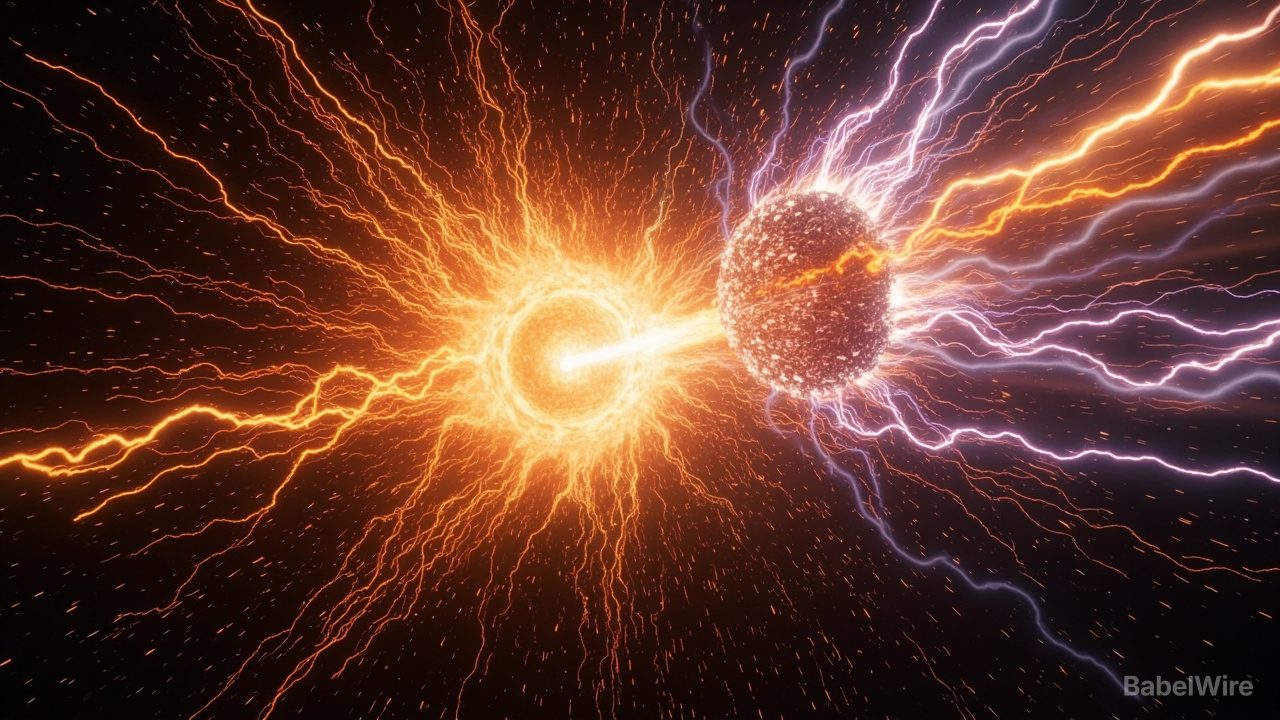
When two atomic nuclei collide at nearly the speed of light, they melt into a quark-gluon plasma — a nearly perfect fluid, hotter than anything else in nature, in which quarks and gluons roam free. Physicists have studied the plasma's enormous vorticity and electromagnetic fields for years, but one of its most basic properties has remained largely unexplored: acceleration, the very force behind its explosive expansion.
A team led by Yu-Gang Ma and Xu-Guang Huang at Fudan University has now produced the first systematic map of that acceleration. Combining two well-established transport models with a smoothing technique that converts discrete particle distributions into continuous velocity fields, they tracked how acceleration builds up across collision energies from 3.5 GeV to 2.76 TeV. The results, published in Nuclear Science and Techniques, reveal peak proper accelerations of several hundred MeV — among the strongest ever produced on Earth.
The simulations show that transverse acceleration always points outward and is strongest at the fireball's edge, where pressure drops steeply and enthalpy density is low. At low collision energies, nuclear stopping produces early deceleration of up to about 500 MeV, while at ultra-relativistic energies the fast-passing nuclei drag the newborn plasma into sharp acceleration pulses. Because the most extreme acceleration always localizes at the boundary, the overall pattern depends only weakly on how head-on the collision is.
The finding may carry deep significance. Through the Unruh effect — by which an accelerated observer perceives the vacuum as a warm bath — a few-hundred-MeV acceleration could mimic temperatures comparable to the quark-hadron transition temperature. That suggests acceleration may reshape the phase structure of strongly interacting matter along a new "acceleration axis," influencing the chiral and deconfinement transitions, driving novel transport phenomena, and polarizing particle spins in ways that could help explain long-standing spin puzzles at RHIC and the LHC.
"Just as temperature and density define the phase diagram of matter, acceleration may open a new axis of that diagram," said Professor Huang. The team now plans to incorporate realistic hydrodynamic evolution and identify experimental observables — such as hyperon spin-polarization patterns — that could put the hidden engine of the hottest fluid to the test.