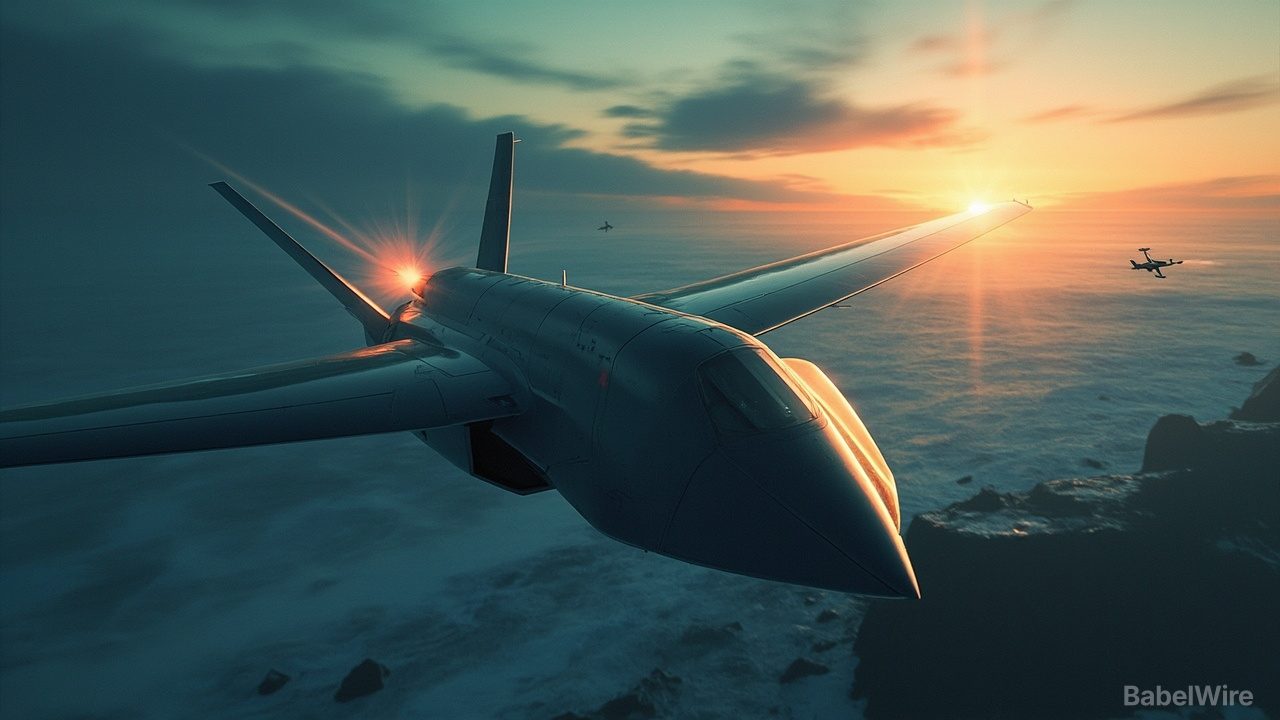
Quantum Systems has given its interceptor drone a headline figure of 777 km/h, roughly 0.63 times the speed of sound and an order of magnitude faster than the propeller-driven quadcopters that dominate the small-drone market. The German manufacturer, based outside Munich, has spent a decade building the Vector family of fixed-wing reconnaissance drones; the interceptor is its bid to sell the other half of the air-defence problem.
Speed is the whole argument. Interception is a geometry problem: an interceptor must arrive at the target's future position with enough energy left to manoeuvre. Against a one-way attack drone cruising at 150–180 km/h, a 777 km/h airframe can be launched later, from further away, and still close the gap from behind or above — directions a ground-based gun cannot reach. That matters most against jet-powered loitering munitions and the Shahed-derived designs now produced at scale in Russia and Iran, whose cruise speeds and altitudes sit awkwardly between "too fast for a quadcopter" and "too cheap for a missile."
The economics are the second half of the argument, and the harder one. A Patriot PAC-3 costs several million dollars per round; an IRIS-T roughly 400,000 euros. Even a cheap purpose-built interceptor in the low tens of thousands undercuts the target it kills only if the target costs more. Shahed-136 clones are estimated at $20,000–$50,000 apiece. That leaves a narrow band in which interception is affordable at all — which is why the industry has converged on gun-launched and rocket-launched cheap interceptors, and why "cost per kill" has replaced "hit probability" as the metric procurement officers ask about.
What the 777 km/h figure does not settle is everything that decides whether the system works. Whether it is a dash speed or a sustained cruise; how long the airframe can hold it; what seeker finds a target the size of a motorcycle at that closure rate; and whether the guidance loop can be flown by an operator on a screen or has to be autonomous. At 777 km/h, a target two kilometres away is eleven seconds out. Human-in-the-loop in that window is a design constraint, not a preference.
Europe's demand signal is not in doubt. The European Sky Shield Initiative, the EU's drone-wall proposals and national counter-UAS programmes have created a market that did not exist in 2021, and Quantum Systems is one of a handful of European firms with flight-proven fixed-wing airframes and a production line. The open question is industrial rather than aerodynamic: whether Europe can build interceptors in the tens of thousands, at a price per unit that makes shooting down a $30,000 drone a decision nobody has to agonise over.
What this story does not yet answer, and what to watch next: whether 777 km/h is a dash or a cruise figure, what the unit cost is at rate production, and whether the first customers are national armed forces or the layered air-defence programmes that buy in bulk. Those three numbers will decide whether this is a product or a press release.