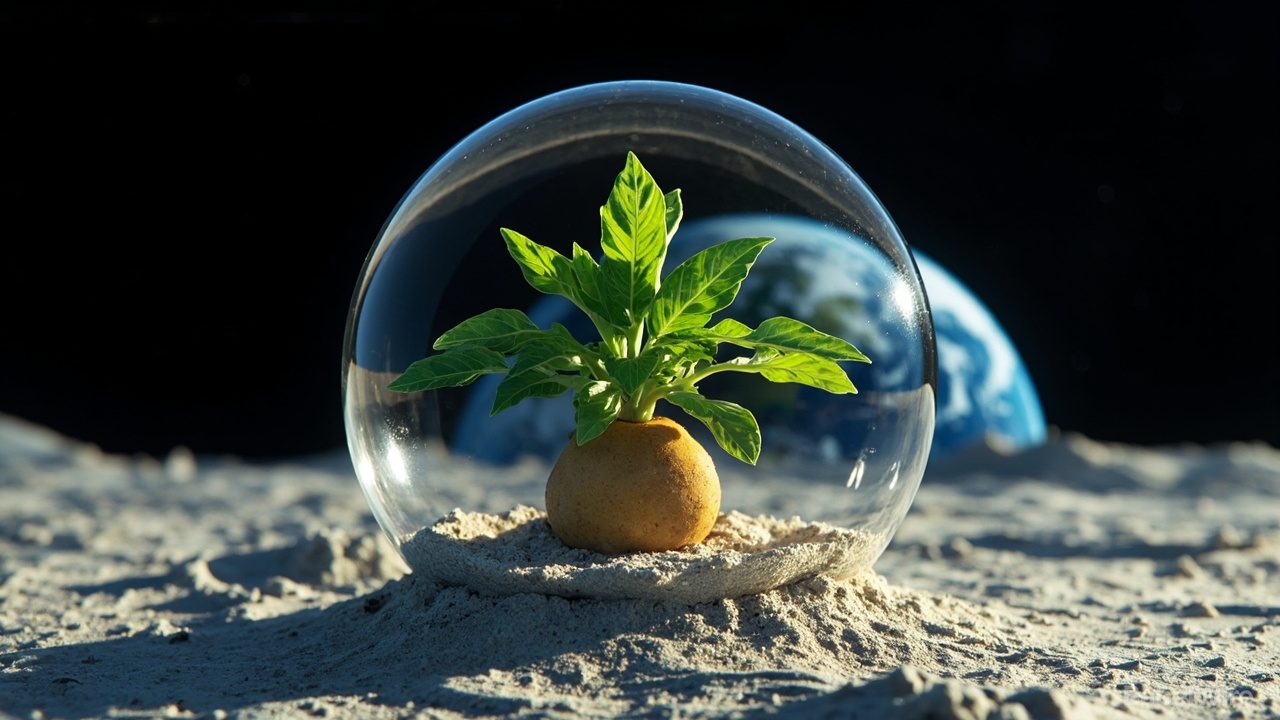
Researchers have grown potatoes in lunar regolith, the sharp, nutrient-poor dust that covers the Moon, according to Golem. Read plainly, it is a gardening story. Read in context, it is a step in a longer campaign to work out whether people who live off Earth will be able to grow some of their own food.
Lunar regolith is a hostile medium, and not only because it contains no organic matter. It is a fine, abrasive powder of glassy shards, formed by billions of years of micrometeorite impacts and radiation, and it holds almost no water. Its iron tends to sit in reduced, reactive forms, and it carries traces of metals such as chromium and nickel — pleasant for a machine, less so for a root.
That is why the earlier milestones were so hard-won. In 2022 a University of Florida team grew Arabidopsis plants in tiny samples of real Apollo lunar soil and found they germinated and grew, but were visibly stressed and smaller than counterparts in terrestrial volcanic soil; added nutrients and careful handling of the soil's reactive chemistry changed the outcome. Experiments since, including work with plant microbial fuel cells and mycorrhizal fungi, have explored how to make regolith more hospitable: inoculating it, buffering its chemistry, watering it carefully.
Potatoes are a sensible target. They are calorie-dense, familiar, and forgiving in the field. But 'grew in regolith' is not the same as 'a farm that feeds a base'. Open questions include how heavily the plants depend on added nutrients, how the regolith behaves when repeatedly wetted and reheated, and the health effects of a soil that carries reactive iron dust, which astronauts already have to treat as a contaminant.
The near-term payoff is likely terrestrial. Every technique that makes a dead, abrasive substrate grow something is also a technique for marginal, salty or degraded farmland on Earth. And every result that narrows the gap between 'a plant survived' and 'a person was fed' makes the Moon look a little less like a place you merely visit.