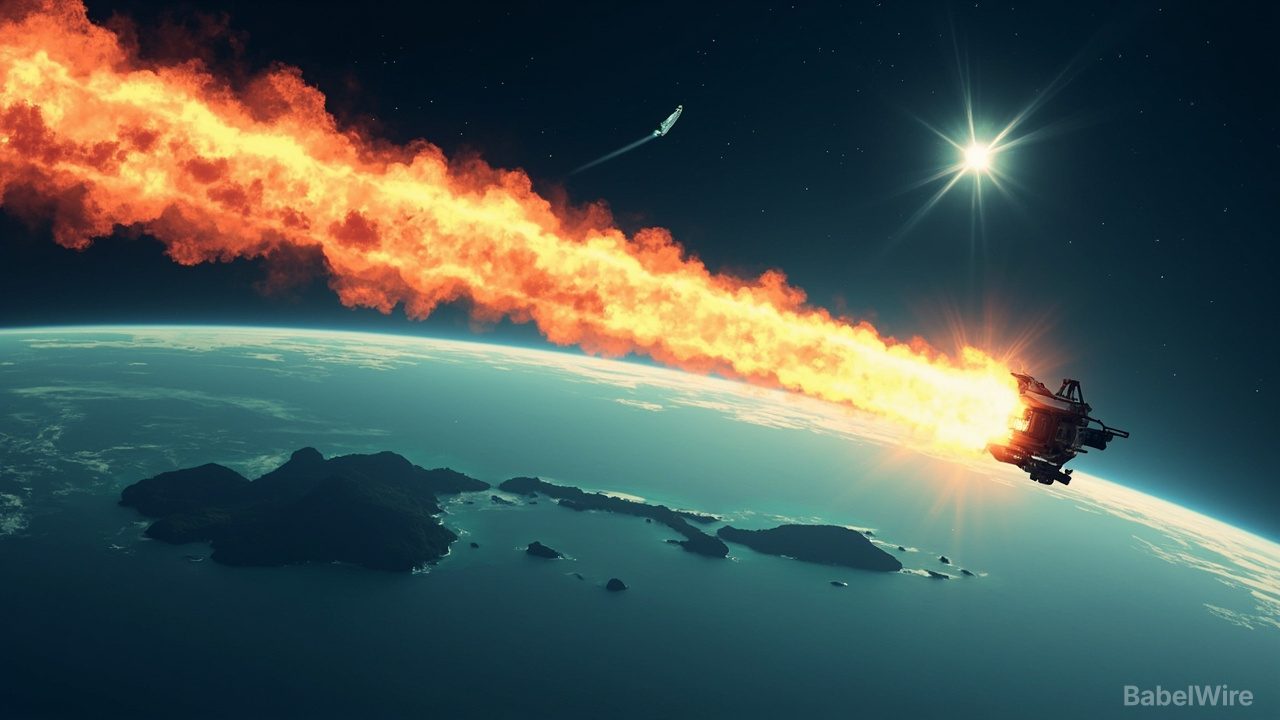
NASA's Neil Gehrels Swift Observatory ended its life on 4 November 2026, re-entering the atmosphere at 7:39 a.m. EST over the North Sumatra region of Indonesia — 22 years after launch, and 20 years past the two-year mission it was designed for.
Launched on 20 November 2004 as the Swift Gamma-Ray Burst Explorer, the satellite was built around speed: detect a burst, pin down its position, relay it to other observatories and swivel into images before the afterglow faded, usually within about a minute. In May 2005 it caught the afterglow of GRB 050509B, a burst lasting 0.03 seconds and only 11 x-ray photons — the first short burst with a detected afterglow, corroboration that such bursts come from merging neutron stars. NASA renamed the mission for principal investigator Neil Gehrels after his death in 2018.
Over its operational life Swift logged more than 2,000 gamma-ray bursts and more than 1,400 supernovae, watched stars being torn apart by black holes, and contributed to roughly 7,000 scientific papers. Its full dataset — about 22 years of brightness measurements and more than 1.5 million ultraviolet and visible-light images, roughly 12 terabytes — remains publicly available.
The ending was almost an extension. Swift had no thrusters, and heightened solar activity expanded the atmosphere and pulled its orbit down faster than predicted: from 585 km at launch to about 363 km by June 2026. NASA signed a $30 million contract with Katalyst Space Technologies in September 2025 to send LINK, a small satellite with three robotic arms, to capture Swift and raise it back to a working altitude. LINK launched on 3 July 2026, but an attitude-control malfunction killed the capture plan; on 19 August NASA and Katalyst redefined it as an in-orbit demonstration. LINK closed to within 12-15 km, fired its three ion thrusters and deployed its arms, then stood down.
The operations team used the remaining weeks to restart the ultraviolet, visible and X-ray telescopes stowed for the rescue and image Tycho's supernova remnant, 13,000 light-years away, on 26 August. Below 275 km the telescope could no longer hold a stable lock; the final observation came on 20 October. NASA is now weighing how to keep fast-response coverage of cosmic transients across its existing telescope fleet.