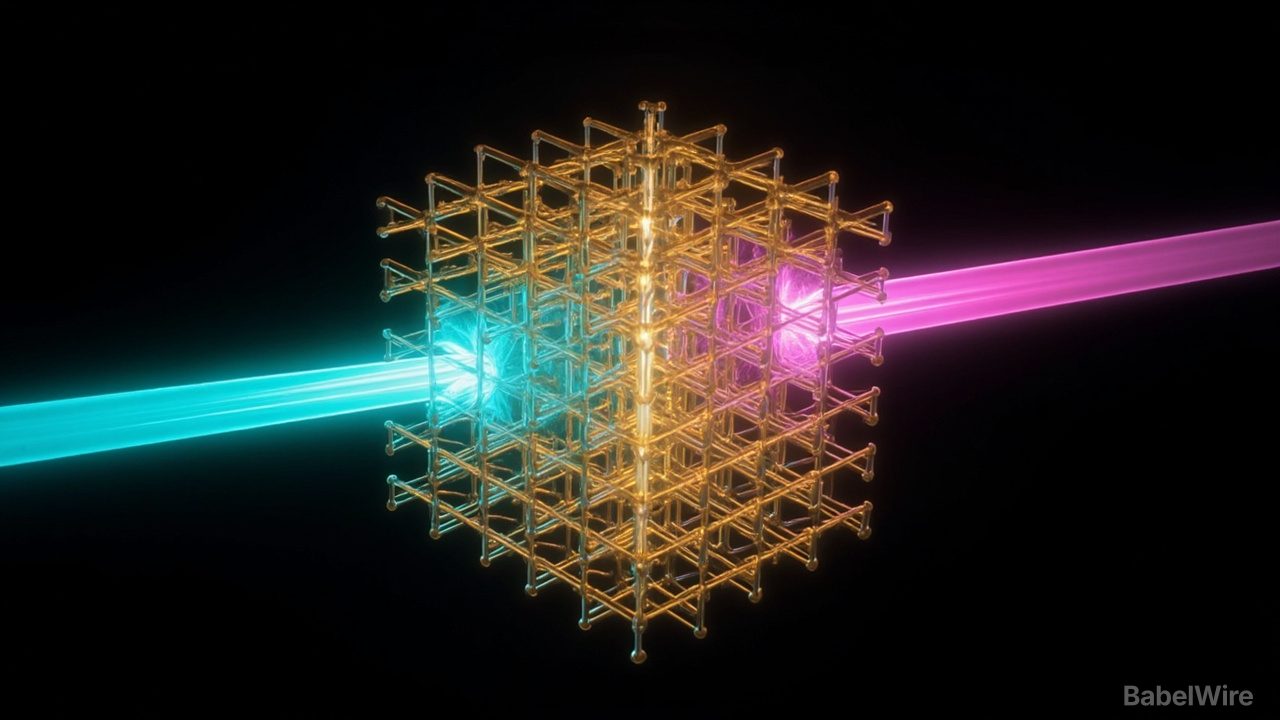
Physicists have achieved a long-sought goal in ultracold physics: a Bose-Einstein condensate (BEC) made from polar molecules, created by cooling sodium-rubidium molecules to condensation with microwave fields that suppress the collisional losses which have blocked the milestone for decades.
The result, published in Nature Physics, comes from a team led by Zhaopeng Shi and Dajun Wang, with theorists Su Yi and Tao Shi among the authors. The researchers used a dual microwave shielding technique to keep ground-state sodium-rubidium molecules stable enough for high-efficiency evaporative cooling.
"Producing a Bose-Einstein condensate of ultracold polar molecules has been a long-standing goal in the ultracold physics community," Tao Shi said.
Unlike the atomic BECs first created in the 1990s, polar molecules interact through strong, long-range dipolar forces that researchers can tune. The team explored different interaction regimes, realizing both the gas phase and the quantum droplet phase of the molecular condensate — a demonstration of tunable dipolar interactions in a condensate.
The work opens new avenues for investigating quantum matter with strong dipolar interactions and for quantum simulation of long-range many-body systems, with potential applications in probing phenomena such as exotic superfluidity. It also builds on recent advances in the field, following the first molecular BEC created from sodium-cesium molecules.