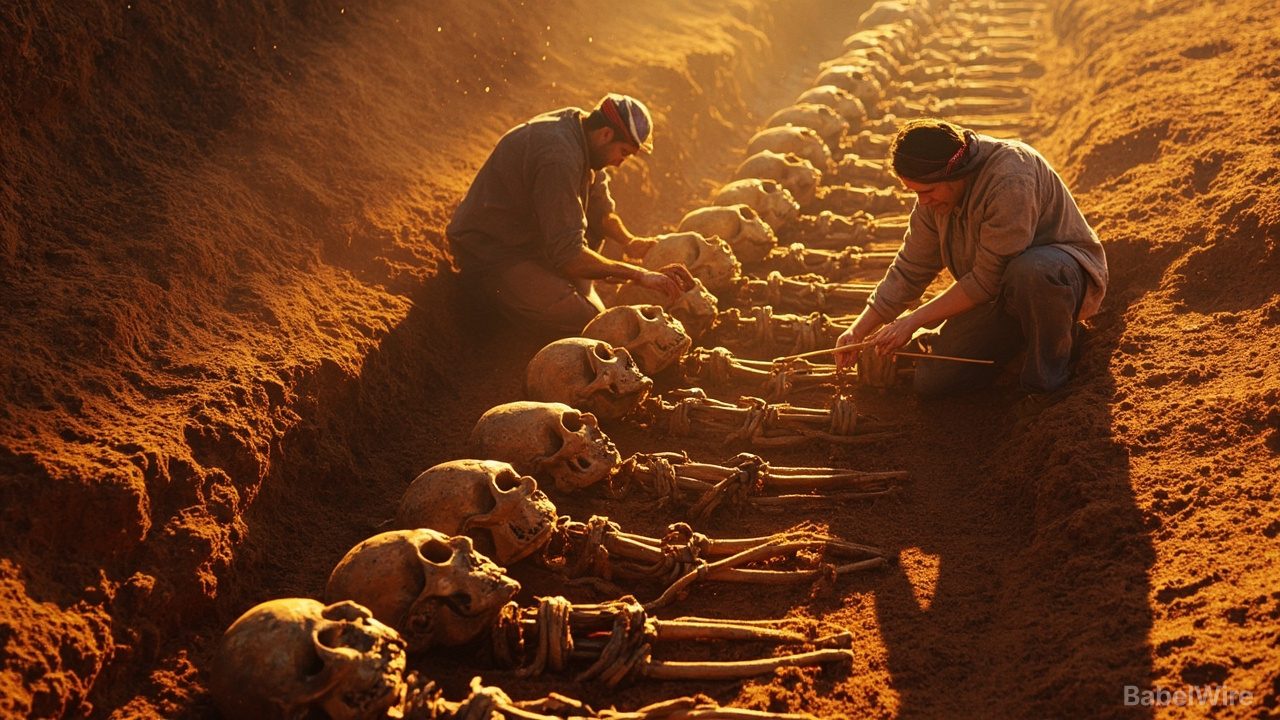
In 2016, archaeologists excavating the Phaleron necropolis near Athens uncovered a mass grave holding 79 adult men laid out in three rows, many still wearing iron shackles around their wrists. For a decade, scholars debated who they were — foreign invaders executed after a battle, or victims of internal political violence during the birth of Athenian democracy.
New research points firmly to the second explanation. A team led by Julianne R. Stamer of Arizona State University analyzed strontium isotopes in tooth enamel from 66 of the shackled men. Because enamel forms in childhood and records the chemical signature of local food and water, it reveals where a person grew up.
About 97% of the tested men showed strontium values consistent with a local origin in Attica, the region around Athens. Only two of the 66 appeared to have spent their childhoods elsewhere. A wider sample of 97 other adults buried at Phaleron showed a nearly identical pattern, with about 96% locally raised.
'If the shackled men had been foreign fighters, researchers would expect to see more varied childhood origins,' the team noted. Instead, their chemical records place them within the same local population as their neighbors in the cemetery.
The findings, published in the Journal of Archaeological Science: Reports, rule out one major explanation for the grave: the men were not outsiders brought to Attica for a political struggle. Their fate appears tied to conflict within the community itself, during a period when Athens was reworking how power and punishment worked — a violent chapter in the city's early history.
Sources
- phys.orgShackled men in 2600-year-old Greek mass graves were likely locals, archaeologists find — Phys.org
- archaeologymag.comShackled men in ancient Athens mass grave were locals, not foreign invaders — Archaeology News
- gizmodo.comArchaeologists Thought a Mass Grave of 79 Shackled Men Held Foreign Invaders. They Were Wrong — Gizmodo