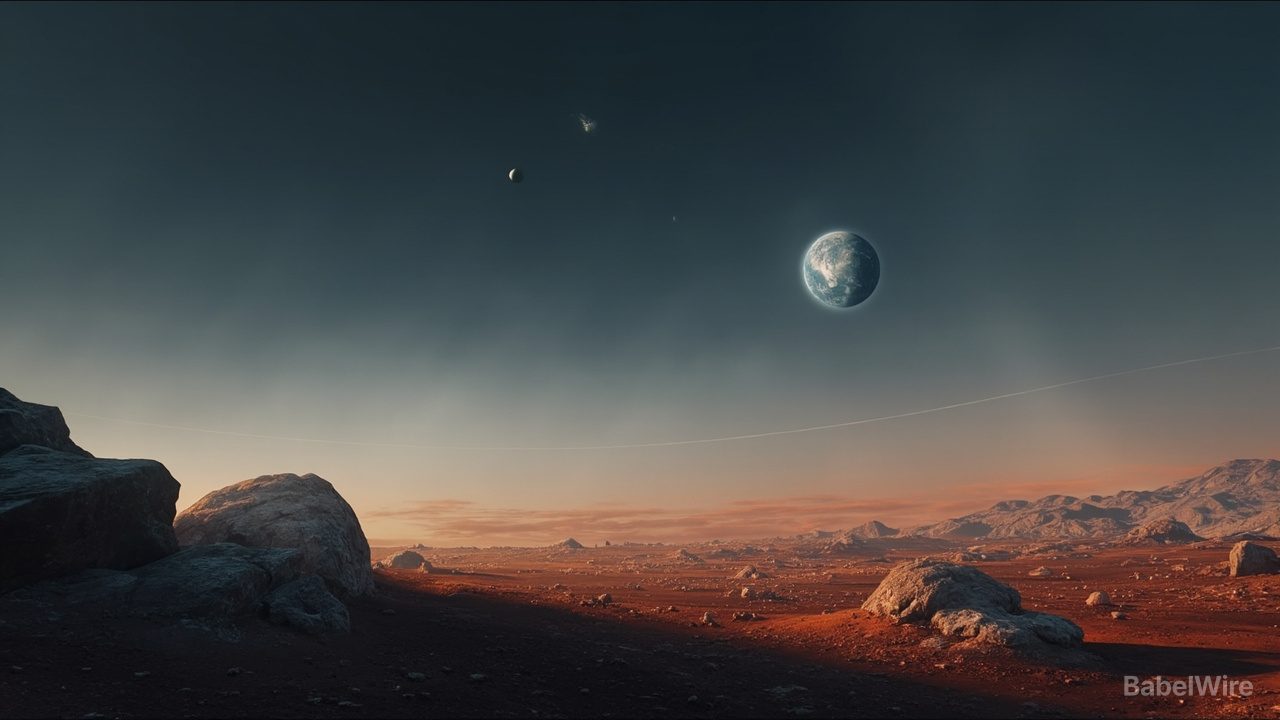
There is a view of Earth that almost no human has ever seen: a tiny bright dot sliding behind the potato-shaped moon of another planet. NASA's Perseverance rover captured exactly that on July 2, 2026 — the 1,907th Martian day, or sol, of its mission — when Earth passed behind Phobos, one of Mars's two moons.
The composite of images from the rover's Mastcam-Z instrument shows Earth, visible as a small bright dot moving from upper left to lower right, disappearing behind Phobos. The five images that captured the occultation span about 40 seconds, taken during the Martian evening twilight roughly 40 minutes after sunset. NASA notes that the gray-blue lower sky and reddish-gray upper sky in the annotated figure approximate the true colors of that evening.
The sequence, released as image PIA26758 with two annotated versions, required precise timing: Phobos crosses the Martian sky about three times a day, while Earth remains visible in the Martian sky for months — the two had to line up just right. The black background of the main composite is the result of image processing that removed extraneous light to enhance detail.
NASA's Jet Propulsion Laboratory, managed by Caltech, built and operates the Perseverance rover. Arizona State University leads operations of the Mastcam-Z instrument in collaboration with Malin Space Science Systems. The release gives skywatchers back home a striking reminder of the distance — and the geometry — separating the two worlds.