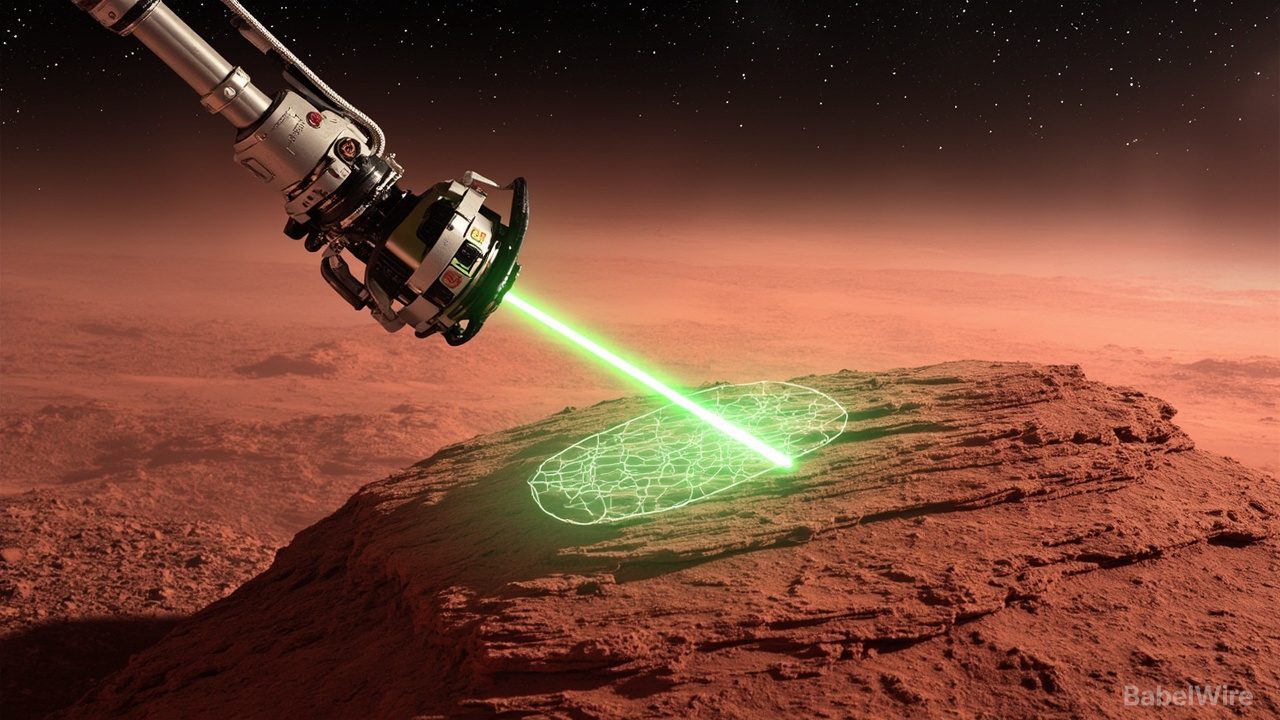
NASA's Perseverance rover has confirmed the presence of complex organic carbon in two ancient rocks on Mars, adding a significant piece to the puzzle of whether the planet could once have supported life — and doing so in a place researchers did not expect organic material to survive.
The result, published in Science Advances, builds on the rover's September 2025 identification of a potential biosignature in rocks of the Bright Angel formation in Jezero crater. Using the SHERLOC instrument on the rover's robotic arm, scientists detected macromolecular carbon — large, interconnected networks of carbon atoms — within the ancient mudstones. SHERLOC identifies minerals and organic compounds by Raman spectroscopy, shining laser light onto rock without destroying it.
Two details stand out. First, the carbon was found in sediments laid down by water that flowed through a river channel into Jezero crater billions of years ago, and alongside carbonate and sulfate minerals that formed later as water altered the rocks — a hint that organic material entered or formed in these rocks during at least two separate periods of Martian history. Second, and most unexpectedly, it survived only a few microns below the exposed surface, less than the thickness of a sheet of paper. That is the shallowest detection of macromolecular carbon reported on Mars, a surprise given that radiation, sunlight and chemical oxidants at the surface tend to destroy organic molecules.
The same two rocks were collected more than 2,000 miles from Gale Crater, where NASA's Curiosity rover previously found organic compounds. Finding such material at widely separated sites suggests the chemistry behind life's building blocks may have been common across ancient Mars, not confined to a single basin. "It is encouraging for Martian habitability," said Ashley Murphy of the Planetary Science Institute, who co-led the study.
The caveat matters: macromolecular carbon can form through biological activity, but also through purely chemical processes, and its presence alone cannot establish that Mars was inhabited. Deciding whether the Bright Angel rocks preserve fossil evidence of microorganisms is beyond the rovers; that will require bringing samples back and studying them with laboratory instruments far more sensitive than anything carried to Mars.