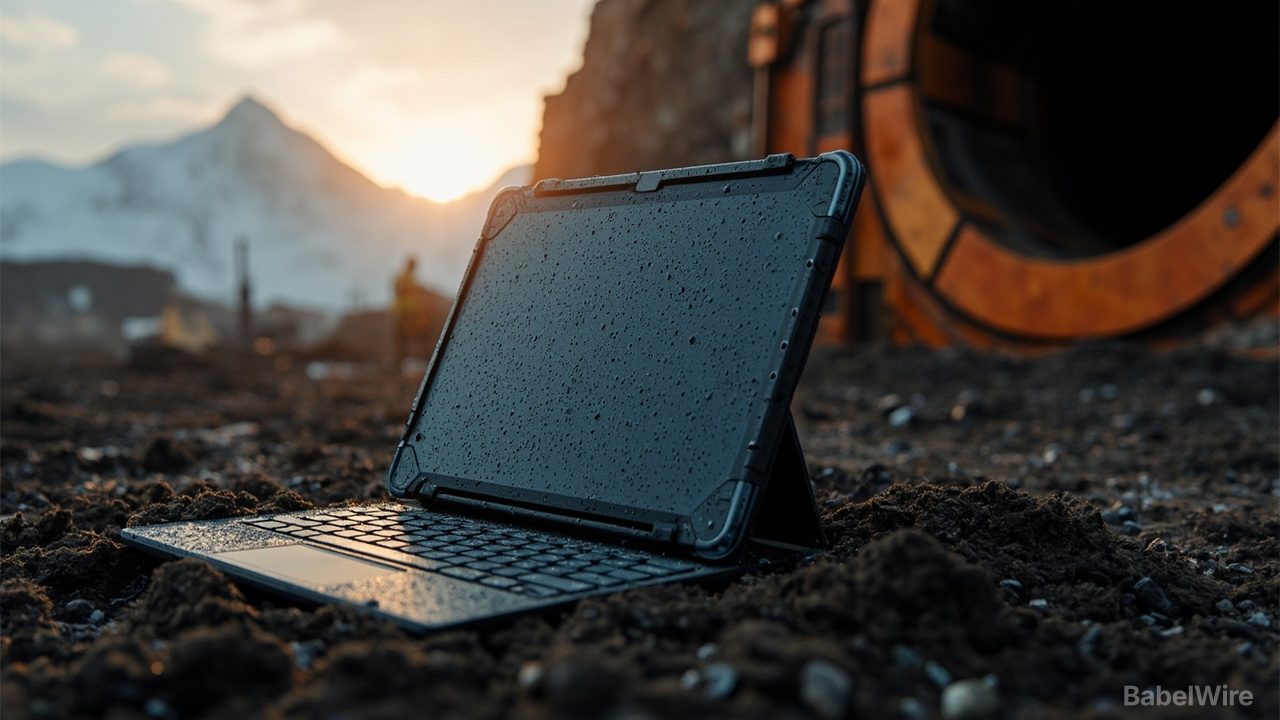
Panasonic is moving two ToughBook lines onto Intel's current processor generation, Core Ultra 300 - better known by its codename Panther Lake. The ToughBook G3 is a Windows tablet with a 10.1-inch display (1920 x 1200, 16:10); the larger ToughBook 34 offers 12.4 inches (1920 x 1280, 3:2). Both sit in ruggedised housings meant to shrug off impacts, dust, salt water and oil.
The touchscreens can be used with bare fingers, gloves or pens, and Panasonic says the IPS panels sustain their maximum brightness of 1000 cd/m² across the whole surface. Brightness adjustment is fast as well - a requirement from Finnish railway operators, so that drivers moving between snow-covered landscapes and dark tunnels can always read the screen without being dazzled.
Both models carry two different swappable batteries that can be combined in various capacities. On the G3, up to 99 watt-hours is available for up to 24 hours of runtime - but that requires a long-life battery protruding from one of the bays. The G3 weighs 1.1 to 1.4 kilograms depending on battery configuration, rising to 2.0 to 2.3 kilograms with the keyboard dock. The larger ToughBook 34 starts at 1.4 kilograms (2.6 kilograms with keyboard) and takes up to two identical 40 Wh batteries; one alone is enough for the 9 hours that its predecessor, the ToughBook 33, managed only with two, and both together stretch to 18 hours.
The runtime owes something to Panther Lake, built on Intel's 18A process. Unlike in the past, though, there are no low-thermal-design-power CPU options any more, so both models need fans - housed separately from the rest of the internals to preserve dust and water resistance, which Panasonic rates at IP66. The devices are said to survive drops from up to 1.8 metres and operate between -29 °C and +63 °C.
Buyers choose between an eight-core Core Ultra 5 355 and a 16-core Core Ultra X7 368H, only the latter with the integrated Arc B390 GPU. Unlike its smaller sibling, the G3 no longer offers an analogue audio jack as standard; an expansion module with one exists at the explicit request of military users. Rear bays accept smartcard or fingerprint readers, SSDs are TCG OPAL-encrypted and sit in quick-release carriers, and military customers can order a kill switch burned into the UEFI firmware that erases the SSD in seconds after a key combination - with no confirmation prompt. The machines are certified for Red Hat Enterprise Linux 10, among others.
Panasonic sells to business customers only and quotes no starting prices; consumers can buy ToughBooks only indirectly through resellers or system integrators. The devices are available now. Disclosure: Panasonic invited the reporter to a product presentation in London and covered travel costs.