Explosive Discovery in the Gulf of California
How hard do you have to ram a fish to make it explode? Ask an orca.
Marine biologists have captured underwater video of killer whales using a coordinated, high-speed ramming technique to blast ocean sunfish into clouds of fragments — a never-before-documented collaborative hunting strategy described Thursday in the journal Frontiers in Ethology.
"I filmed the first event several years ago and couldn't believe what I was witnessing," said lead author Kathryn Ayres, a research scientist for the marine conservation nonprofit Beneath the Waves.
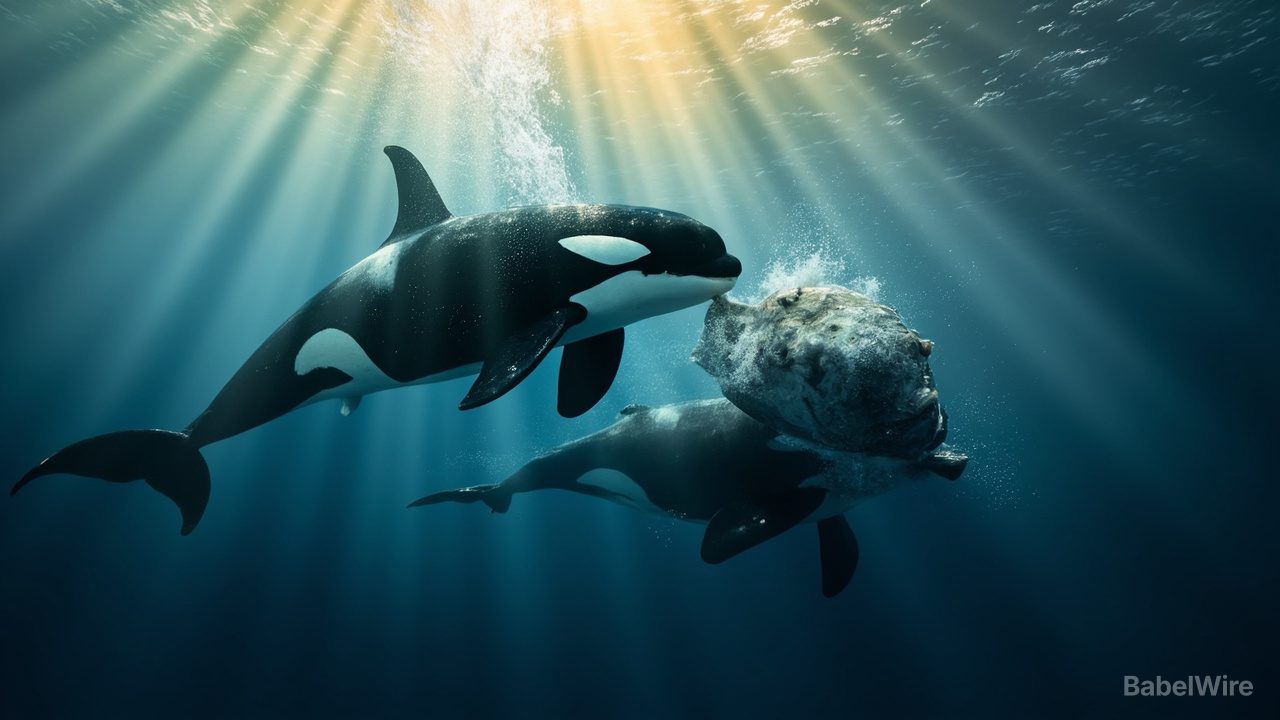
The footage shows one orca gripping a sharptail sunfish (Masturus lanceolatus) by its tail and holding it steady. A second orca then charges at high speed — orcas can reach over 40 km/h in short bursts — and the restraining orca releases the fish a split-second before impact. The result: the sunfish, which can weigh over 2 tonnes and measure up to 3 meters long, essentially explodes into thousands of pieces.
Why Blow Up Your Food?
The researchers documented two separate ramming events — one off San José del Cabo in July 2024 and another in the Gulf of California in late 2025. In both cases, the orcas had already consumed the nutrient-rich internal organs before resorting to fragmentation.
"Seeing the sunfish fragment into countless pieces was unlike anything I had encountered before," Ayres said.
Senior study author Erick Higuera, a marine biologist and cinematographer, said the behavior serves dual purposes. First, it's practical: sunfish have dense, rubbery outer layers that are difficult to tear apart. Fragmenting the carcass via high-impact ramming breaks the prey into smaller, manageable portions — especially helpful for juveniles who lack the jaw strength of adults.
Second, it may be fun. Orcas are highly intelligent, social animals known to engage in object manipulation and play. They've been observed wearing dead salmon as hats, draping seal intestines over their fins, and tossing sea lion pelts into the air.
"The behaviour provides a practical energetic benefit by facilitating communal feeding while simultaneously serving as a mechanism for play and juvenile learning," Higuera said.
A Growing Catalogue of Orca Ingenuity
The hunting technique adds to an expanding record of orca intelligence and specialization. One particular pod in the Gulf of California, led by a male called Moctezuma, are specialist hunters of sharks and rays.
Orcas have also made headlines in recent years for coordinating to ram and sink yachts near Spain and Portugal, and for hunting great white sharks to extract their livers.
"Killer whales are incredibly adaptable predators, and we know that different populations have developed very specialised ways of hunting and processing prey," said marine scientist Bec Wellard from Project ORCA, who was not involved in the study.
"This study highlights just how much we still have to learn about killer whale behaviour."
What About the Fish?
Sunfish, despite appearing sluggish, have their own evasive maneuvers. Marine biologist Marianne Nyegaard, a research associate with Auckland Museum, said sunfish can turn themselves upside down at the sea surface to protect their bellies, breach, thrash their massive fins, and spin to deter orca attacks.
"We do not know how successful these behaviours are," she said. "It may be that if an orca is just out to harass a sunfish, these behaviours may help them survive."
Field biologist John Totterdell from Western Australia's Cetacean Research Centre suggested the ramming may also preserve orca teeth. "These Molids have abrasive skin like sharks, and it's highly likely killer whales prefer to open them up instead of wearing down their teeth."