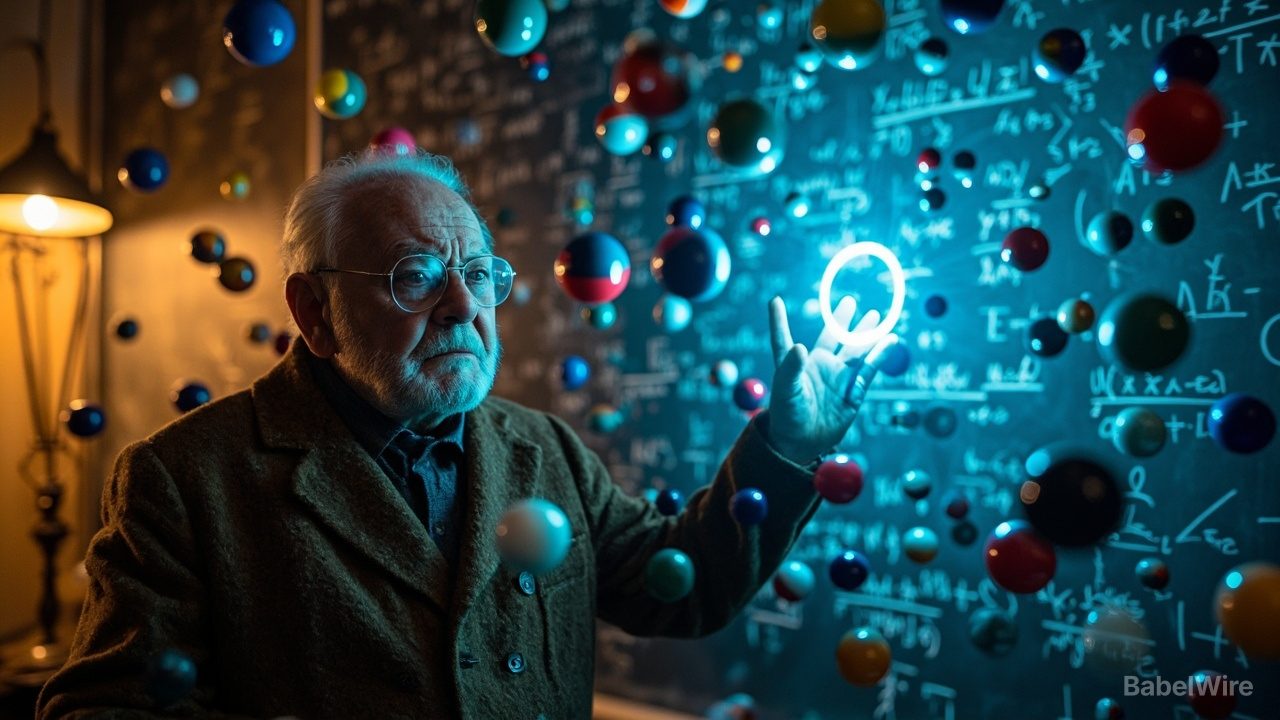
Two physicists have used generative artificial intelligence to solve a stubborn mathematical problem in physics that had vexed researchers for more than a decade.
Nobel laureate Giorgio Parisi and Francesco Zamponi, both physicists at the Sapienza University of Rome, along with collaborators, had mathematically described the phenomenon of "jamming" — the sudden transition from a fluid system to a rigid-but-disordered one — in a 2014 paper. In the process, they noticed that two parameters, a and b, would mysteriously always add up to exactly 1.
"We were quite bothered by the fact that we had never been able to mathematically prove the relation a+b=1," Zamponi told Live Science.
The AI Breakthrough Fast-forward a decade with no progress, Parisi had an unconventional idea: perhaps generative AI could offer a fresh perspective. He turned to Anthropic's Claude. After Claude successfully reproduced the 2014 numerical result, Parisi prompted the AI to prove why a+b=1.
Zamponi recalls reviewing Claude's output mid-flight: "As I read through the LaTeX file Claude generated, it became immediately clear that the core idea was correct. That moment significantly shifted my perspective on what these models can achieve in theoretical physics."
In just 40 prompts, the researchers had a verified publishable analytical solution, published July 1 in the Journal of Statistical Mechanics: Theory and Experiment. The solution was hidden directly within the equations themselves — no external physical assumptions needed.
"It is entirely possible that a pure mathematician who works full time on such equations might have spotted the solution," Zamponi said. "But Claude gave us instant access to a vast repository of mathematical training and formal skills that lay just outside our usual domain."
Implications for AI in Science The work marks a significant milestone in AI-assisted scientific discovery. While Zamponi acknowledges that the model may have used pattern matching rather than true creativity, he said the distinction is "moot" because "we could not see the path forward, and Claude did."
The researchers are now applying the same collaborative approach to a problem involving random sequential addition of hard hyperspheres. The discovery comes just weeks after OpenAI's internal AI model solved an 80-year-old math problem, suggesting a new era of AI-augmented theoretical research is emerging.