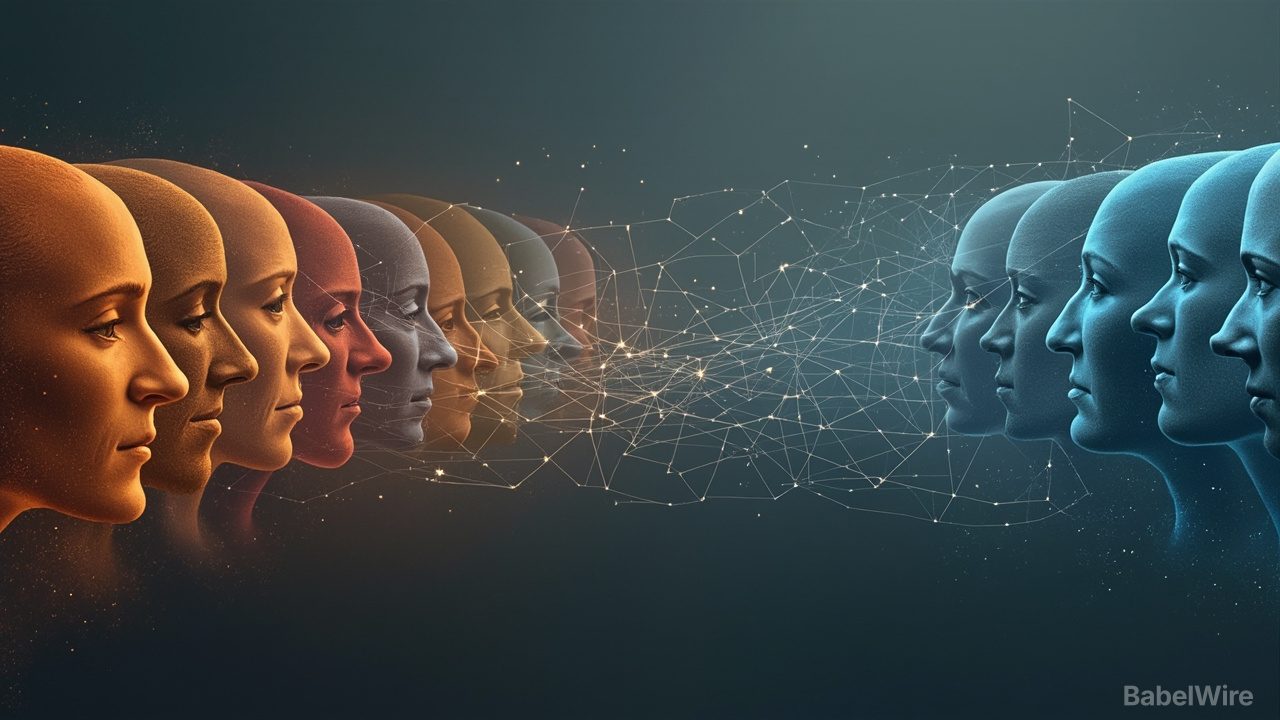
Generative AI is not just changing what people write -- it may be reshaping how they think. A major feature published in Nature on September 1 compiles a growing body of research showing that large language models are homogenizing culture and cognition in ways researchers find alarming.
PhD student Zhivar Sourati at the University of Southern California says he regularly experiences deja vu reading recent computer science papers: everything looks kind of the same. He and colleagues have documented a decrease in linguistic variation across local news, arXiv preprints, and Reddit posts since ChatGPT's release in late 2022.
The evidence spans multiple domains. Duke University computer scientist Emily Wenger tested 22 LLMs and 102 people on creative tasks and found that while LLMs produced slightly more original individual ideas, their outputs were more similar to each other than human responses. A separate study mapping narrative features of short stories found AI-generated tales clustered tightly together, while human-written ones spread widely.
Working with AI tools can also reduce human creativity. In one study, people who used ChatGPT for brainstorming produced more creative ideas according to evaluators, but those ideas were less diverse. A 2026 meta-analysis confirmed that AI homogenization is strongest for idea generation, especially in complex tasks.
Perhaps most concerning: the effects appear to linger. In one experiment, participants who used AI tools for five days still gave more homogeneous answers two months later, even without AI access. The researchers called this a creative scar.
The homogenization extends to cultural identity. A study of participants in India and the US found that autocomplete AI suggestions erased cultural distinctiveness in writing -- Indians sounded more American, and descriptions of rituals like Diwali became generic. Cornell Tech researcher Mor Naaman calls this both cultural and cognitive imperialism, describing how LLMs create a form of mind hijacking that alters not just what users write but their actual attitudes.
The causes are both technical and psychological. On the technical side, models are rewarded for predicting likely patterns rather than divergent ideas, and face mode collapse when failing to produce variety. On the psychological side, people tend to adopt the perspectives of AI models they work with, partly through anchoring effects and partly through a sense of ownership over AI-assisted output.
Researchers warn that if the trend continues, humans could collectively become less adaptable. Sourati invokes George Orwell: the way you talk affects the way you reason. If AI use leads everyone to talk the same, they might reason the same too.
Sources
- nature.comBland new world: is AI making us all think the same? -- Nature
- dornsife.usc.eduAI is changing more than your writing -- USC Dornsife
- theconversation.comAI-induced cultural stagnation is no longer speculation -- The Conversation
- research.tilburguniversity.eduGenerative AI Makes Creative Output More Homogeneous -- Tilburg University