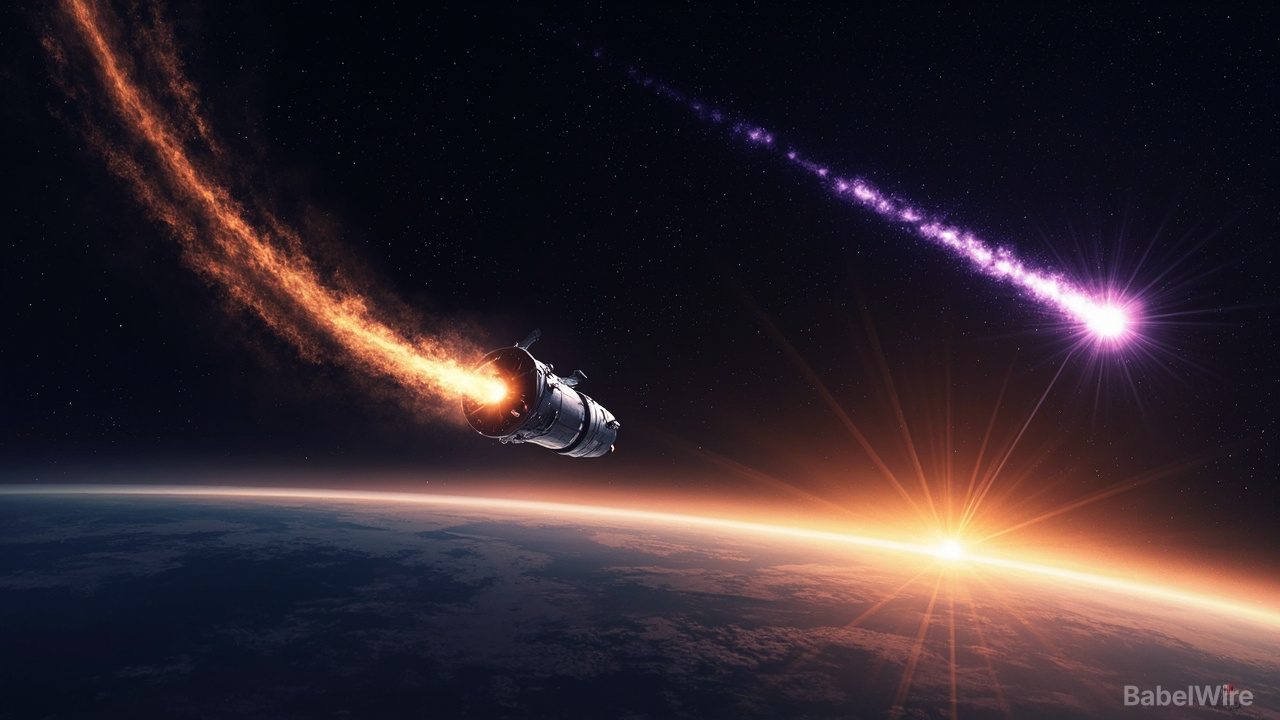
The Neil Gehrels Swift Observatory has stopped doing science. NASA said the telescope is orbiting below 275 kilometres and should re-enter within weeks, because the thickening atmosphere no longer lets it hold astronomical targets steadily enough. Its last research data was collected on 20 October.
That closes a mission designed for two years that ran more than ten times as long. Swift launched in 2004 and was renamed in 2018 for its late principal investigator, Neil Gehrels. Its subject was gamma-ray bursts, the most energetic explosions in the universe. The spacecraft's real asset was never its optics but its reaction time: typically about a minute from trigger to a pointed, instrumented observation. That speed made it the tripwire for ground-based astronomy. Other observatories, including the largest optical telescopes, could swing round within minutes and catch the afterglow while it was still bright. A great deal of what is now routine astrophysics exists because Swift called first.
The ledger NASA is now recalling is accordingly large: more than 2,000 gamma-ray bursts studied, over 1,400 supernovae, contributions to roughly 7,000 scientific papers, a complete data set of about 12 terabytes. For research, that archive is the part of this ending that matters. The spacecraft burns up; the data does not. It will still be mined long after other instruments are on the sky.
The ending was not an accident but a defeat that had been announced in advance. As atmospheric drag increasingly slowed Swift, the US company Katalyst built and launched a spacecraft in record time to push it into a higher orbit — a rescue attempt without precedent. It never even got to try. The failure became public in August; in September the observatory was allowed to keep working for a while. Now there is no option left: nothing can prevent re-entry, and where the debris comes down depends on how the drag evolves.
What is notable is less that a 22-year-old satellite is dying than the way it is dying. Swift fell victim to the same expansion of the upper atmosphere that is squeezing other low-orbit spacecraft — a problem that will not shrink as megaconstellations grow. The rescue attempt, meanwhile, showed how much is technically possible at short notice when one scientifically valuable satellite is at stake, and how narrow the corridor for success actually is. A second attempt was never on the table.
Astronomy is left with a gap that cannot be closed quickly. Successor instruments exist, and new sky surveys do find gamma-ray bursts. But the combination of all-sky monitoring and an extremely short repointing time was Swift's distinguishing feature, and that is now history — at least until a successor launches and delivers the same promise.