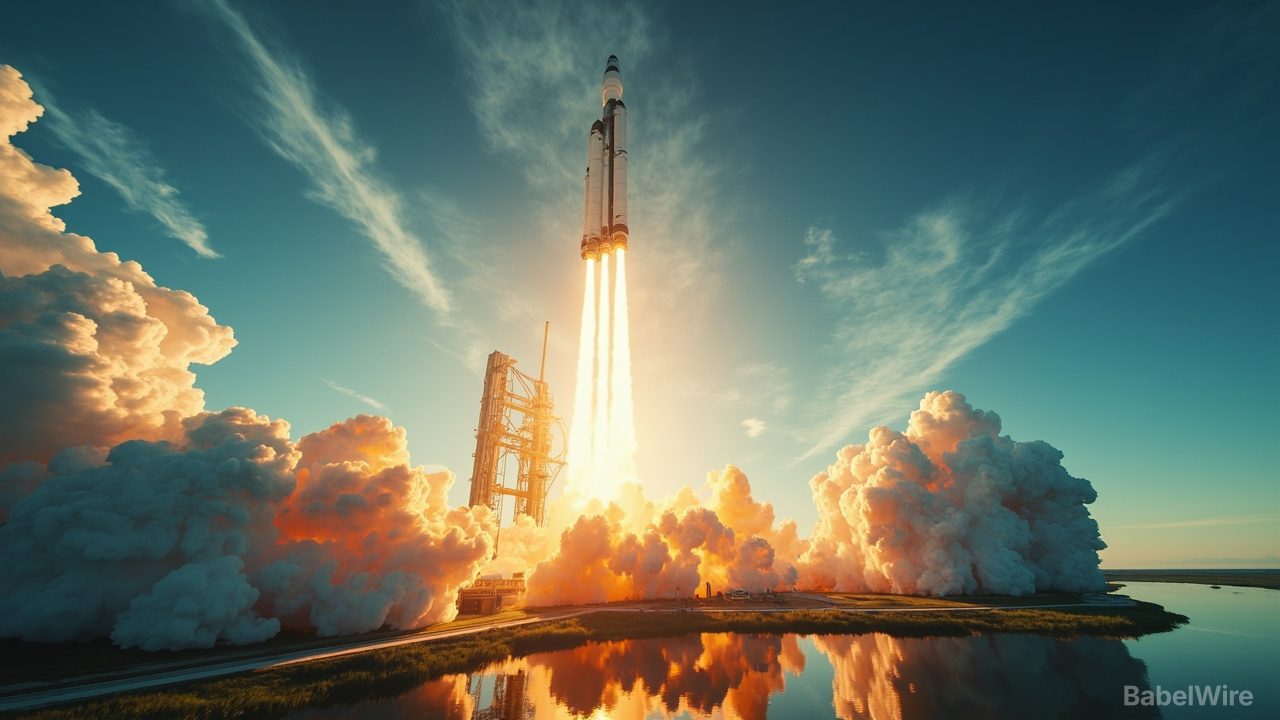
NASA has a new eye on the universe. The Nancy Grace Roman Space Telescope, a roughly $4 billion flagship infrared observatory, successfully launched on August 30 aboard a SpaceX Falcon Heavy rocket from Launch Complex 39A at Kennedy Space Center in Cape Canaveral, Florida. The launch came nine months ahead of schedule.
The telescope is now on a three-month journey to the Sun-Earth L2 Lagrange point, approximately one million miles (1.6 million kilometers) from Earth, where it will park itself in orbit beyond the moon. Mission scientists will spend the next 90 days commissioning it and preparing for science operations. Roman is expected to beam back its first high-resolution images "before the winter holidays," according to project manager Jackie Townsend.
Roman is designed to complement the James Webb Space Telescope, launched in 2021. While Webb peers deeply into the early universe with exquisite sensitivity, Roman captures panoramic views — like a wide-angle lens compared to Webb's zoom. The telescope can survey the entire Milky Way galaxy in a single month, a task that would take Hubble a century.
The observatory's primary mission is to create the most comprehensive 3D map of the universe to date. Its main survey, taking more than a year, will catalog over two billion galaxies to study two of cosmology's deepest mysteries: dark energy, the invisible force driving the universe's accelerating expansion (estimated at 68% of the cosmos), and dark matter (about 27%), which holds galaxies together through gravitational influence. Ordinary matter — stars, planets, everything we can see — makes up just 5%.
Roman will also conduct one of the most comprehensive searches ever for exoplanets, expected to discover thousands of new worlds and provide the first statistical census of planetary systems similar to our own.
The telescope has an unusual origin story. It was originally built for the National Reconnaissance Office's spy satellite program, which was over budget and terminated. The NRO donated it to NASA in 2012, and the agency repurposed it for cosmic exploration. Its planned five-year mission could extend to ten years if fuel reserves permit.
"I have no doubt that Roman will become a household name alongside those great instruments of discovery," NASA Administrator Jared Isaacman told reporters at the post-launch conference, where he took a call from President Trump who said the launch "looked beautiful on television."
The launch survived multiple cancellation attempts during both of Trump's presidential terms, with Congress preserving funding each time. NASA's approximately $24 billion 2026 budget also survived an earlier White House proposal to cut the agency's funding by about $6 billion.
Sources
- reuters.comNASA launches powerful Roman Space Telescope, a spy satellite turned to the stars | Reuters
- science.nasa.govNASA Concludes Roman Space Telescope Launch Coverage | NASA Science Blogs
- en.wikipedia.orgNancy Grace Roman Space Telescope | Wikipedia
- space.comThe Roman Space Telescope, NASA's next great observatory | Space.com