A novel telescope still under construction in Chile has captured one of astronomy's missing links: clumps of gas cast off by a dying star as they return to the interstellar medium. The observations, reported this week in Nature, show how carbon, oxygen and other elements forged inside stars become the raw material for future stars, planets — and ultimately life.
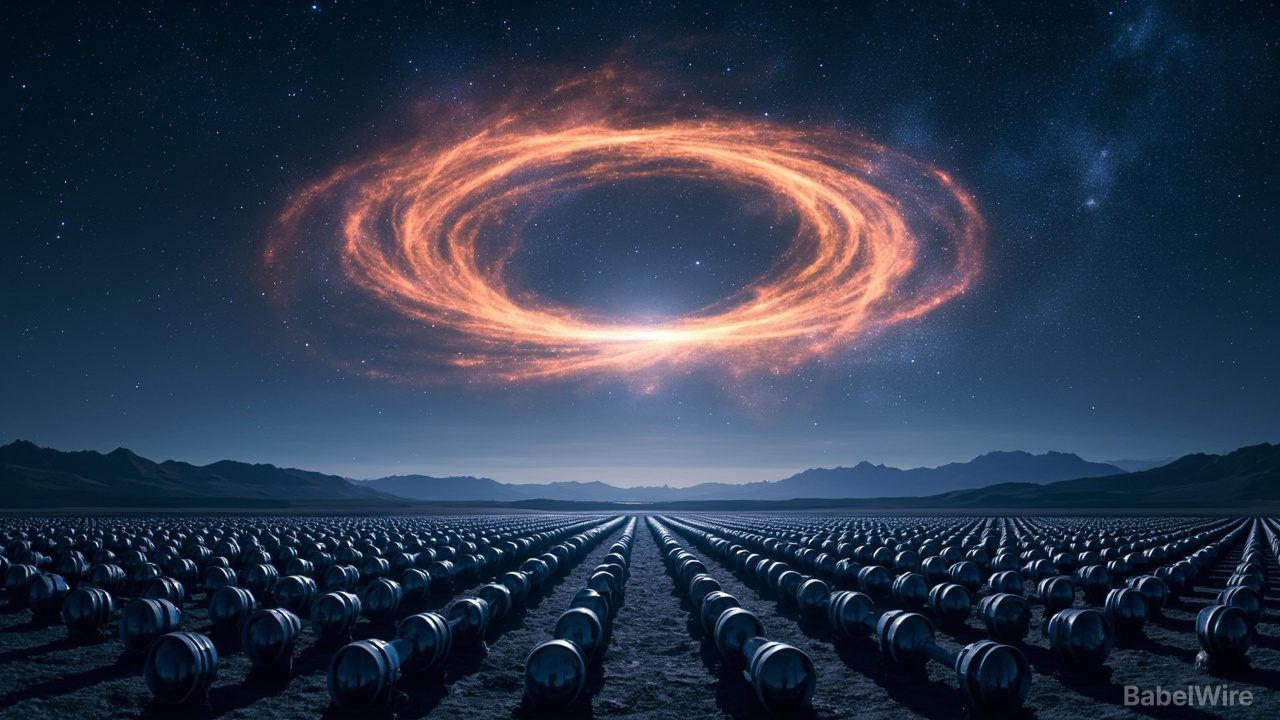
The discovery came almost by accident during test observations in November 2025, while astronomers were building MOTHRA — the Modular Optical Telephoto Hyperspectral Robotic Array — at the El Sauce Observatory in Chile. The instrument combines hundreds of high-end, off-the-shelf telephoto lenses into a single compound eye; with fewer than 200 of its planned 1,140 lenses installed, the team pointed it at the Helix Nebula, a bright ring of gas about 650 light-years from Earth that formed when a Sun-like star shed its outer layers at the end of its life.
Even in its unfinished state, the telescope revealed 22 faintly glowing arcs beyond the nebula's familiar bright ring, in a region known as its halo. The team interprets the arcs as bow shocks — similar in shape to the waves in front of a boat — created as the clumps of ejected gas plow through interstellar gas. The farther the bow shocks lie from the nebula's center, the smaller, fuzzier and more fragmented they become, a sign that the gas is gradually eroding and dissolving into its surroundings, a process thought to take about 10,000 years.
"MOTHRA's goal is to map the tendrils of gas that thread between galaxies — most atoms are not in stars," says project co-leader Roberto Abraham of the University of Toronto. The array, built for a few tens of millions of dollars with support from Alex Gerko, founder and CEO of XTX Markets, is expected to be complete by the end of the year. "And lo and behold we saw all this new stuff. It was unbelievably exciting," adds co-leader Pieter van Dokkum of Yale University.
Astronomers have long assumed that expelled stellar material mixes with the thin gas between stars and helps form new generations of stars and planets — but catching that process in action has proved difficult. "Just because an object is bright and has been well observed, we cannot assume that we know everything about the object," says Sun Kwok of the University of British Columbia. "See what a low-cost telescope can do!"