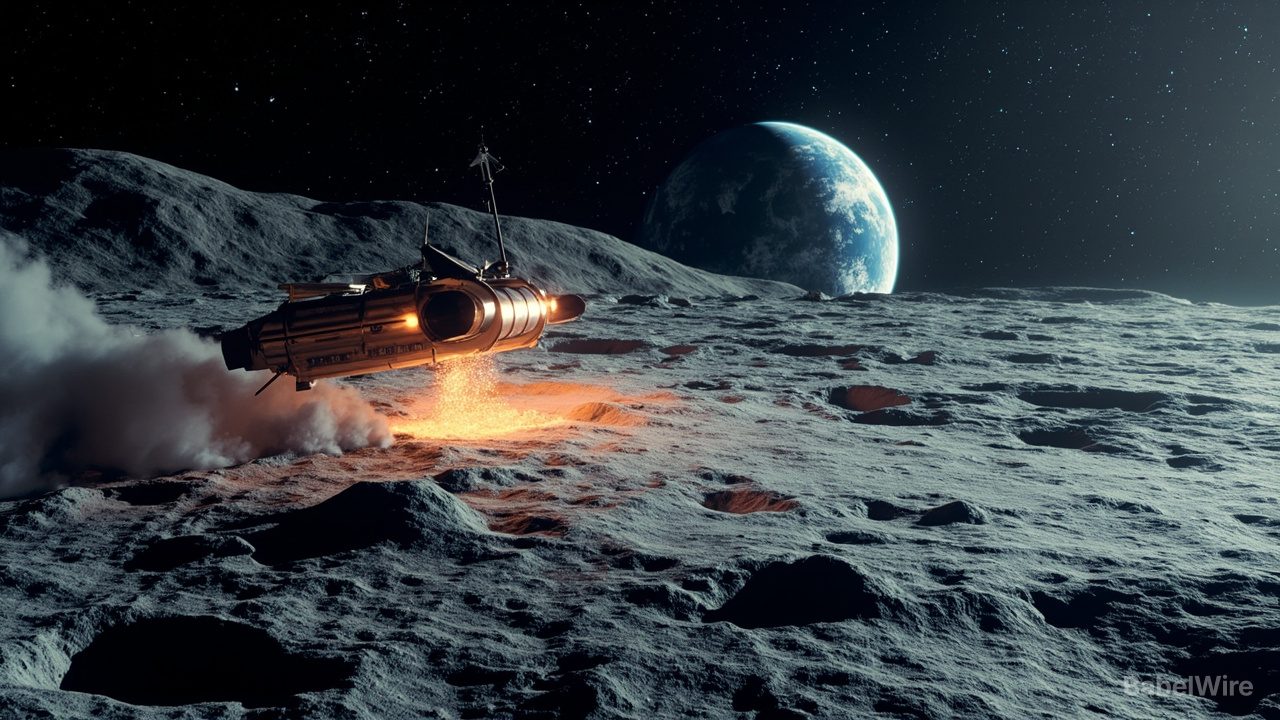
Scientists are preparing for a new era of lunar exploration, but a groundbreaking study published in the Journal of Geophysical Research: Planets warns that every landing could leave behind more than footprints — it could erase the very evidence scientists hope to find.
Researchers from the European Space Agency and Instituto Superior Técnico have discovered that methane released in spacecraft exhaust may spread across the Moon with astonishing speed. Their computer simulations show that methane released near the South Pole could reach the North Pole in less than two lunar days. Within seven lunar days — roughly seven months on Earth — more than half of all released methane becomes "cold trapped" in permanently shadowed polar craters.
The Pristine Archive Under Threat
Near the Moon's poles lie craters that have never seen sunlight — permanently shadowed regions that have remained largely unchanged for billions of years. These frozen environments contain ice that may have trapped material delivered by comets and asteroids, including "prebiotic organic molecules" — the chemical ingredients that may have eventually combined to form the first building blocks of life, including DNA.
Unlike Earth, whose constantly shifting surface has erased most ancient evidence, the Moon offers a pristine archive of the early solar system. Scientists believe these deposits could reveal how life first developed on Earth — but only if they remain uncontaminated.
"We know we have organic molecules in the solar system — in asteroids, for example," said Silvio Sinibaldi, the European Space Agency's planetary protection officer and senior author of the study. "But how they came to perform specific functions like they do in biological matter is a gap we need to fill."
How Contamination Spreads
The Moon has almost no atmosphere. Without air molecules to slow them down, exhaust molecules move freely under the influence of gravity, bouncing across the surface as sunlight energizes them.
"Their trajectories are basically ballistic," said lead author Francisca Paiva, a physicist at Instituto Superior Técnico. "They just hop around from one point to another."
This means there may be no completely safe landing location. "We showed that molecules can travel across the whole Moon," Paiva said. "In the end, wherever you land, you will have contamination everywhere."
A Call for Better Practices
The researchers emphasize that contamination is not inevitable. Colder landing sites may help keep exhaust molecules more localized. Instruments on future missions could measure contamination in real time. But the clock is ticking.
With NASA's Artemis program, China's crewed lunar plans, and numerous commercial missions all targeting the Moon in the coming decade, the window to collect pristine samples is closing. Paiva noted that similar protections exist for Earth environments: "We have laws regulating contamination of Earth environments like Antarctica and national parks. I think the Moon is an environment as valuable as those."
Sinibaldi stressed that the findings demand immediate action: "I want to bring this discussion to mission teams, because at the end of the day, it's not theoretical — it's a reality that we're going to go there. We will miss an opportunity if we don't have instruments on board to validate those models."