Milky Way Once Flipped Upside Down in Cosmic 'Gymnastics', Astronomers Reveal
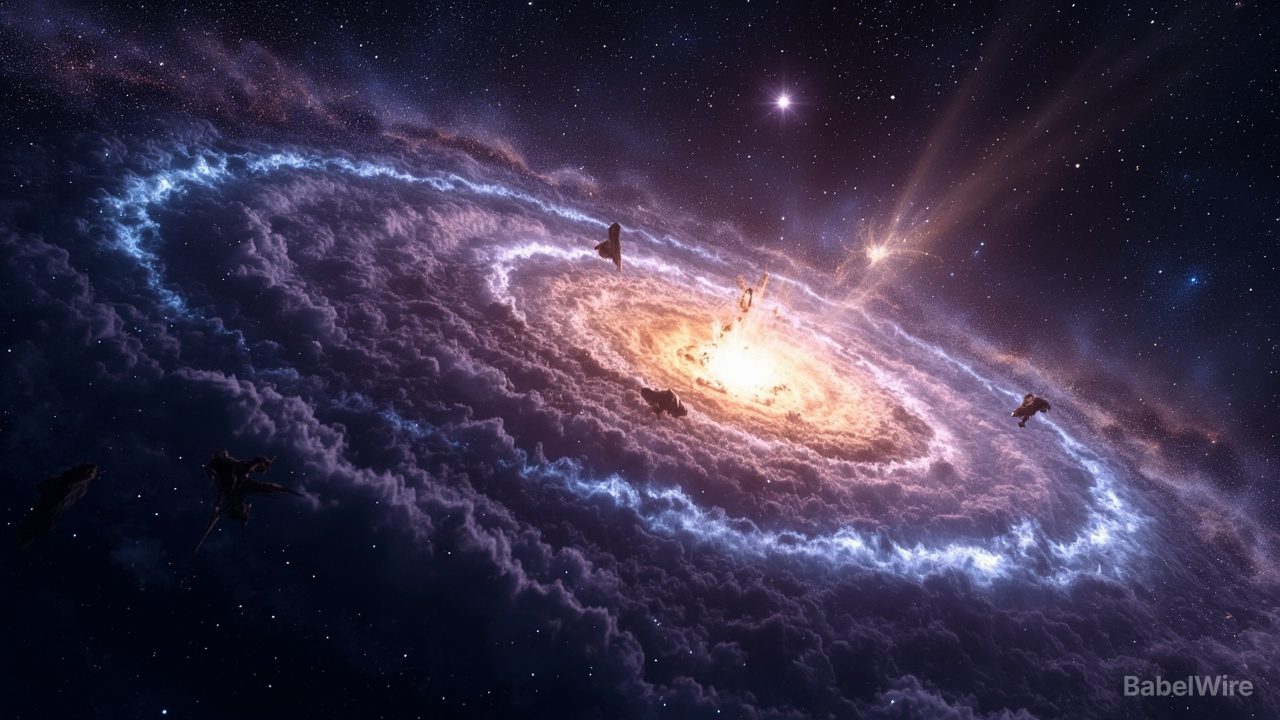
BIRMINGHAM, UK — The Milky Way may have performed a spectacular cosmic somersault during its early history, according to new research presented this week at the Royal Astronomical Society's National Astronomy Meeting in Birmingham.
Using supercomputer simulations of galaxies like our own, a team of astronomers from Durham University found that galaxies with slowly rotating stellar haloes — the sparse sphere of stars enveloping a galaxy's bright disc — are telltale signs of a past 'disc flip,' where the galaxy's disc changed its orientation by more than 90 degrees.
The Slow-Rotation Mystery
Observations from the European Space Agency's Gaia mission have long shown that the Milky Way's stellar halo rotates very slowly, but astronomers have been unable to explain why. Most of our galaxy's stars reside in its flat spiral disc, while the surrounding stellar halo consists mostly of stars that originally formed in smaller galaxies before being absorbed through mergers.
To investigate, the researchers analyzed the evolution of 25 Milky Way-like galaxies in the Auriga suite of cosmological simulations, tracking their development over billions of years.
The results were striking: galaxies with the slowest rotating stellar haloes shared two defining features — they had experienced a major head-on merger with another galaxy, and they had undergone a disc flip.
The Gaia-Sausage-Enceladus Collision
"We already know that the Milky Way had a massive head-on collision in the past with a galaxy known as Gaia-Sausage-Enceladus (often simply called the Gaia Sausage). So, we think that the Milky Way disc likely flipped in the past," explained astronomer Kirill Batrakov, the lead researcher.
The Gaia-Sausage-Enceladus was a massive dwarf galaxy that collided with and was absorbed by the early Milky Way about 10 to 11 billion years ago — the largest single event in our galaxy's early history. The collision reshaped the Milky Way and left billions of stars orbiting in highly elongated, sausage-shaped paths, giving the dwarf galaxy its name.
A New Chapter for Our Galaxy
"A disc flip also means most of the Milky Way's stars once moved on very different trajectories than they do today — possibly even our own Sun, meaning our 'stable' spot in the galaxy might not have been so stable for the Solar System's whole lifetime," Batrakov said.
The discovery offers a new way to understand how the Milky Way assembled and may provide indirect clues about the motion of its invisible dark matter halo. The study also found that the rotation of the Milky Way's stellar halo is closely linked to the rotation of its dark matter halo, suggesting the two evolved together as the galaxy grew by accreting smaller satellite galaxies.
"Because we live inside the Milky Way, we can study it in more detail than any other galaxy, which makes it a key testbed for understanding galaxies more broadly," Batrakov added. "Finding that its disc flipped adds a new chapter to that story, one we must account for when placing the Milky Way in a broader context of other galaxies."
Implications for Galactic Archaeology
The research demonstrates that complex galactic history can be reconstructed from present-day observations. Identifying a past disc flip gives astronomers a new tool for understanding not only our own galaxy's past but also the formation histories of similar spiral galaxies across the universe.
The talk titled 'Why is the Milky Way stellar halo slowly rotating?' was presented at NAM2026 on 21 July 2026.