Mexican hairy dwarf porcupines glow under ultraviolet light — vividly, consistently, and in a way that turns out to be genuinely useful to the scientists studying them.
Writing in Neotropical Biology and Conservation, researchers from El Colegio de la Frontera Sur in Chetumal, Mexico, describe the photoluminescence of Coendou mexicanus, a solitary, nocturnal rodent native to eastern Mexico and Central America. The finding was accidental: in 2024, study author Jonathan Pérez-Flores noticed two female porcupines glowing during a routine clinical check, lit by an ordinary consumer UV LED flashlight.
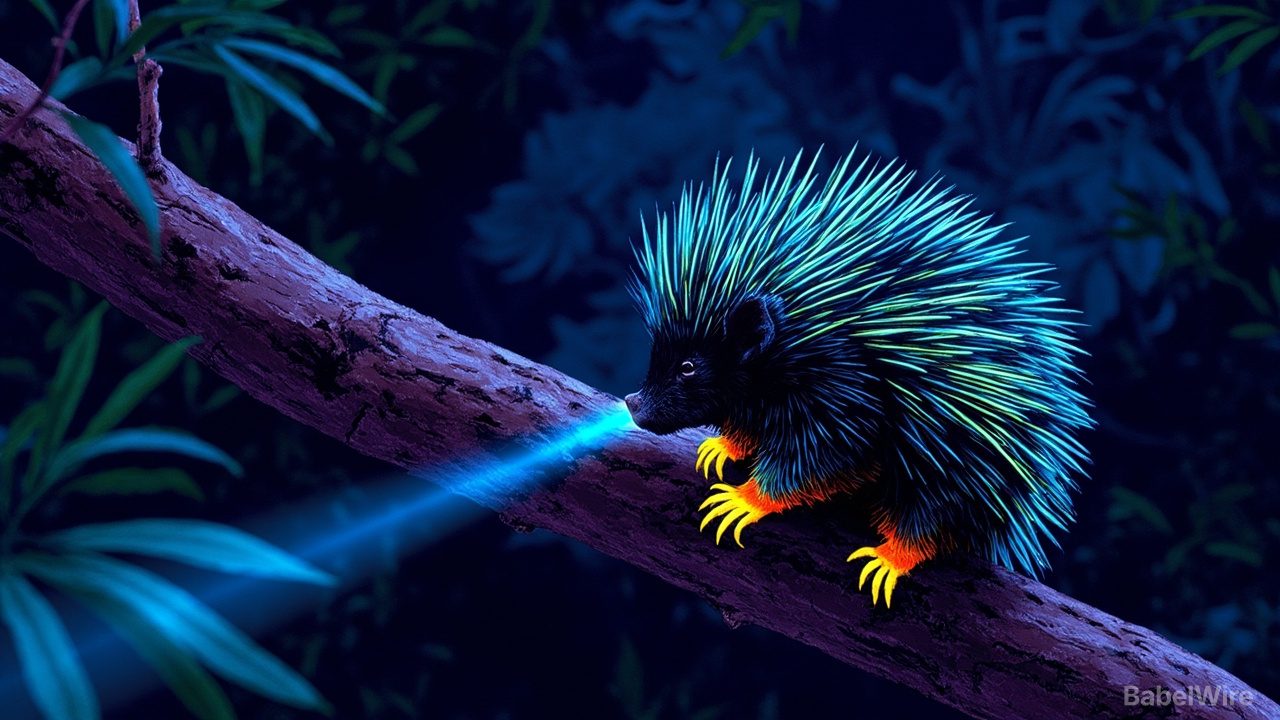
The team then photographed 20 wild porcupines. Every single one glowed the same bright blue-green. The head was the brightest region, the quills emitted the most light, hairless skin reflected purple, and the palms and soles of the feet shone bright yellow.
Live animals glow far brighter than museum specimens
Two preserved museum specimens were examined alongside them — and their glow was barely visible. The quills emitted a faint green; fur, skin, palms and feet showed nothing at all. That gap matters: most of what science knows about mammalian photoluminescence comes from preserved specimens, and about 125 mammal species are now known to display the trait. Live records are rare, and this one is unusually strong.
A conservation tool, not just a curiosity
The glow has an immediate practical application. The porcupines' brown-and-yellow coloring normally camouflages them against the forest; under UV they pop against the dark canopy as bright blue-green silhouettes. In nocturnal surveys across 10 observation points, the team logged 20 porcupines, an average of 1.6 sightings per walk — an easy, cheap way to monitor a species already the focus of a three-year conservation effort in Chetumal.
Why they glow is still unknown
The biological function remains a mystery. The team proposes testing for UV-sensitive pigments and checking whether these porcupines have UV vision; if they do, the glow might play a role in how the animals see and signal to one another at night. Until then, the discovery stands as a rare case of animal photoluminescence observed live in the wild, and of a glow that earned its keep in the field.
Sources
- physicsworld.comPhysics World: Mexican hairy dwarf porcupines glow under ultraviolet light
- neotropical.pensoft.netPensoft / Neotropical Biology and Conservation: study of Coendou mexicanus photoluminescence
- eurekalert.orgEurekAlert: Mexican hairy dwarf porcupines glow under UV light, researchers find
- discovermagazine.comDiscover Magazine: Why the porcupine's glow remains a mystery